
Author: joemartuccillc

  • 2,400 NOAA employees are gone, now what?

    2,400 NOAA employees are gone, now what?

    This article first appeared in Shore Local News on May 9

    By Meteorologist Joe Martucci

    Consider 164 endangered or threatened species conserved and recovered, 47 rebuilt fish stocks since 2000 and 1.5 million forecasts and warnings each year – that’s just some of the scope of the National Oceanic and Atmospheric Administration (NOAA), which is part of the United States Department of Commerce.

    Between layoffs, buyouts and early retirements, over 2,400 NOAA employees have departed from the agency since February. It represents a combined 27,000 years of experience, according to DaNa Carlis, director at NOAA. This is part of the fallout from the Department of Government Efficiency (DOGE)’s cost-cutting crusade.

    I’ve been asked more than a few times what my thoughts are on this. I don’t work for NOAA, I never have. However, I have friends that do, mainly at the National Weather Service, probably the most popular arm of NOAA. One friend no longer work for NOAA as a result of what has happened over the past few months.

    There’s also the elephant in the room – the politics. I ask you to ask yourselves, how would you feel if Kamala Harris, Robert F. Kennedy Jr., or Joe Biden had done this? I also remind you that Congress, not the president, is given the power of the purse.

    Like climate change, there are facts, and then there are questions about how to feel or not feel about them. I do the first part. You all motivate me to talk and write about the weather every single day. It’s tremendous.

    With all of that being said, let’s break it down.

    The facts

    Roughly 20% of NOAA’s nearly 13,000 employees have left since the end of February. That breaks down to the following:

    About 1,000 probationary employees – those who held their current job for less than two years, per USA Today. That also includes those who worked with NOAA for decades, but just earned a promotion; 500 employees who took a voluntary buyout, per The New York Times, and an additional 1,029 workers in mid-March, according to USA Today.

    Our local National Weather Service office, which is located in Mount Holly, Burlington County, and was located at Atlantic City International Airport as recently as the mid-1990s, did not have layoffs. They provide us with human-curated forecasts, public outreach and, perhaps most importantly, weather watches, warnings as well as advisories.

    In offices where there have been reductions, there have been fewer public outreach events. There has been less ability to conduct meteorological research outside of forecasting and, in a worst-case scenario, the Goodland, Kansas National Weather Service office temporarily stepped away from 24-hour coverage.

    Around-the-clock coverage is crucial. Even on “quiet” weather days, something like wildfire, air pollution, tornadoes, or tsunamis may occur. NWS meteorologists are there to account for that around the clock, not to mention phone calls from your local or county government, or any member of the public.

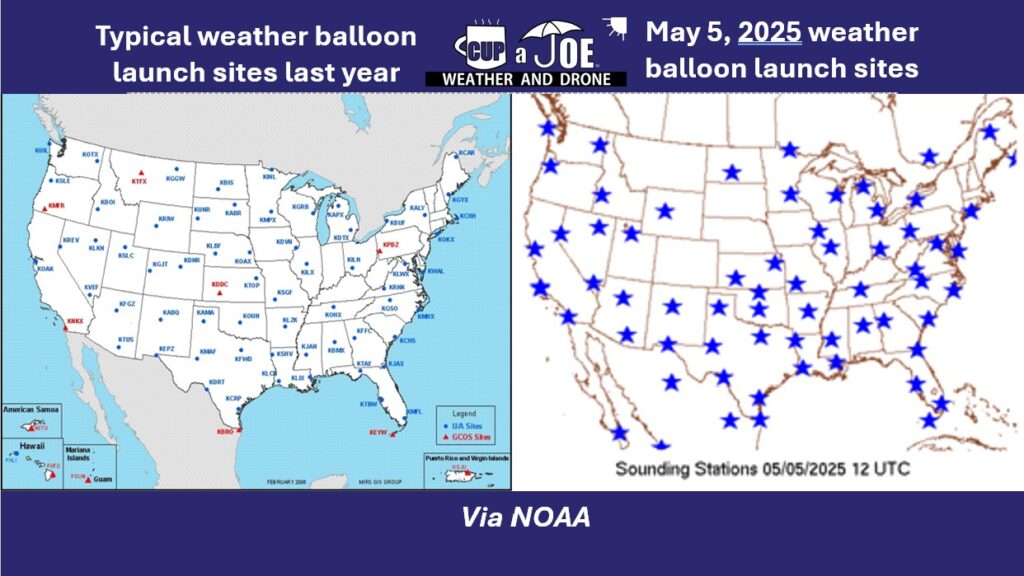
    In the United States, and our territories, weather balloon launches have been suspended in Kotzebue, Alaska; Omaha, Neb.; Rapid City, S.D.; Albany, N.Y. and Gray, Maine. Weather balloons are our eyes in the sky, providing crucial data up to 50,000 feet high. Launched twice daily, they collect data too high to be observed by weather stations. Temperatures, dew point, pressure, wind speed and wind direction are all included in this.

    This is still a small percentage of the balloon launches. However, every single forecast weather model is only as good as the data being put into it. High-resolution balloon launches are a key part of this. Compared to last year, there is a large coverage gap in the Northern Great Plains and New England.
    The National Aeronautical and Space Administration, which needs highly accurate and precise weather forecasts for launching rockets into space, says that 18% of their observations come from weather balloon launches.

    Hurricane season starts June 1. The National Hurricane Center, a division of the National Weather Service in Miami, Fla., just set a new record for prediction accuracy from 12 hours out, down to 5 days out. Staff involved in the Hurricane Analysis and Forecast System, critical for improving track and intensity forecasts, were cut. A few hurricane hunter crew members were impacted, too.

    The entire external affairs team for NOAA was laid off. They are the people I speak with for interviews, data and more. Scientists working on artificial intelligence climate prediction were also let go. That includes Zack Labe, who is a good follow on social media.

    The forecast

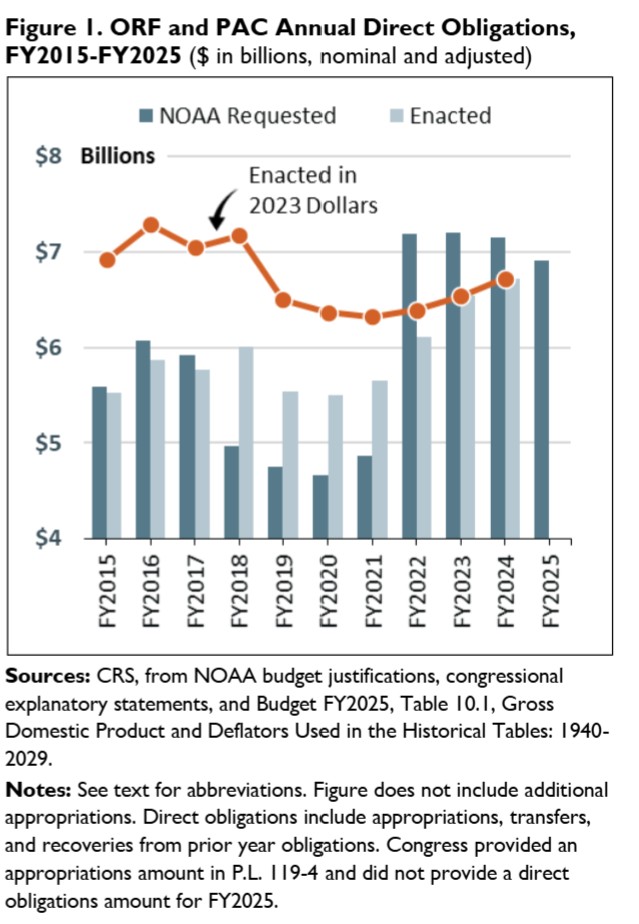
    In fiscal year 2024, NOAA had a $6.8 billion budget. The proposed 2025 Trump administration NOAA budget is down to $6.6 billion, and the administration proposes a reduction of $1.67 billion in NOAA’s fiscal year 2026 budget. Funding from NOAA ultimately trickles down to the National Weather Service budget.
    The administration’s proposal suggests ending a variety of research grants to individuals, organizations and data related to climate. Cuts to grants such as “Policy Experience in Equity, Climate and Health,” are mentioned, too. This also asks for a $8 billion cut to the satellite program.

    If you read the full description of cuts, it doesn’t specifically mention cuts to weather operations. While climate and weather are separate, they are under the same umbrella, no pun intended. It’s like how you need flour and water, two different items, to make bread. To get our clearest possible understanding of the environment, you need both.

    According to NOAA’s “passback” document from a few weeks ago, funding for the National Weather Service would revert back to 2024’s level. The proposal calls for moving the Space Weather Prediction Center to the Department of Homeland Security. They are the ones that provide data on the aurora borealis, including the serene scene we had at the Jersey Shore from the Northern Lights last October.

    Outside of the National Weather Service, but within NOAA, no funding would be provided for Coastal Zone Management Grants, which helps coastal towns and nonprofits address coastal flooding and erosion. The National Coastal Resilience Fund would be eliminated, which supports the restoration and enhancement of natural infrastructure to protect our shore.

    The next generation of weather satellites, named Geostationary Extended Observers (GenXO), would be cancelled. However, the document does maintain that a new upgrade to satellites is needed in the 2030s. An increase of $46.5 million is proposed to fund low earth orbit satellites, such as the ones that collect weather data at the Earth’s poles.

    This is the Trump administration proposal. Congress will then review this and make adjustments that work for Congress and the president.

    The NWS has been understaffed for years. Even before 2025, the National Weather Service offices had a number of vacancies across the United States. Now, roughly 50% of the 122 weather forecasts are at least 20% short of fully being staffed.

    The National Weather Service has reorganized before, most recently in the 1990s. That moved the local office at Atlantic City International Airport to its current location in Mt. Holly.

    You can make the argument that the NWS, and its parent NOAA reorganization, need cuts to reduce the federal debt, which stands at $36.8 trillion on May 5. You can make the argument that if the government needs to conduct reductions in force and that there should be a master plan to account for this.

    You can make the argument that NOAA needed to stay at its current levels or maybe even double in size. That’s not the purpose of this column.

    However, saying “my phone app tells me the weather so we don’t need NOAA” is not an answer. As Marshall Shepherd, former president of the American Meteorological Society wrote in Forbes, that’s like saying you don’t need potato farmers because you can get french fries from McDonald’s. NOAA is the source that provides data to weather apps, and to your friendly, local meteorologists, too.

    Furthermore, the argument that AI advances mean we don’t need all of these NOAA jobs is not true either. AI can’t conserve endangered species, or rebuild fish stocks on their own. They certainly don’t have the internal knowledge the Mt. Holly office has of our coastline as they issue weather alerts.

    The reduction in force at NOAA is a decision based around dollars and power.

  • Jones Road Fire shows how fragile NJ’s Pine Barrens are

    Jones Road Fire shows how fragile NJ’s Pine Barrens are

    The article initially appeared in Shore Local Magazine on May 1. Find it here.

    By Meteorologist Joe Martucci

    The Jones Road Fire, which was first spotted at 9:45 a.m. on April 22, was New Jersey’s largest wildfire in 18 years, swallowing up 23 square miles in Ocean County, or a little over 15,000 acres.

    While drought conditions have improved across the area, the fire is a stark reminder that we are in the midst of a wildfire season that has big potential to be severe, if we are not careful.

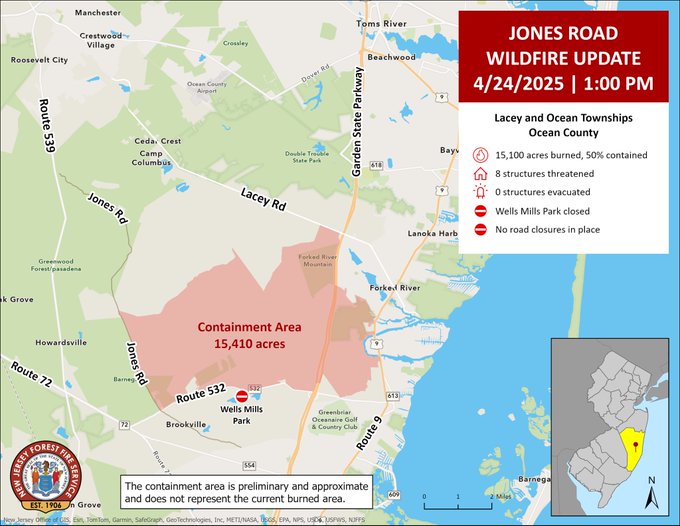
    Jones Road Wildfire update from 4/24, near the peak of the fire (New Jersey Forest Fire Service)

    The Pine Barrens is such a unique landscape that maybe we take it for granted. You learn about it in elementary school, and you might even be told about the Jersey Devil (whose home is in Galloway, according to legend).

    In Meteorology School at Rutgers University, you learn the sandy soil makes it cool off quickly at night. Its composition makes it perfect for growing cranberries and blueberries. The forest is so dense, that satellite imagery shows this as a noticeably darker area than the rest of the state.

    All that dense forest means one fire can spread quickly. Any forest that has dry ground with low humidity and a gusty wind can increase the size of the blaze. However, the New Jersey Pine Barrens, specifically, have a few factors that make this area uniquely prone to to fine.

    Pitch pine

    Pitch pine, which the region gets its Pine Barrens name from, is highly flammable. The needles and bark ignite easily.

    Quickly drying soil

    The sandy soil of the Pinelands, known as sugar soil to the locals, drains water quickly. Think of sand on the beach. You pour a bucket of water on it and a few minutes later, that wet spot pretty much dries out.

    The same is true in the Pinelands. The ground dries out faster than most forests. The old adage that it will rain overnight, and you’ll have wildfire by noon is based on this truth. This year’s drought only amplifies that.

    Topography and wind

    The Pine Barrens in New Jersey are flat, like a big, open field. The trees there aren’t very tall, and their tops (called the canopy) have lots of gaps. This makes fires spread really fast.

    Because the trees are shorter, wind from above can blow down to the ground where the fire is, without getting blocked like in other forests with taller trees.

    Forest next to people

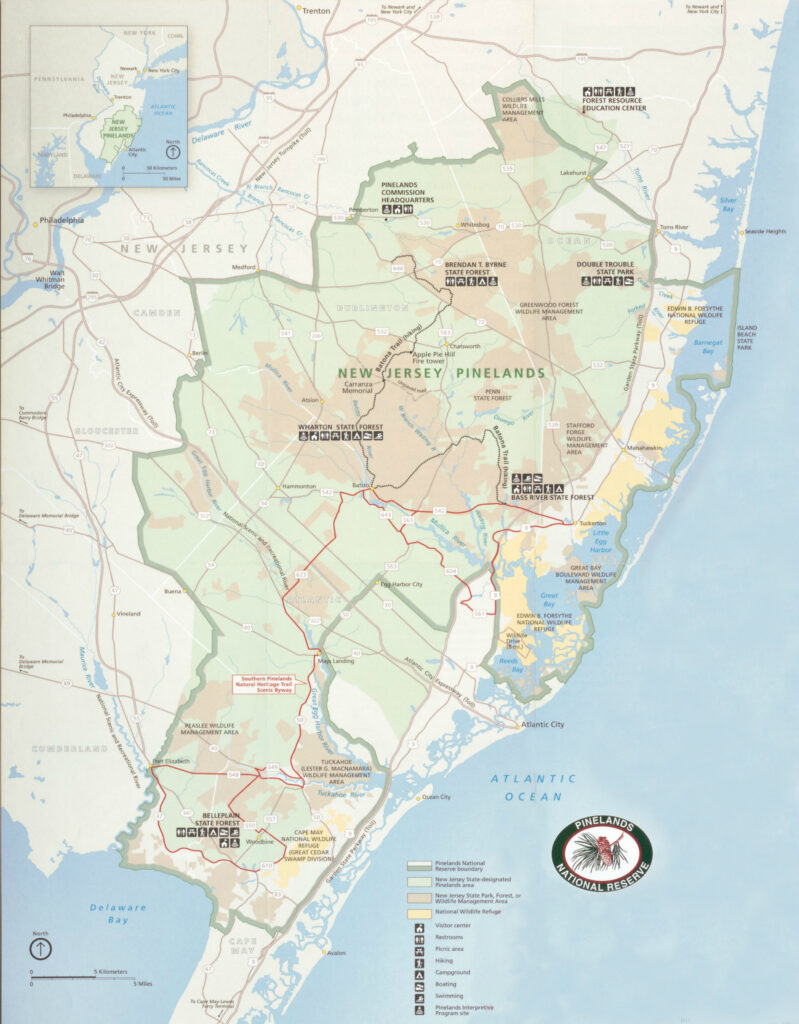
    Map of New Jersey, with the Pinelands National Reserve in the green outline. (State of New Jersey)

    The Garden State Parkway is like a big boundary line in New Jersey. It separates the wild, state-protected Pinelands Area to the west from towns and cities to the east.

    In Ocean County, starting at Toms River and going south, the west side of the Parkway is the Pinelands, while the east side has homes, stores, and businesses.

    The Jones Road Fire happened in Ocean County. In Atlantic County, the Parkway separates the Pinelands from developed areas until about Mays Landing. In Cape May County, the Pinelands National Reserve follows the Parkway from Marmora down to around Swainton and Goshen.

    You don’t have to go far from the Pinelands to find busy places! In Ocean County, right across the Parkway, there are huge neighborhoods with lots of houses. In Lacey Township and Ocean Township, where the Jones Road Fire burned, over 35,000 people live with homes, shops, and more, just a short distance from the forest.

    Plus, you have to consider the Garden State Parkway running through there. In 2018, 389 million toll transactions took place on the road, according to NJ.com. When the Parkway closes, it backs up traffic and slows the local economy.

    Last Tuesday, I had to go north, through the Jones Road Fire on the Parkway. I was diverted onto County Road 539 in Ocean County.

    Thankfully, the traffic was moving north. However, going south on that one lane it was bumper-to-bumper traffic for miles. It’s an issue which could happen in the South Jersey shore area, too.

    This drought plays a role

    As of April 25, 662 wildfires have occurred in New Jersey this year – 16,572 acres burned, the vast majority of that the Jones Road Fire.

    Last year through by April 25, about half as many wildfires occurred, burning just 315 acres.

    The difference is drought. When the Jones Road Fire began, that area was in a transitionary state between drought and no drought, known as abnormally dry conditions, according to the United States Drought Monitor.

    All of Atlantic and nearly all of Cape May counties were officially in drought. Plus, the New Jersey Department of Environmental Protection put forth a drought warning for the state in November.

    Drought means, among other things, the ground is dry, and the water table is lower. This only enhanced the spread of wildfire.

    There has been no wetter-than-average month in 2025. Statewide, it was the third driest January on record, according to the Office of the New Jersey State Climatologist (0.92 inch average).

    February was below average, too. March then bucked the trend, with nearly average precipitation. April should come in around the same (not known at the time of writing).

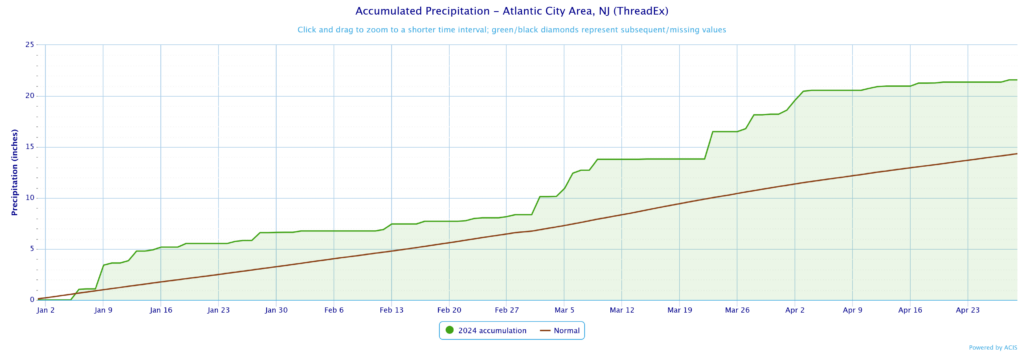
    Last year was nearly the opposite. It was the wettest start of the year, on record, through April 25, at Atlantic City International Airport, according to the National Oceanic and Atmospheric Administration. Located on the edge of the Pine Barrens, it’s a good indicator for the South Jersey Pinelands.

    Precipitation accumulated for Atlantic City International Airport in Egg Harbor Township from January 1 to April 25, 2024. Last year was the wettest start to the year, on record, up to April 25.

    In Hammonton, farther into the Pine Barrens, it was the sixth wettest. Records have been kept fairly regularly since 1893.

    As long as drought continues, and I believe it will in Atlantic and Cape May counties into the summer, the potential for another Jones Road Fire is higher than usual.

    You can prevent wildfires

    About 85% of wildfires in the United States are caused by humans, according to the United States Forest Service. Fire is a natural and needed part of our ecosystem. However, humans disrupt Mother Nature’s rhythm, which would typically happen from lightning strikes.

    No published research has been done in New Jersey, but in California, researchers found that human-sparked wildfires spread more than twice as fast as lightning-induced burns, according to the University of California-Irvine.

    What Smokey Bear first said in 1944 holds true in 2025, “Only you can prevent forest fires.”

  • Is it warm enough to plant at the Jersey Shore this April?

    Is it warm enough to plant at the Jersey Shore this April?

    Find the original article on Shore Local News here!

    By Meteorologist Joe Martucci

    The old adage goes that in New Jersey, once you get to Mother’s Day you can start planting your gardens. That holds merit. Mother’s Day in the United States is celebrated between May 8 and May 11 (May 11 this year), on the second Sunday in May.

    At Atlantic City International Airport in Egg Harbor Township, there’s an 11% chance that low temperatures will be at or below freezing on or after May 8, according to the National Oceanic and Atmospheric Administration (NOAA). Go to May 14, and that’s happened just twice in the 80-year history of weather records at the airport.

    Cross the bridges to the beaches and your risk of a freeze goes away completely. The latest freeze on record at Sen. Frank S. Farley State Marina in Atlantic City, is April 30. That was back in 1874, the first year of record keeping in the then-young city. Note that the northern Jersey Shore has had freezes as late as May 11. However, there’s only a 7% chance of a May freeze.

    You don’t need to rely on the old adage for your planting advice this season. Your friendly, neighborhood, Shore Local meteorologist can help you with the question of whether or not it’s time to plant this spring.

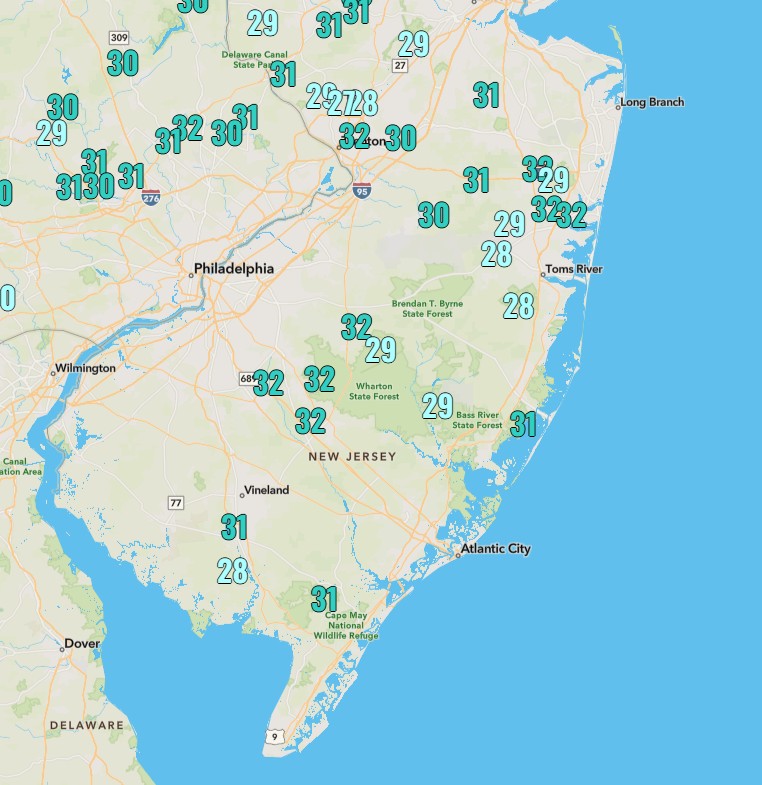
    Low temperatures on April 18, 2025, the last inland freeze of the spring, so far. (Image via the National Weather Service)

    When was our final freeze of the season?

    Was April 18 the last freeze in the inland parts of the Jersey Shore in the 2025 season? Woodbine (Cape May County), Tuckahoe (Cape May County), as well as parts of Ocean and Monmouth counties dipped below 32 degrees. While Atlantic County did not report a freeze, there was localized patchy frost, which harms young plants as well. At the immediate coast, the last widespread freeze was back on April 9.

    It’s differences like this that we take for granted as residents of the Jersey Shore. Most places in the United States don’t have these kinds of microclimates.

    What is the forecast for the rest of April?

    It’s much more likely that we will go the rest of the month without a killing freeze. The Climate Prediction Center, part of NOAA, was forecasting “likely” above average temperatures for April 26 to May 2 in their April 18 update. With average low temperatures in the mid-40s inland, and near 50 at the coast, you have a better chance of putting your ceiling fan on at night than a killing freeze. I can’t completely rule out frost in the rural Pine Barrens, but this is unlikely.

    How about May?

    The shore will be frost and freeze free. By May 1, we would need a historic polar plunge of cold air. Remember, too, that Atlantic City has never had a freeze past April 30.

    For the inland part of the shore counties, 16% of Mays had a low temperature below 32 degrees. The most recent was May 11, 2010.

    The general weather pattern for the Northeast in the first half of May is a thicker-than-usual atmosphere overhead. The thicker the atmosphere, the more potential for warmer air in the ground.

    Of course, the cold ocean can kick in a chilly daytime sea breeze. However, sea breezes also moderate the overnight low temperature to the warmer side. So the risk of a freeze is low.

    By the second half of May, freezes or frosts in this part of the state are unheard of. After May 15, you’d need a historic cold plunge to get one, and I just don’t see that happening.

    You can plant with confidence now

    Hidden Creek Farm in Stow Creek, Cumberland County, NJ

    If you’re at the beaches, you can start planting if you haven’t already. It’s not unusual to begin planting at this time.

    For inland locations, like Somers Point or Egg Harbor Township, I say go for it and let the fruits and vegetables grow. Farmers planted their asparagus and spinach weeks ago, and they’ll start harvesting in early May.

    When I was growing up in Union County, we used to go to my Nonna’s (grandma in Italian) house to plant corn, plenty of tomatoes and carrots. It was one of my favorite days of the year. Each year, they would let my sister and me plant a fruit or vegetable of our choice. We tried growing watermelons with little success, and sunflowers with better success.

    The plot was about 10 feet by 10 feet, but it felt like a jungle as a kid during the late summer and autumn, with stalks taller than me all around.

    She is still with us, but we decommissioned the garden years ago. However, the memories last forever. I hope you have some of the same this season.
    Joe Martucci, a Certified Broadcast Meteorologist and Digital Meteorologist, is the President and Director of Meteorology for Cup A Joe Weather and Drone. You can connect with him at cupajoe.sparkable.opalstacked.com/.

  • Powerful new technology shows NJ flood risk through 2100; here’s how

    Powerful new technology shows NJ flood risk through 2100; here’s how

    By Meteorologist Joe Martucci

    View the original article on Shore Local News on April 17 here.

    You may have seen a number of articles come out in the first week of April with headlines like:

    “Rising Sea Levels Will Threaten 323K+ In NJ By 2050, New Study Says: See The Map”

    “Severe coastal flooding could threaten Wildwood, Ocean City, and A.C. by 2050, report says”

    “New Study Projects Climate-Driven Flooding for Thousands of New Jersey Homes”

    What do they actually mean? Why such a flurry of articles from reputable news sources? They sound kind of scary.

    They all come from the release of Climate Central’s Coastal Risk Finder tool on March 31. Climate Central is a nonprofit organization based in Princeton, Mercer County, whose mission is to “address climate science, sea level rise, extreme weather and energy topics.”

    I was fortunate enough to be asked by Climate Central to be a panelist for the public release of the product that Monday. More than 120 journalists and media meteorologists attended the virtual meeting to learn about the tool which forecasts future flooding and its socioeconomic impacts.

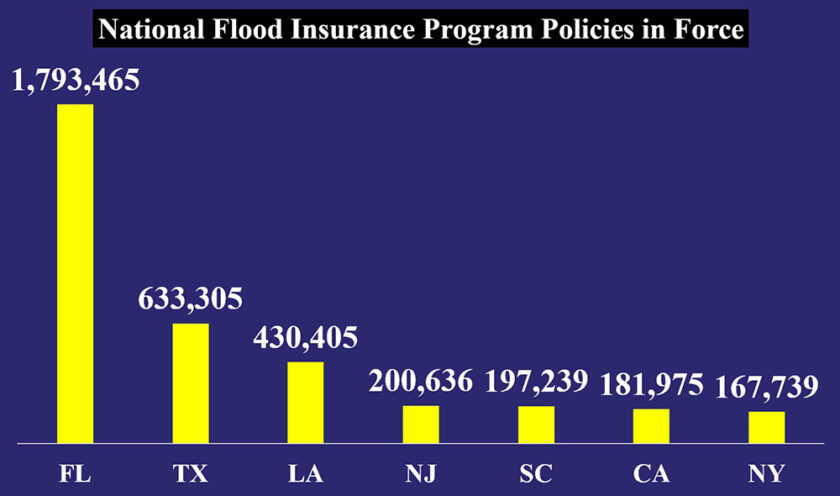
    National Flood Insurance Program Policies In Force.

    As of March, there are 200,636 flood insurance policies in force by the National Flood Insurance Program in New Jersey. That’s the fourth highest of the 50 states, ranking just above South Carolina. Furthermore, those policies cover over $50 billion worth of New Jersey property.

    Below is a summary of what the Coastal Risk Finder shows for the present and future of the Jersey Shore, as well as how to use the tool. All of the data is based on an intermediate sea level rise scenario. This scenario lines up best with the options presented by Climate Central, in comparison with what has happened historically in Atlantic City, our primary Jersey Shore tidal location.

    Interagency data from 2022 is the source for sea level rise projections used. Population is based on 2020 levels. To get the most out of the new tool, be sure to use a desktop or laptop computer.
    Not much change in flooding impacts by 2030

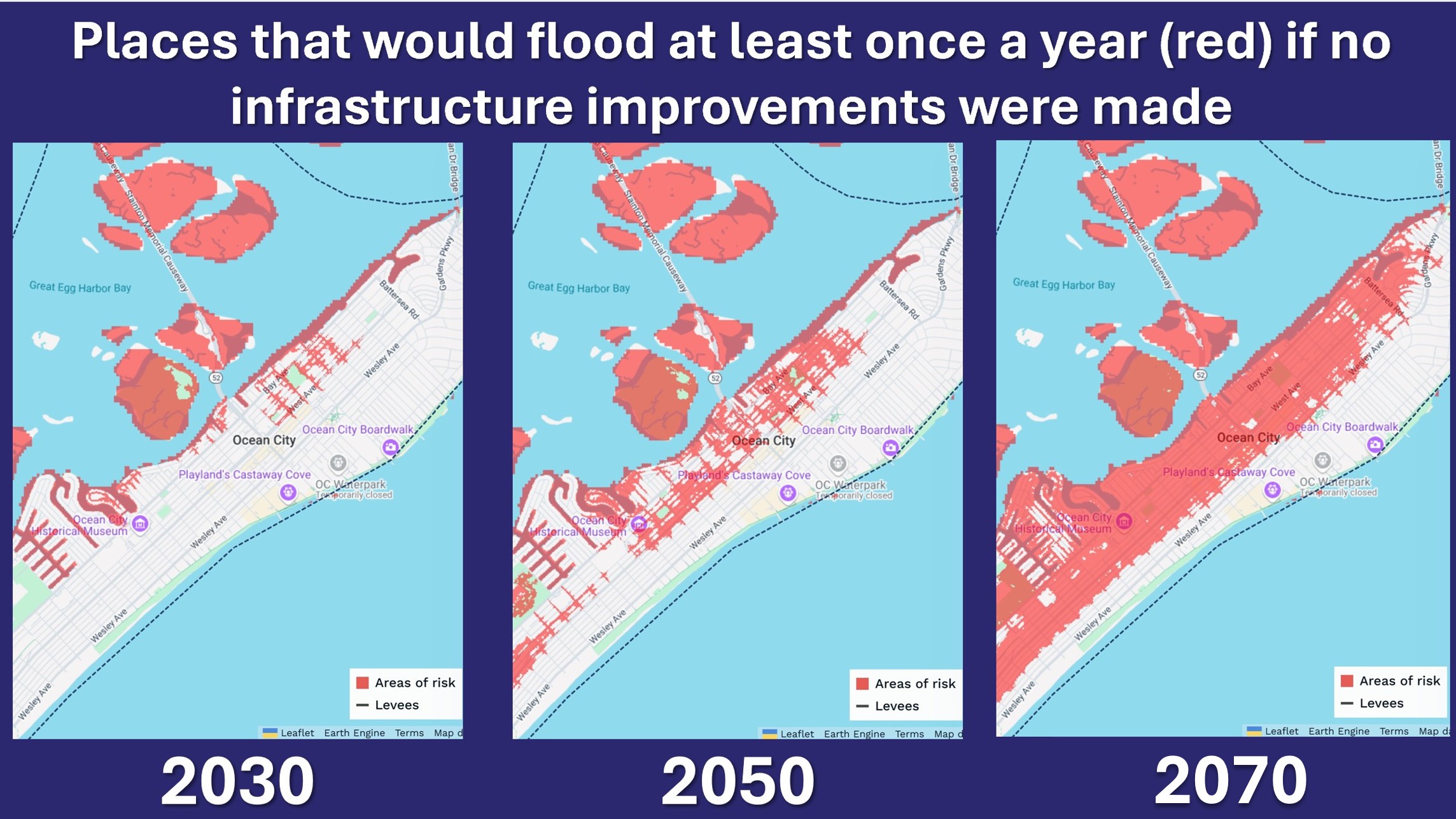
    According to the risk finder, 7.9% of people in Cape May County, and 1.9% of people in Atlantic City are at risk of water inundation in their homes at least once in 2030. That’s roughly what it is now. In other words, a flood 2.7 to 2.8 feet above mean higher high water (MHHW) floods the area at least once a year. MHHW is the average height of the two high tides seen per day.
    By 2050, those impacts double in size

    By 2050, according to the risk finder, 14% of people in Cape May County, and 4.8% people in Atlantic County are at risk from either sea level rise or a flood that happens once a year, on average.

    This indicates a flood 3.2 to 3.4 feet above mean higher high water in Ocean City, which would involve most areas bayward of West Avenue, from Second Street to 18th Street. Compare that to 2030, where only areas bayward of West Avenue, from Third Street to Eighth Street, would be underwater.

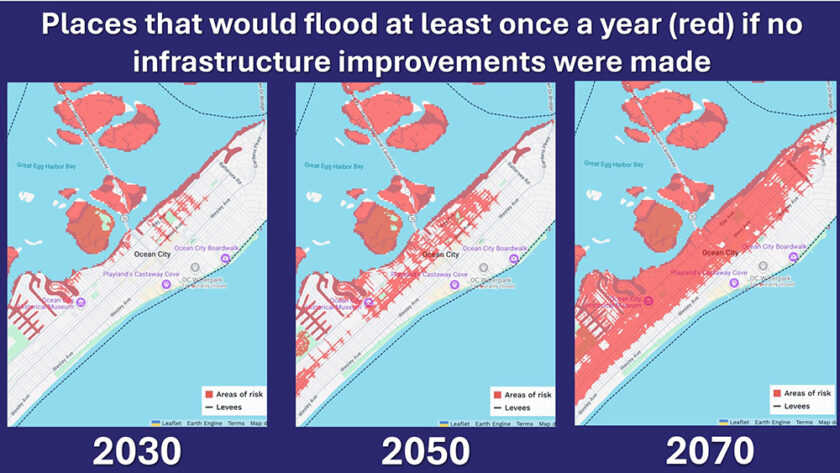
    Places that would flood once a year.

    Our kids and grandkids could be at serious risk

    Lastly, we’ll look at 2100. While most of us probably won’t be alive (I would be 109 then), our kids and especially grandkids would be around. That projects a vastly higher number.

    According to the risk finder, 35% of people in Cape May County, and 16% in Atlantic County would flood at least once a year. When considering just the shore towns, that number jumps to at least 65% of Ocean City and the Downbeach towns would flood during a flood that’s 5.2 to 6.1 feet above MHHW.

    Using Ocean City again, nearly everywhere bayward of Central Avenue would experience floodwater at least once a year. That’s nearly all of the island. Most of the Ocean City Municipal Airport would be included in that, too.

    What else to consider

    Your town’s emergency managers, elected officials and administrators take pride in protecting your property from floodwaters. The New Jersey Coastal Coalition, for which I do work, brings communities up and down the Jersey Shore together to share common sense flooding solutions. The result has been a reduction in your flood insurance premiums.

    Ocean City is eligible for a 30% rate reduction this year. Longport, Linwood, Margate and Ventnor have all earned 25% off. Somers Point has earned 20% off.

    All of this is through the Federal Emergency Management Association’s Community Rating System (CRS) program. Through a combination of public information, mapping, regulations, flood damage reduction, as well as warning and response programs, your communities earn points toward rate reduction. For example, Avalon saved residents $1.6 million in 2020, and each year going forward, by going up a class rating.

    The data and projections shown on the Coastal Risk Finder do not take into account future actions your town will take to increase their CRS score. It also doesn’t consider other actions being considered by towns and the state such the NJ Resilient Environments and Landscapes program.

    How to navigate the Coastal Risk Finder

    First go to www.climatecentral.org. Then go to Tools and select “Coastal Risk Finder” from the dropdown.

    On the left-hand side, you’ll be able to select your town, county or state. You can then select your scenario. You can view the risk by year, good for viewing what sea level rise projections will bring. Or you can view the risk by water level, which you could use to see how another Superstorm Sandy (search for 4 or 5 feet) would flood somewhere now.

    If you select the risk by year, you then go to additional settings to find your scenario.

    For purposes of this article, I used the sea level rise + annual flood under “projection type.” Then, for “sea level protection source” I used U.S. Interagency 2022.” Then I clicked on the “intermediate” sea level scenario.

    Joe Martucci, a Certified Broadcast Meteorologist and Digital Meteorologist, is the President and Director of Meteorology for Cup A Joe Weather and Drone. You can connect with him at cupajoe.sparkable.opalstacked.com/.

  • NJ has 28% chance of a near hit in 2025 Hurricane season forecast

    NJ has 28% chance of a near hit in 2025 Hurricane season forecast

    This article was first shown on Shore Local Magazine on April 10. Find it here, too!

    Expect a more-active-than-usual hurricane season in 2025, with a greater-than-average chance of a strike, or near miss in New Jersey.

    That’s the takeaway from Colorado State University’s hurricane forecast, which was released at the National Tropical Weather Conference in South Padre Island, Tex. on April 3.

    You’re probably wondering why a landlocked state like Colorado would have any interest in hurricane forecasting. We owe that to the late William Gray. He came to the university in 1961. He pioneered tropical forecasting in the 1980s. Philip Klotzbach, his student, took over for him in 2006 and has done it ever since.

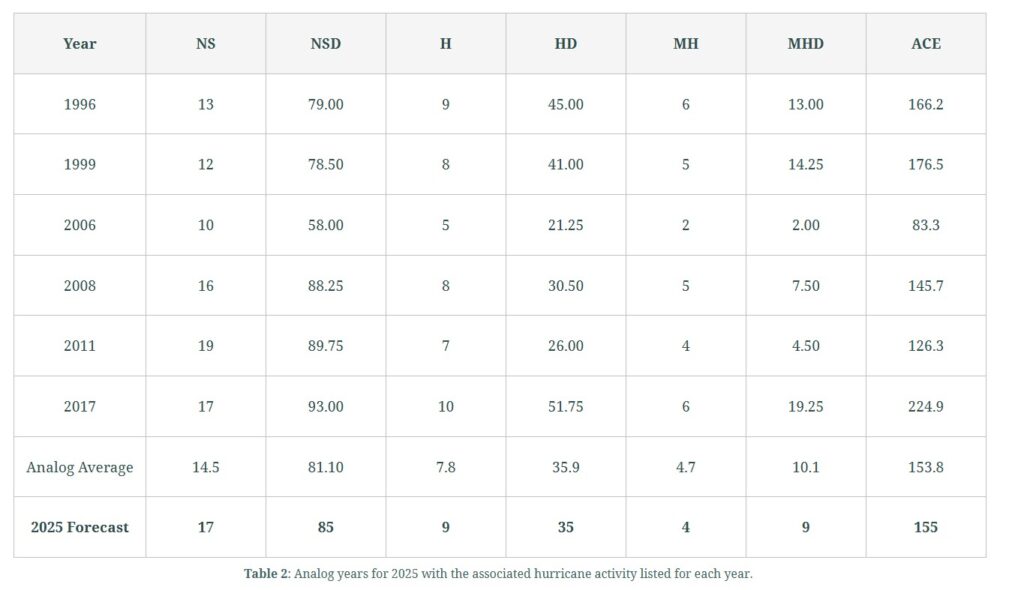
    Here is a look at the forecast, as alongside the climate average.

    Named Storms: 17, Avg. 14.4

    Hurricanes: 9, Avg. 7.2

    Major Hurricanes: 4, Avg. 3.2

    There’s also another factor called the Accumulated Cyclone Energy (ACE), which measures the combined strength and duration of tropical cyclones in a season, calculated using wind speeds from each storm’s six-hour updates. This year, the first is 155. That’s 150% above the average.

    This is the first of what will be a few forecasts throughout the hurricane season, which runs from June 1 to Nov. 30. So, like a regular weather forecast you would see from me, the closer you get to the season, the more correct it will be.

    “The authors do note that the initial April forecast historically has the lowest level of skill of CSU’s operational seasonal hurricane forecasts, given the considerable changes that can occur in the atmosphere-ocean,” the press release from Colorado State reads.

    Colorado State University studies years that had weather patterns like 2025 to estimate what might happen next. They checked six years and found that the average number of hurricanes and big hurricanes – ones in Categories 3, 4, or 5 – was a little more than usual. The ACE, which measures how strong storms are and long hurricanes last, was also higher than normal.

    Analog years for the 2025 Hurricane Season forecast that Colorado State University used.

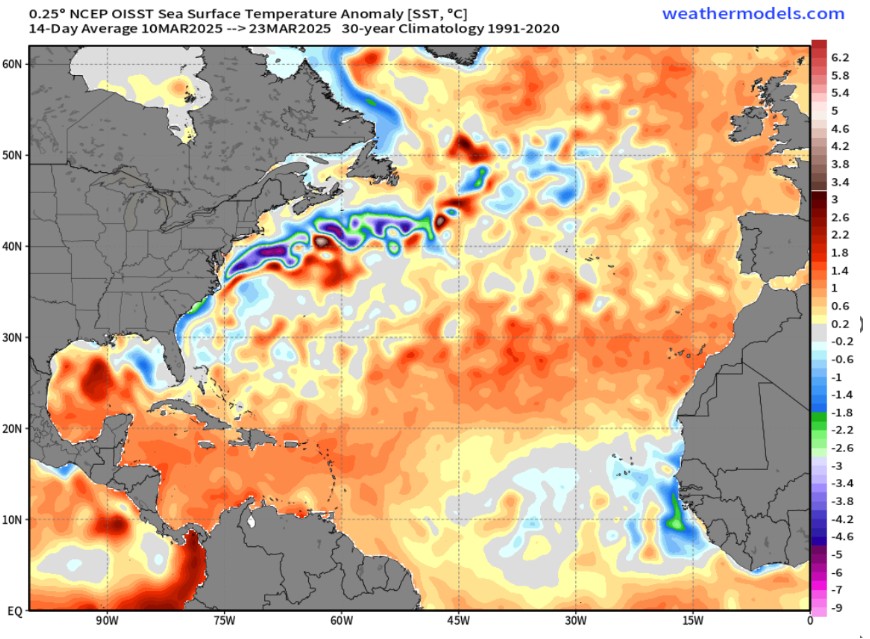
    All of those six years had two things in common: First, waters in the Tropical Atlantic Ocean were warmer than average. Warm water, specifically, temperatures at or above 80 degrees, provides the fuel needed for storms to develop and blossom into hurricanes.

    Sea surface water temperatures from late March (Via WeatherModels.com)

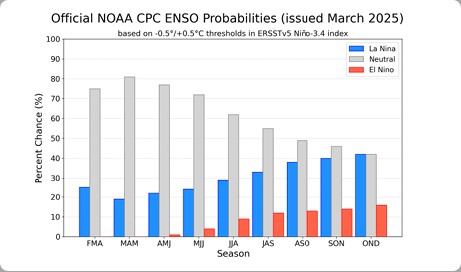
    During the peak of hurricane season, from August to October, the El Niño Southern Oscillation is expected to be either normal or in a La Niña phase. This phenomenon indicates the deviation of water temperatures in the Pacific Ocean near the equator, by Peru’s coastline, from their typical levels.

    In El Niño, hurricanes are less likely to occur. That’s because the wind shear – change of wind direction as you go up in height – increases in the Tropical Atlantic Ocean, where storms form. That rips these storms apart.

    In La Niña, the opposite occurs. There’s less wind shear, providing developing storms with a more relaxed environment in which to strengthen.

    In reality, the most likely situation is that things will be pretty normal. The water in the Equatorial Pacific Ocean would be about average in temperature. But when you mix that normal state with the warmer-than-usual temperatures expected in the Atlantic Ocean, it leads to a forecast that’s higher than normal.

    Probability of a three month period seeing a La Nina (blue), Neutral state (gray) or an El Nino (Red). The months use the first letter of the name on the bottom. (Via National Oceanic and Atmospheric Administration).

    Of course, it only takes one storm near us for it to be remembered as an active season. That’s where Colorado State’s forecast shines. They are able to forecast the chances of a tropical storm, hurricane or major hurricane being within 50 miles of a state’s coastline.

    For New Jersey, it’s a slightly higher than average chance.

    Named Storm: 28%, Avg. 23%

    Hurricane: 9%, Avg. 7%

    Major Hurricane: 1%, Avg. 1%

    So it’s still a low chance that we see a direct or near-direct hit. Usually we receive a soaking rain of one or two remnant storms. The exception was last year, and that was a problem. That helped lead to our ongoing drought, and was mostly responsible for October, 2024, being our driest month, statewide, since records began in 1895, according to the Office of the New Jersey State Climatologist.

    We’re still weeks away from hurricane season, but now is a good time to prepare. Do you have a “go bag” filled with water, medication, a light source and pet supplies? Is your flood insurance up to date? Do you know where you would go if you needed to evacuate?

    Hopefully we won’t have to face such an emergency this year. However, like anything in life, preparation is key.

    Joe Martucci, a Certified Broadcast Meteorologist and Digital Meteorologist, is the President and Director of Meteorology for Cup A Joe Weather and Drone. You can connect with him at cupajoe.sparkable.opalstacked.com/.

  • April Snow at the Jersey Shore: How often does it happen?

    April Snow at the Jersey Shore: How often does it happen?

    By Meteorologist Joe Martucci

    This article appeared in the April 3rd edition of Shore Local Magazine, which you can find here!

    April showers bring May flowers, as the saying goes. But what about April snow showers? Some April snow is common at the Jersey Shore, but don’t expect the plows to pass by the blooming cherry trees.

    Snow is tough to love, especially the older you are. I visited a homeschool group at Lakewood Chapel in Mays Landing on March 26. When I asked who liked snow, most of the children raised their hands, with a few parents agreeing. But most of the parents didn’t like the snow.

    With the arrival of spring, this story plays out often for me, too. April snow especially has a face only Mother Nature could love. (Let me know how you feel about April snow on my social media pages).

    Personally, I love snow until St. Patrick’s Day. Then I’m done with it. However, I could make an exception for record-breaking April snow.

    How often does the Jersey Shore have snow in April?

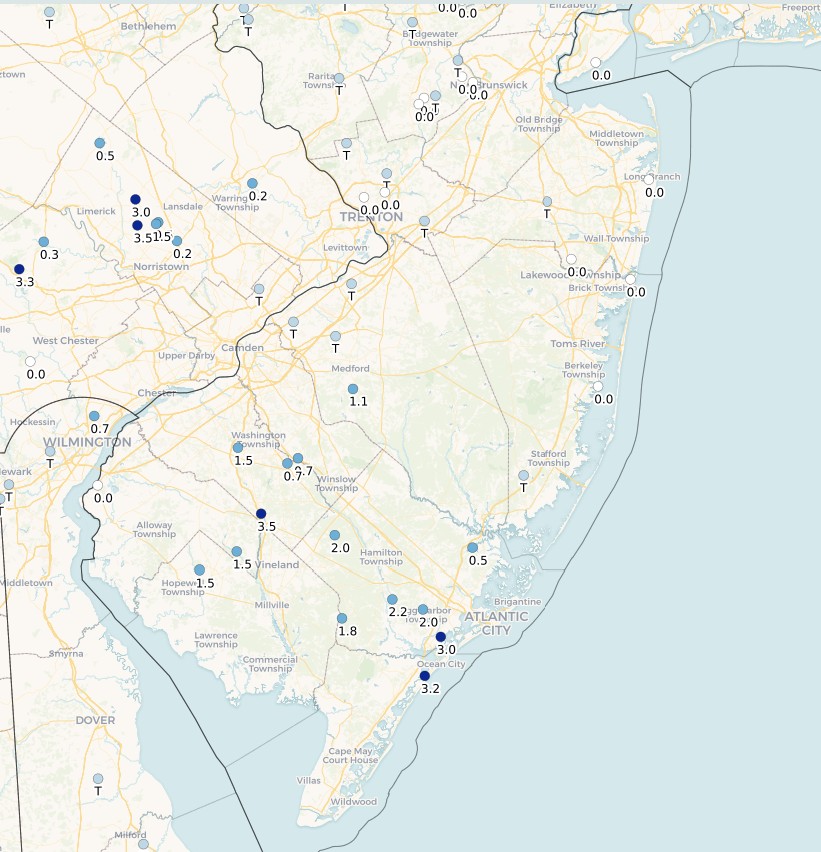
    For inland parts of the shore counties, 15% of Aprils have had measurable snow, at least 0.1 inches of snow or greater. The most recent time this happened at Atlantic City International Airport was on April 9, 2016. Totals that day, reported via CoCoRaHS, were downright weird.

    Snow on April 9, 2016 up the coast in Monmouth County (Via Justin Godynick)

    First, any measurable snow in April is uncommon. But this was a South Jersey snow special. Ocean City reported 3.2 inches of snow. Estell Manor saw up to 2.9 inches of snow, according to the Office of the New Jersey State Climatologist. Central and northern parts of the state barely had accumulation, even on grass.

    Snowfall totals from the April 9, 2016 Snow (Via the Community Collaborative Rain, Hail and Snow Network)

    The Sen. Frank S. Farley Marina in Atlantic City hasn’t kept snow records since 1956. However, looking at the short term, current data in Margate suggests that measurable April snow in the beach towns has a 5-10% chance of occurring in a given year. Longer-term data in Lower Township also supports this probability. For reference, the northern part of the Jersey Shore jumps up to around 20%.

    This all being said, April flurries are common. You can go for a few years in a row with a few festive flakes floating in the spring sky.

    Has it snowed enough to be plowable?

    For the purposes of this question, we’ll assume that 2 inches of snow is plowable.

    Since snow records at Atlantic City Airport began in 1945, there have been only six April days with at least 2 inches of snow or more. In Margate, there has only been one time since records started in 2000 when this has occurred.

    Even in a cooler climate period, the Sen. Frank S. Farley Marina in Atlantic City only had three such days during their 1884-1956 snow record-keeping period. All records come from the National Oceanic and Atmospheric Administration. In other words there has, and continues to be a less than 1% chance the snowplows will come around in any given April at the shore.

    What year produced the most April snow?

    Since measurable April snow is uncommon, and plowable snow is rare, the Aprils with the most snow are largely driven by one day of snow.

    At ACY Airport, 1996 saw the most April snow – 5.7 inches of snow fell that year. However, all of that fell on April 9.

    Margate’s highest April snow year was 2016 with 2.0 inches. Again, April 9 was the day when all of that fell at once. Another way to look at it is the April with the most days of accumulating snow.

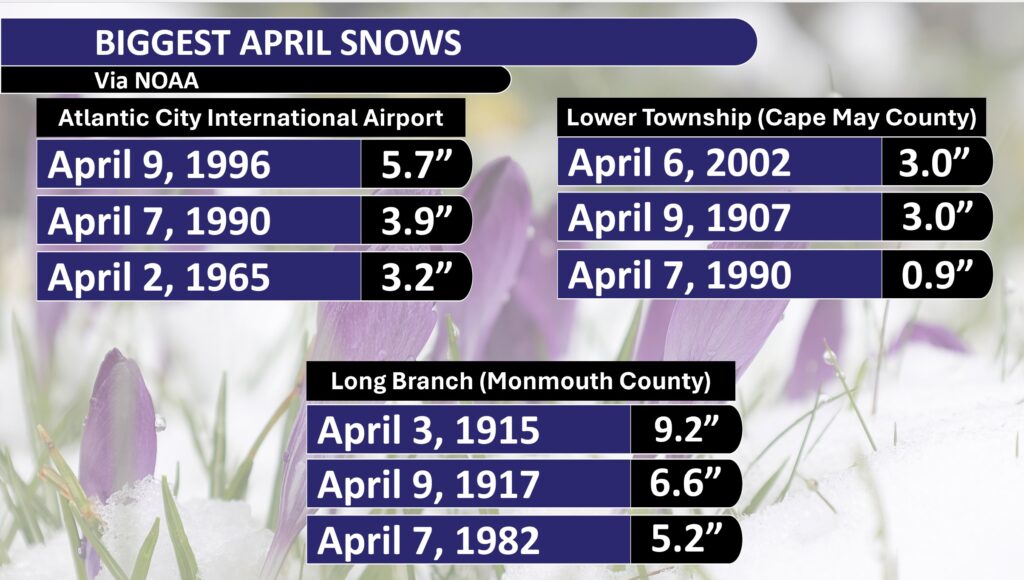
    ACY Airport saw two days of measurable snow in April 1956, 1959 and 1983. Lower Township had two days back in 1907. Meanwhile, Margate only had snow accumulate in April once – in 2016.

    Biggest April snows

    Here’s a look at the three biggest April snow totals up and down the Jersey Shore.

    If you’ve lived in the shore counties your whole life and are over the age of 14, you should remember the 2016 snow.

    May snow?

    The Jersey Shore never had measurable snow in May during its period of record. Non-accumulating flurries are uncommon, but not rare. I remember when flurries flew on Mother’s Day weekend back in 2020.

    Hurricane season forecasts

    On the completely opposite side of the weather spectrum, the first hurricane season forecasts will come out this month.

    It kicks off on April 3 when Colorado State University releases its outlook for the season. Despite the state being landlocked, it was home to William Gray, widely considered the pioneer of this specialized weather field.

    The Weather Channel typically releases its hurricane forecast during the first half of April. So, be on the lookout for that.

    Then, the National Hurricane Center will release its forecast in late May. The Hurricane Center manages all tropical watches, warnings and storm-specific forecasts in the United States.

    As we go deeper into spring, stay tuned for a few hurricane-related articles here.

  • NJ’s drought improves but path to drought-free will get tougher

    NJ’s drought improves but path to drought-free will get tougher

    By Meteorologist Joe Martucci

    This article ran in Shore Local Magazine on March 27th. The original article had data through March 21 (read here). However, this version is updated to the 27th.

    Mother Nature has made up for lost time, bringing plentiful rain to the state since March 5. That’s led to three consecutive weeks of improved drought status, according to the United States Drought Monitor.

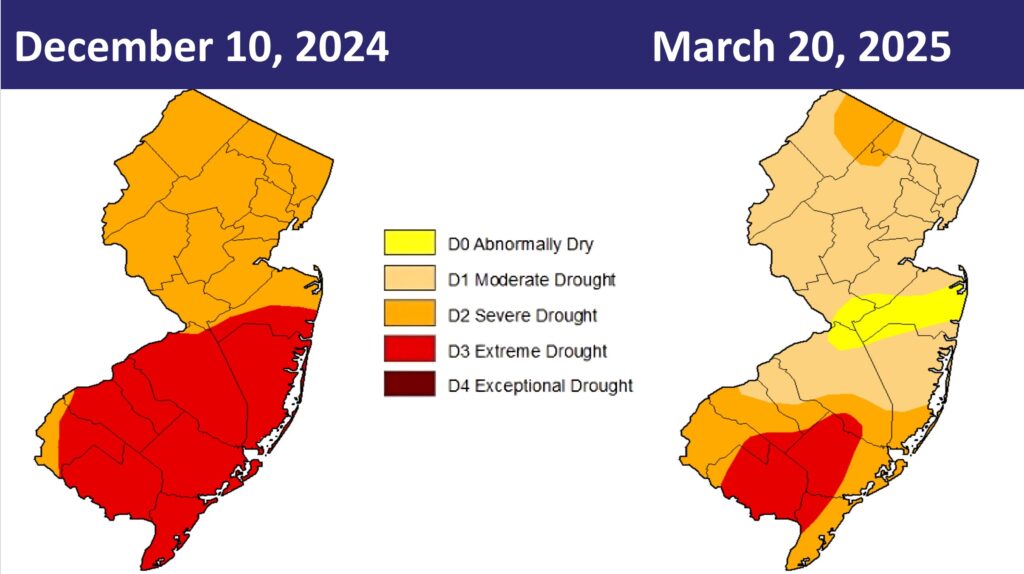
    The improved status is clearly visible in the latest update (dated March 20) from the United States Drought Monitor.

    From New Year’s Day through March 4, 3.81 inches of rain fell at Atlantic City International Airport in Egg Harbor Township. The report came from the National Oceanic and Atmospheric Administration. From March 5 until March 21, 5.55 inches of precipitation fell.

    The Sen. Frank S. Farley State Marina in Atlantic City saw a similar increase, recording 5.21 inches of precipitation March 5-21. Before that, it was 3.44 inches since the year began.

    It’s not just Atlantic County. Longtime weather reporting stations in Long Branch (Monmouth County), Trenton (Mercer County), and Philadelphia all saw as much or more precipitation since March 5. This is compared to the previous 64 days of the year.

    The weather pattern favors more storminess through the first week of April. So the shore should continue to see steady or improved drought status. However, improvement for the rest of the spring is considered unlikely. We will say more about that in the moment.

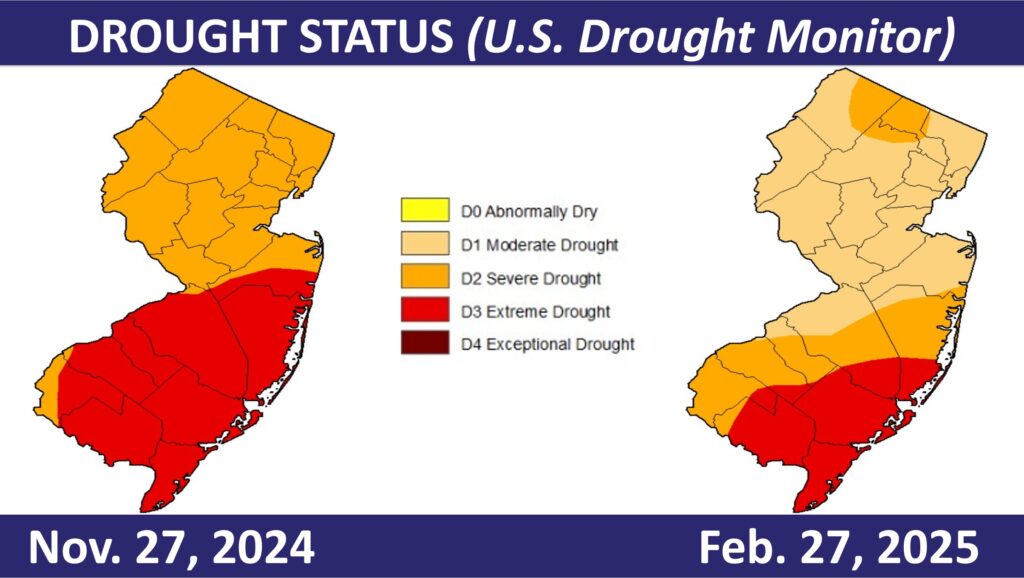
    On March 20 the South Jersey shoreline, from Stafford Township and Long Beach Island on south, improved from extreme drought. This was a level three of four drought. It improved to a severe drought, which is a level two of four. That’s our lowest level since Nov. 5, 2024.

    Inland Atlantic County (west of the Garden State Parkway), was still in extreme drought, though. Those areas join most of Cumberland County, and a small portion of inland Cape May County. This is the only area east of the Mississippi River in significant drought, as my friend and New Jersey State Climatologist Dave Robinson texted me last week.

    Still, New Jersey’s drought is improving. The 7% of the state in extreme drought is the lowest since Oct. 29, when the state was in the midst of its historic driest month on record.

    Drought status between December 10, the peak of the drought, and March 20, in New Jersey (United States Drought Monitor)

    The waning days of March, and the beginning of April bring plenty of opportunities to improve drought even more.

    The Climate Prediction Center, part of NOAA, gives a lean toward wetter conditions around our area through April 4. That’s because the jet stream – the river of air about 30,000 feet high – will be over or around New Jersey during this time. Think of the jet stream as the storm track, with a colder air mass to the north and warmer air mass to the south. This is in part a reaction to the polar vortex entering the Northeast last week, which I talked about on social media if you follow me there.

    We’ll take what we can get. In March, 0.75 inches of rain a week generally keeps us from slipping further into drought. Over an inch, like we’ve seen for most of March, will improve drought’s status.

    However, once we go into April, water usage increases. The sun evaporates more water out of the ground as it goes higher in the sky. We’ll need an inch per week just to keep up, with over 1.25 inches a week to improve drought. These need to be region-wide soakers, too.

    Sure, 3 inches of rain in Linwood from pop-up thunderstorms is great. However, in order for the Kirkwood-Cohansey Aquifer, from which southeastern New Jersey gets its drinking water, and reservoirs for the rest of the state to recharge, we’ll need rain from a coastal storm or a large inland low-pressure system.

    As of March 25, levels in the Manasquan Reservoir were at about 84% of capacity, according to the New Jersey Water Supply Authority. Typically, 97% is the average for March, according to the agency.

    The underlying data still shows there’s work to be done. As of March 23, average stream flows over the past 90 days are still in the “extremely dry” category up and down the Jersey Shore. In the southern part of the shore, it’s been this way for 23-straight weeks.

    I took a deep dive into the Climate Prediction Center’s outlooks. They break it down into three-month periods.

    The way I read it is I should expect a more humid-than-usual summer. That will at least increase the probability of pop-up thunderstorms. That’s good news, but again, we’ll need widespread rainmakers, which are unlikely in our climate once we hit mid-June. Rain storms from tropical cyclones don’t make their way here until late July, usually.

    In a bit of good news, there is a small lean toward wetter weather than usual here. A remnant storm or two would do wonders for us. We failed to get any last fall, which led us into this drought anyway.

    In my opinion, the best case scenario is that drought doesn’t worsen over the next few months. Then we get a tropical cyclone or two to pull us back to normal.

    The worst-case scenario: The extreme drought (level three) expands back to the Jersey Shore. The state would seriously need to consider their first drought emergency since 2002, and the mandatory drought restrictions that come with it, later in the spring.

    The NJDEP issued a statewide drought warning last November which called for voluntary water restrictions.

  • We lived through the Jersey Shore’s windiest winter since 2010-2011

    We lived through the Jersey Shore’s windiest winter since 2010-2011

    By Meteorologist Joe Martucci

    This article appeared in Shore Local Magazine on March 20th. Read the story here, also!

    No, it wasn’t just you thinking the wind was howling this winter. This was the windiest winter since 2010-2011, and featured the second highest wind gust on record.

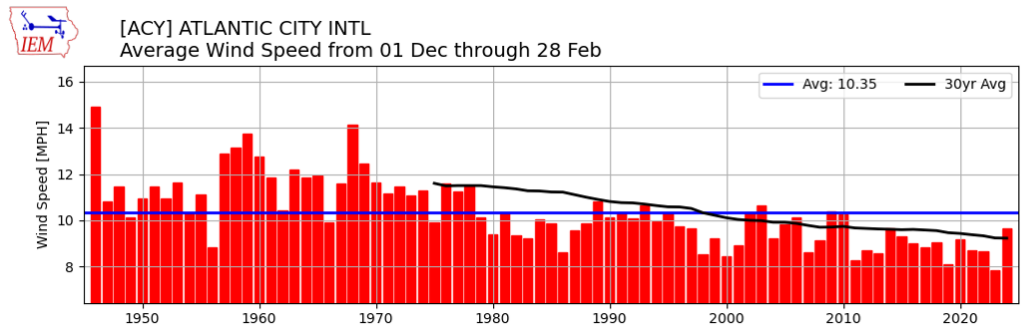
    At Atlantic City International Airport, the average sustained wind speed from December through February (climatological winter) was 9.7 mph, according to the Iowa Environmental Mesonet. During the winter of 2010-2011, that number was 10.3 mph.

    It’s not just the airport. Toms River (8.1 mph) was the windiest since 2010-2011. Meanwhile, Lower Township, at Cape May County Airport, was the breeziest since the winter of 2017-2018 (9.0 mph), according to the Mesonet. The top wind gust all winter was 71 mph at Atlantic City International, which occurred Feb. 16. That was the second strongest gust during climatological winter since records began in 1944.

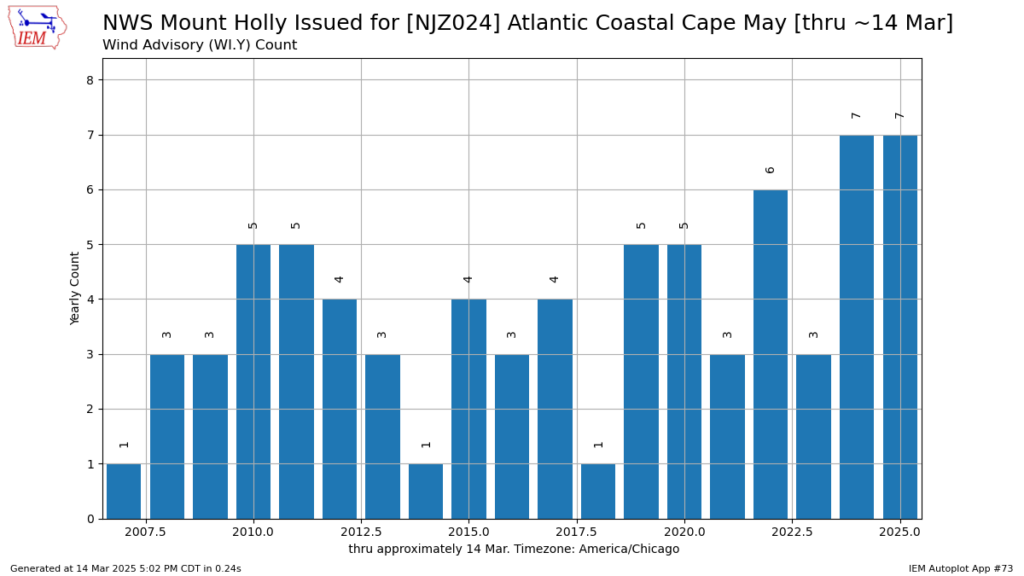
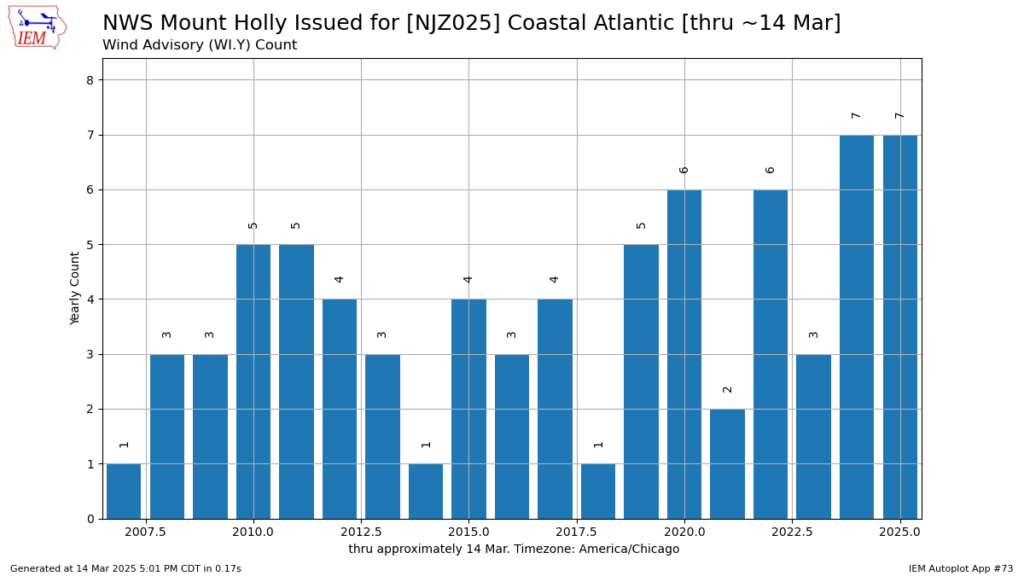
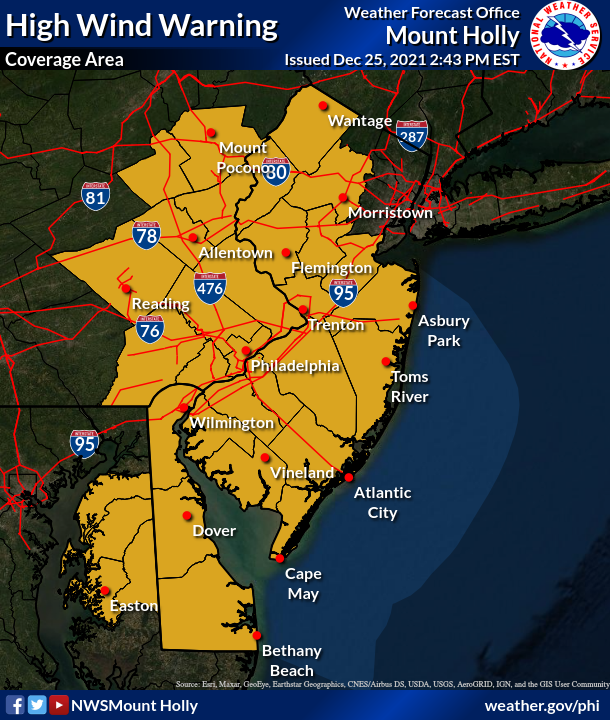
    The breezy weather lasted beyond climatological winter. Atlantic and Cape May counties had the most wind advisories. They either led or tied for the most issued by the National Weather Service this year up to March 14. (A wind advisory is issued when wind gusts are forecast to hit 46 to 57 mph, or steady winds will be 31 to 39 mph).

    The number of wind advisories issued by the National Weather Service for the coastal part of Cape May County (National Weather Service).
    The number of wind advisories issued by the National Weather Service for the coastal part of Atlantic County (National Weather Service).

    Wind speeds this past winter were more significant than in recent years. However, they were still within the normal range for the period of record. Similar to temperature trends, it was ultimately a seasonable winter for wind speeds.

    Since the 1970s, winds have gotten slower at Atlantic City International Airport, according to the Iowa Environmental Mesonet. The winds we felt in the winter of ’24-’25 were calmer than what was normal before the 1980s. Back in the middle of the last century, winter winds usually blew faster than 11 mph. That’s about 20% stronger than the winds we have now.

    A wind speed graph at ACY Airport over time
    Average wind speed, by year, at Atlantic City International Airport (Iowa Environmental Mesonet)

    It’s not just ACY that has lighter winds these days. I checked two other airports with long records. At Monmouth Executive Airport in Wall Township, the winds have been slowing down little by little over the last few decades. But at Millville Municipal Airport, where they started keeping track just a few years after Atlantic City, the winds have dropped significantly since the late 1990s.

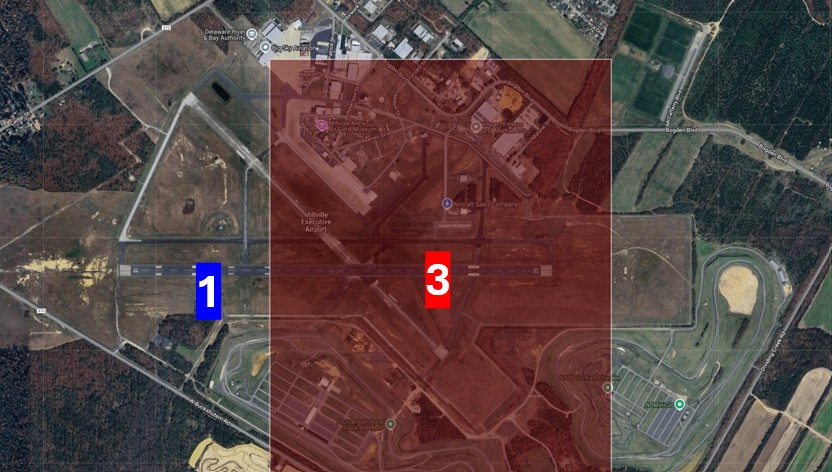
    In Millville, the sharp decline can be explained. In 1999, the weather equipment was moved from the eastern side of the airport to its current location on the western side, according to NOAA. There is an area of trees about 350 feet south of there. While they meet the standard practice of being at least 100 feet away from trees, this still likely weakens southerly winds. These winds encounter the anemometer equipment used to measure wind speeds.

    a map of Millville Airport
    The positions of the weather station at Millville Executive Airport. The 3 indicates it’s location up until 1999. It then moved west to its current location, marked by the number 1. (Google)

    At ACY Airport, there’s no clear year in the data that shows the weather equipment moved and caused lower wind speeds. The biggest drop seems to have been in 1978.

    The airport moved its equipment in 1968 and 1995, but the wind speeds didn’t really change much before or after those years. However, there was no location change then, according to NOAA. There was no major equipment change, either. I asked the National Weather Service for an explanation but could not find one. Monmouth Executive Airport’s weather station also doesn’t have any equipment or location explanation for the lower winds.

    There is research supporting the idea. Winds have been getting weaker in recent decades in the Northeast, away from the beach towns.

    “We show that surface wind speeds have declined by 5-15% over almost all continental areas in the northern mid-latitudes, and that strong winds have slowed faster than weak winds,” stated Robert Vautard, research director at the French National Centre for Scientific Research in a 2010 research article. The article looked at the period from 1979 to 2008.

    Vautard argues that a combination of reforestation and urbanization has played a large role in this. To a lesser extent, a weaker jet stream contributed. This jet stream is a river of strong winds about 30,000 feet high that separates two air masses.

    Urbanization makes sense. Atlantic County has grown a lot – 56% more people since 1970, according to the United States Census. Monmouth County, where the executive airport is, grew by 39%.

    The forest idea works, too. Around the late 1970s, when the winds started slowing down, the Pinelands National Reserve was created. This stopped people from building there, so the forest got thicker. Thicker trees block the wind and slow it down. Atlantic City Airport isn’t in the Pinelands, but it’s close enough that it might matter.

    Even so, this winter was pretty windy. There were 11 days when the wind stayed above 15 mph this winter.

    The last time it was windier was back in 1991-1992.

    However, in the 1960s and 1970s winter would have been the calmest season of the whole year. Even in the 2000s, you would consider the season’s breeze average.

    Similar to this past winter’s temperatures, which were the coldest in 10 years, the wind was noteworthy, but in the grand scheme of things, similar to what we used to see. Mother Nature must have had nostalgia for winters past this season.

  • It’s Spring Break: How far south should you go?

    It’s Spring Break: How far south should you go?

    This article initially appeared in Shore Local Magazine on March 13. You can see it here.

    The clocks have turned forward an hour, the buds are on the trees and now, it’s time to pack up and get a glimpse of summer, away from New Jersey. It’s spring break season.

    That may mean a cruise, with dreams of laying on the pool deck with a drink in hand. It may mean cheering on the Philadelphia Phillies at their Spring Training stadium (BayCare Ballpark) in Clearwater (or in my case, Sarasota for the Baltimore Orioles).

    Or, for our college readers, it means a few days you’ll never forget on the beach with your friends, and perhaps your future spouse considering that 1.5 million United States college students travel for spring break annually, according to Michigan State University.

    Count me out, though. The only spring break trip I ever took was north, to Boston, for St. Patrick’s Day.

    On the occasions people tell me they were disappointed in their spring break experience, the weather was to blame: It wasn’t hot enough, it wasn’t dry enough and the water wasn’t comfortable enough.

    So, if and when you decide to pack up and travel south for a spell in March, here’s a look at a few popular destinations and the climate they have to offer.

    Criteria

    For a spring break destination, I’ll assume that you’re looking for a place with average highs between 75 and 85 degrees. You’ll look for places that are largely rain free. Low humidity is a bonus. Mornings should be comfortable – mild enough to stroll around in nothing more than a light layer.

    This is nearly the same criteria I use here at the Jersey Shore for my Shore Summer Weekend Weather Report Card. The data listed below is from the National Oceanic and Atmospheric Administration, unless otherwise specified.

    Myrtle Beach, SC

    “The Golf Capital of the World” is comfortable for golf, but don’t plan on pool or beach time here.

    Afternoon highs in March rise from the low-60s to the upper-60s, on average, as the month goes on. You typically have mornings starting out in the 40s. So, it’s nice. There’s a 31% chance of some rain throughout the month, with a 7% chance of a ruin-your-outdoors-time, half inch of rain.

    Myrtle Beach has a similar climate to New Jersey’s, so in March, expect a fair amount of cloudiness from large-scale storms, like nor’easters.

    Panama City Beach, Fla.

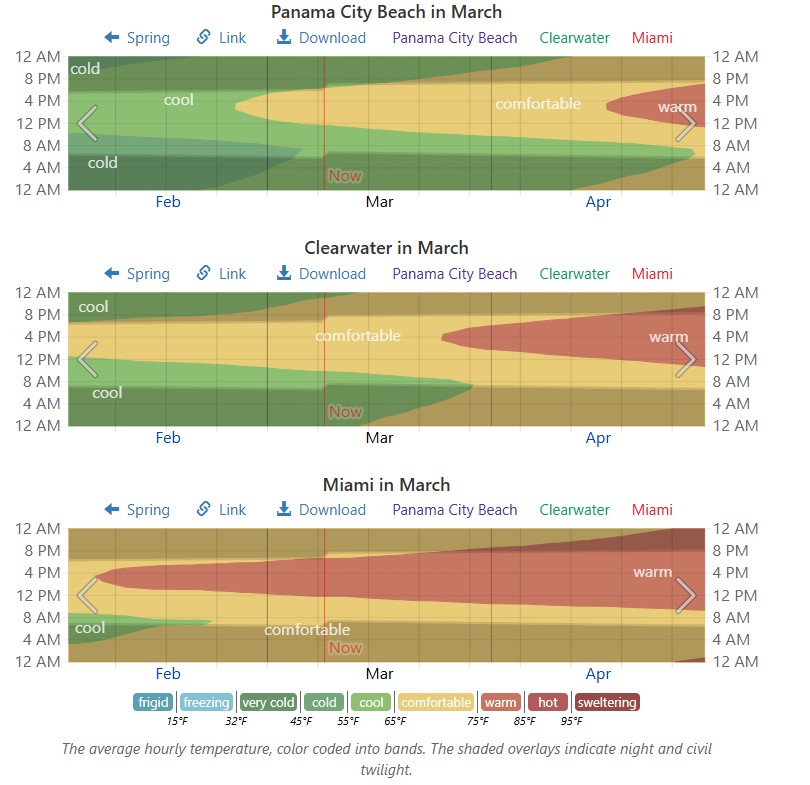
    A classic college spring break destination, Florida’s “Endless Summer” license plate doesn’t extend here. Temperatures are OK for hanging out on the sand. Morning lows start out 50-55 degrees, rising to 70-75 degrees, on average. That being said, there are days where highs will stay in the 60s, even 50s. A solid stretch of very warm weather is unlikely.

    It is drier here, on average, than Myrtle Beach. There’s a 23% chance of rain on any given day in March. However, bigger soakers are more common here than Myrtle Beach.

    Clearwater, Fla.

    Now we’re getting to beach weather, and baseball weather, too. Average morning lows go from the mid-50s at the beginning of the month, to 60 degrees by the end of the month.

    Daytime highs are regularly in the mid to upper-70s; 80s are a homerun at least a few times during the latter half of the month. The weather is nice for watching baseball, and for the sea, 60s occur with some regularity until March 22.

    Rainfall occurs roughly 25% of days in March. Soaking rain over a half inch is uncommon, with a less-than-10% chance each day. Expect lots of sun this time of year.

    Orlando, Fla.

    Spring break with the little ones is extremely comfortable this time of year. Temperatures start out in the 50s during the morning and peak in the upper-70s to around 80 degrees on average. Plus, that swampy, muggy air is still weeks away.

    March is still in the midst of dry season in Central Florida. Like Clearwater, there’s about a 25% chance of rain on any given day. Heavier rains, over a half inch, are uncommon.

    South Florida/Florida Keys

    You can break out those “Endless Summer” Florida license plates here, surfboard in tow.

    Both coasts in South Florida boast average high temperatures in the upper-70s to low-80s in March, rising as the month goes on. The same is true for the Florida Keys.

    Mornings are great for early exercise, or your caffeine boost with friends and family. Lows start out in the low to mid-60s. Similar to Central Florida, most days are without sticky weather, too.

    It’s even drier here than the rest of Florida’s Panhandle. Expect plenty of sunshine in this part of the Sunshine State. From Key Biscayne to Key West, there’s roughly a 20% chance of rain on any given day. Downpours are downright rare.

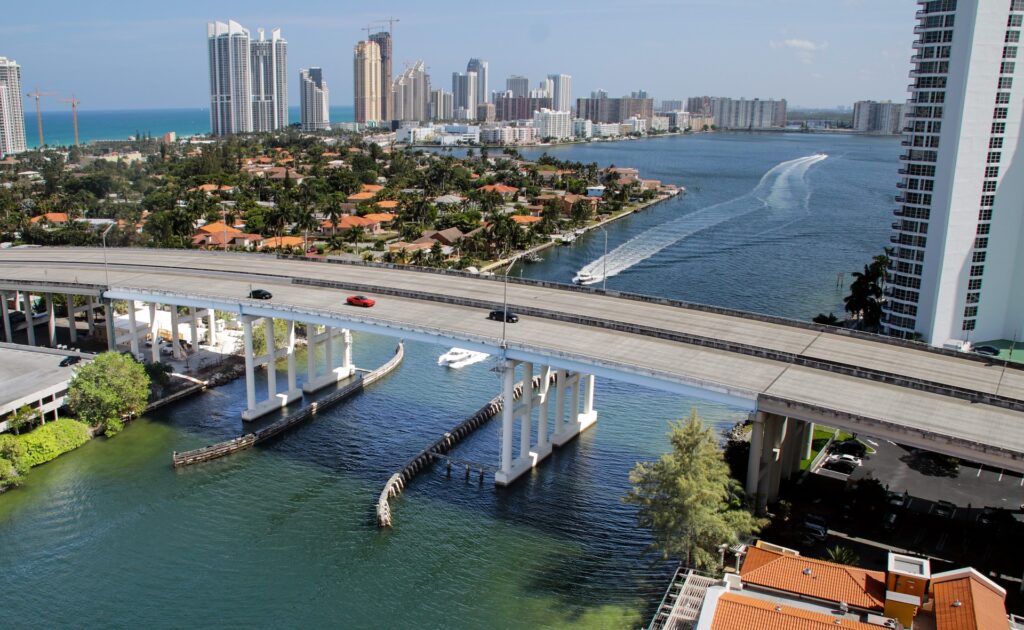
    Roughly from Jupiter on the East Coast, to Ft. Myers on the West Coast on south is in the Tropical Köppen Climate Zone. That means there’s an average of 64.4 degrees or higher every month of the year, with significant precipitation (at times).

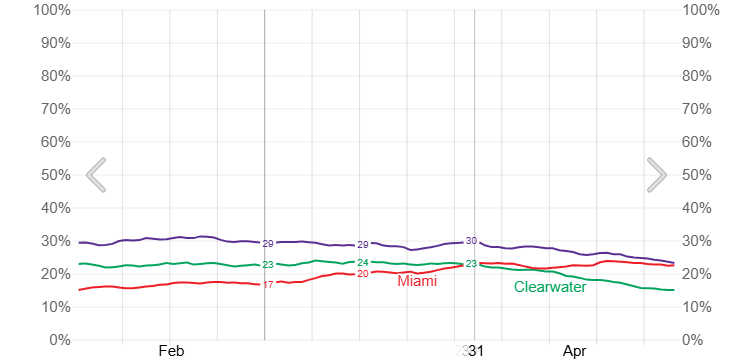
    Daily Chance of Precipitation from February to April for Miami (Red), Clearwater (Green) and Panama City Beach (Purple). Data via WeatherSpark.
    Average March temperature comparison for Florida in Panama City Beach, Clearwater and Miami. Data via WeatherSpark.

    Punta Cana, Dominican Republic

    Our first international destination of the list, Punta Cana is located on the eastern tip of the island nation. It’s firmly in the tropics, meaning March is a beach paradise.

    Morning temperatures start out in the upper-60s to low-70s, with balmy breezes blowing. Afternoon highs reach the mid-80s. It is humid, however it’s not quite the stifling humidity you’ll see later in the year.

    They average seven days with wet weather in March, but soaking rain is rare before March 20. They become more common afterwards.

    Cancun, Mexico

    Perhaps the most notorious spring break spot in North America, Cancun brings the heat during March.

    March temperatures in Cancun are similar to Punta Cana. Mornings start out around 70 degrees and rise to the low and mid-80s during the afternoon, on average, according to WeatherSpark.com. Highs in the 70s and lows in the 60s are common in March, but that’s still fine for time in the water.

    Precipitation occurs three or four days a month, on average. Furthermore, there’s a dip in the number of soaking rains this time of year. It’s rare for long-lasting rain to occur. That being said, it is fairly humid.

    The main difference between Cancun and Punta Cana is the clouds. Average days are cloudy, according to WeatherSpark.com.

    Aruba

    They say Aruba is “one happy island” and with its excellent March weather, it’s easy to see why. With dry conditions, not too much humidity and sunshine, there’s lots of time for the outdoors.

    There’s just a 2-3 percent chance of rainfall on any given day during March, according to WeatherSpark. Cloud cover averages partly sunny during the month, too.

    Temperatures start out in the very balmy upper-70s. Afternoon highs peak in the mid-80s. The humidity is high. However, the island breezes try to mix that out as much as possible.

    Conclusion

    If you’re looking to lay by the beaches, pools and bays for days, you need to be in South Florida, or farther south to enjoy these without worry. However, you can be in Clearwater watching the Phillies or in Orlando and get a stretch of comfortable shorts weather.

    If you are wishing for warmer days but aren’t able to get away for spring break, have no fear; highs reach 75 degrees by March 31, on average, at Atlantic City International Airport, and April 26 at Sen. Frank S. Farley State Marina in Atlantic City.

  • The coldest winter in 10 years just froze N.J.

    The coldest winter in 10 years just froze N.J.

    By Meteorologist Joe Martucci

    This story first appeared in Shore Local magazine on Mar. 6. Read it here!

    Climatological winter – December, January and February – is over, and the latest data shows that this was the coldest since 2014-2015 for the Jersey Shore.

    The average temperature was 34.8 degrees at Atlantic City International Airport in Egg Harbor Township, and 36.4 degrees at the Sen. Frank S. Farley State Marina in Atlantic City.

    What stood out the most to me was how long the cold lasted. December, January and February were all colder than normal, according to the National Oceanic and Atmospheric Administration (NOAA). The only exception was February at the airport, which was exactly average for the season. Note that average here means the 1991-2020 universally used time. We’ll talk more about that later.

    Monthly temperature departure from average

    Here’s the Monthly Temperature Departure from Average in degrees Fahrenheit, according to NOAA:

    December was -1.0 at the airport and -0.9 at the marina.

    January was -3.5 at the airport and -3.7 at the marina.

    February was 0.0 at the airport and -0.2 at the marina.

    It truly felt like a start-to-finish winter at the Jersey Shore. This has become less and less common over the decades.

    While all three months were at or colder than average, that conclusion is based off of the mean temperature from 1991-2020. Looking back at all of recorded history shows that this winter was more in line with an average one than a frigid one.

    Yes it was cold, but…

    Take Atlantic City International Airport. Out of the 82 winters on record, this winter ranked exactly at the halfway point between them all. Taking it a step further, the average temperature for the entire period is 35 degrees, just 0.2 degrees above this past winter’s temperature.

    Go to the beach and we have Atlantic City Marina, one of America’s premiere weather reporting stations. It has had nearly continuous record keeping since 1873 – one of the country’s longest established weather outposts. Plus, situated right at the marina, its data reflects the true impact of the water on the shore’s climate.

    This was in the colder half of the 150 winters on record, but not by much. It was the 68th coldest, putting it in the top 45%. The long-term average is 36.1 degrees, which is actually slightly colder than what we just experienced.

    Neither Atlantic City International Airport nor Atlantic City Marina set any new cold temperature records. The last time either place had record cold, for high or low temperatures, was in 2022, according to the Iowa Environmental Mesonet.

    The only new record was in Estell Manor, Atlantic County. On Feb. 19, the highest temperature of the day was just 30 degrees, the coldest ever for that date. Records there go back to 1966. While it’s not as well-known for climate data as the airport or marina, it still provides useful information.

    Overall, this winter wasn’t extremely cold when looking at all past records. But compared to recent years, it was colder than usual – the coldest since the winter of 2014-2015.

    Frozen waters

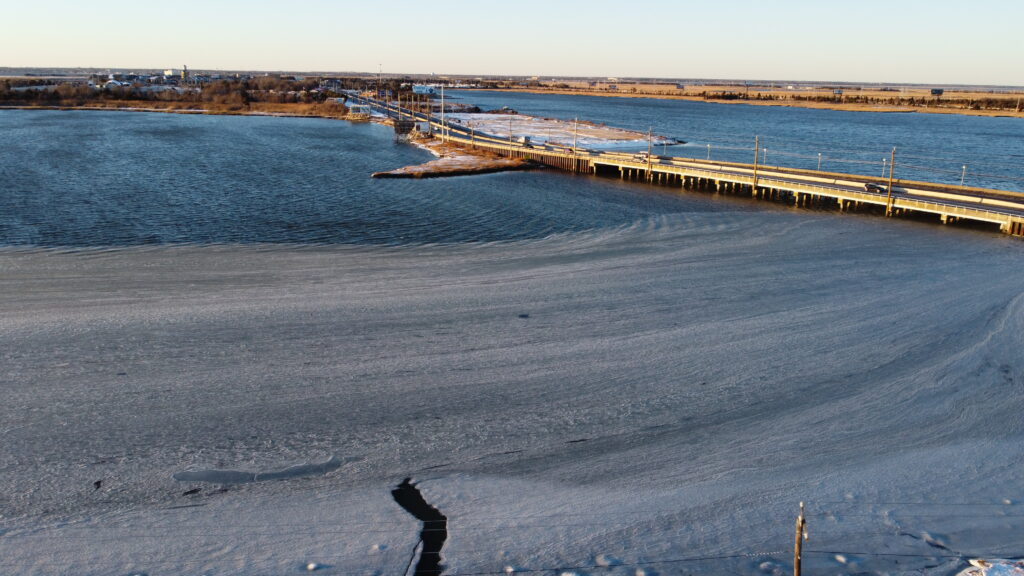
    Ice is visible well off the shore on the Beach Thorofare in Atlantic City during January, just off of West End Avenue. (Photo by Joe Martucci)

    The salty bays had some ice on them from late December to mid-February. In some places, the ice stretched far out into the water.

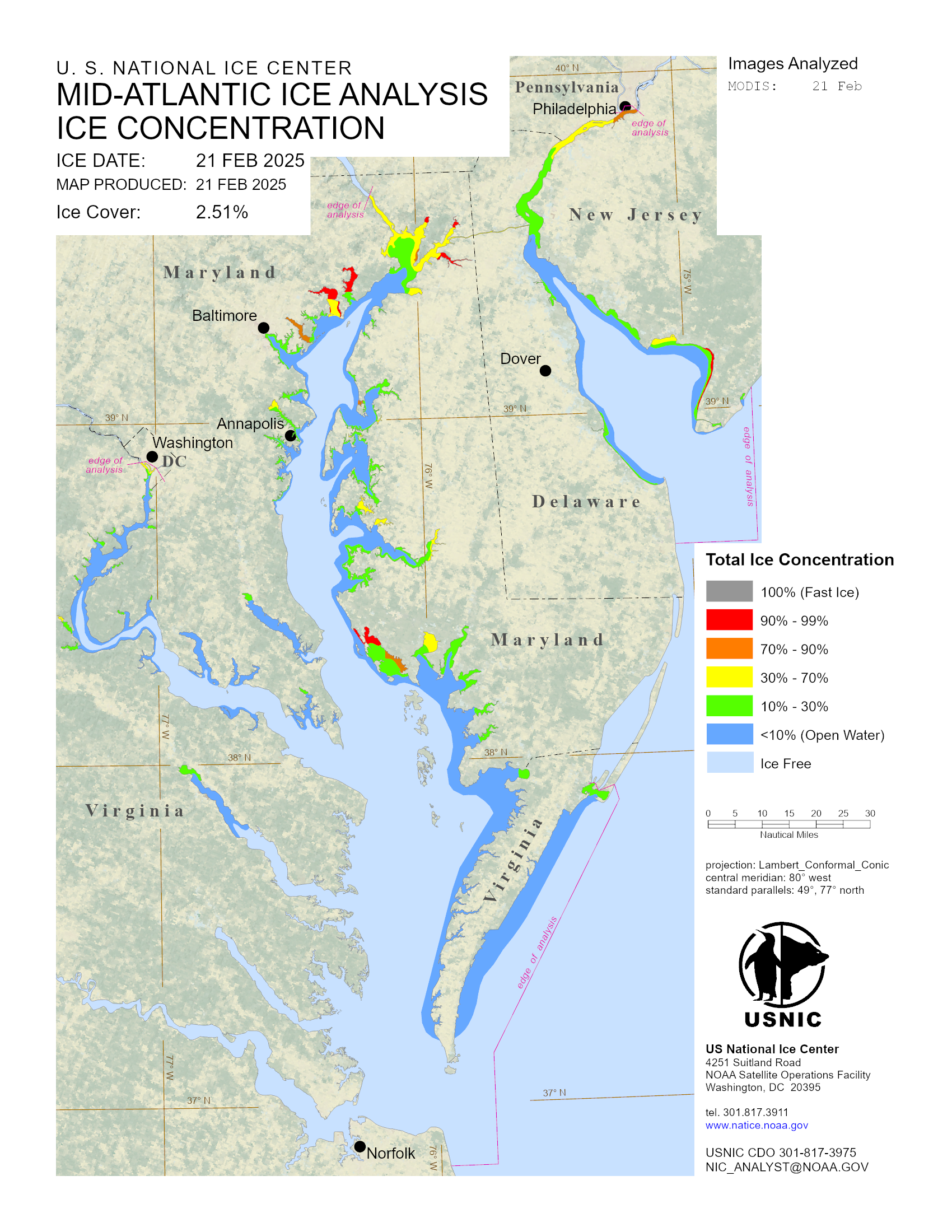
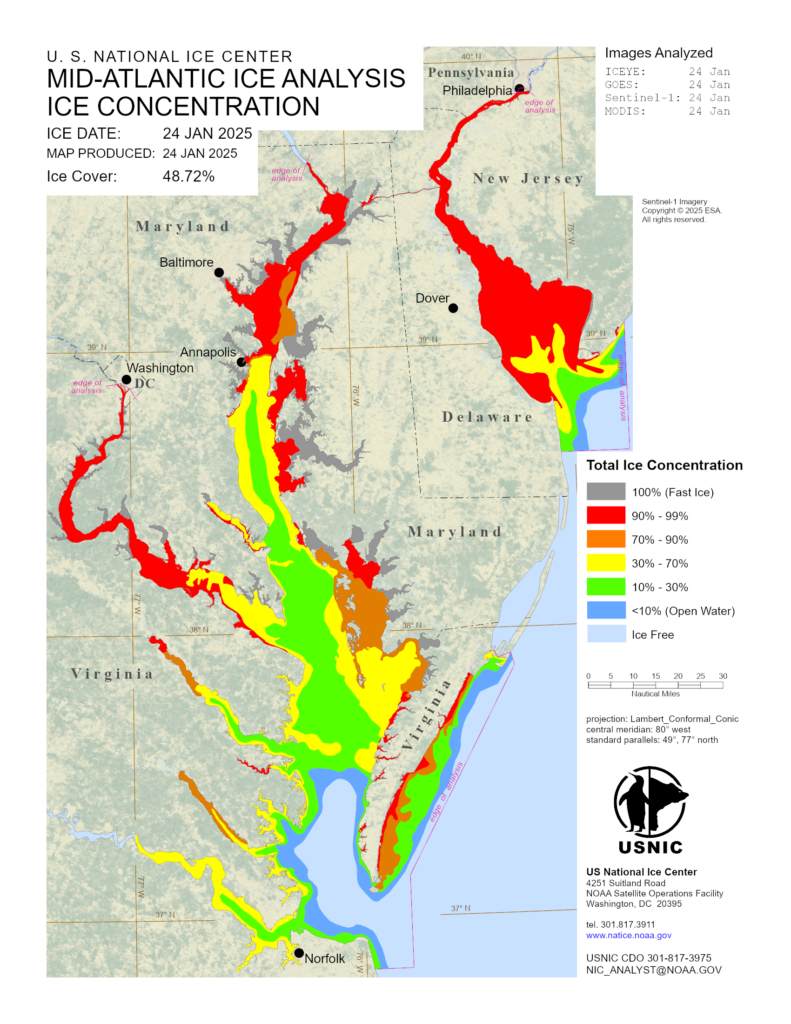
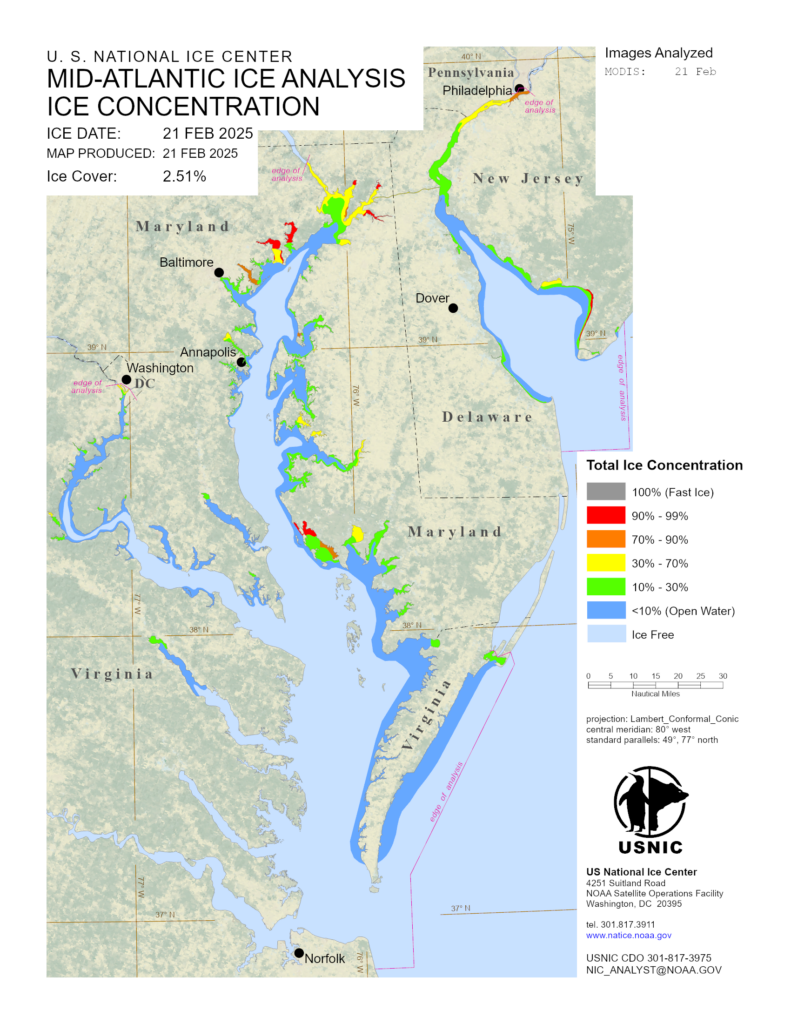
    Ice was especially extensive on Jan. 24. Most of the Delaware Bay had a total ice concentration of 90%, according to the United States National Ice Center. Even on the Atlantic Ocean side, there was some ice in Cape May County.

    The Delaware Bay shoreline, from roughly Del Haven, Middle Township, over to East Point Lighthouse was at least 90% iced over on Feb. 21, according to the United States National Ice Center. At least some ice covered nearly the entire Delaware Bayshore that day, too. That extended up the river to Philadelphia.

    The freshwater ponds were frozen over for a long while this winter. Pictures on social media of people playing pond hockey, skating or even ice sailing were seen up and down the Jersey Shore. Furthermore, the cold reversed the trend of plants and trees budding in mid to late February.

    Why was it so cold?

    The reason for the coldest winter in nearly a decade has to do with two factors: the polar vortex and the cold ocean.

    The polar vortex is a cold dome of low pressure in the stratosphere. It sits over the poles in its resting state. This winter, it stretched down into the northern United States numerous times. As of the end of the month, it occurred 10 times, according to Judah Cohen of Atmospheric and Environmental Research (AER) in Massachusetts. For those keeping score at home, that’s a lot.

    When that happens the jet stream – the river of air about 30,000 feet high that separates colder and warmer air masses – will dive toward the equator about 10 to 14 days after the polar vortex moves in.

    The polar vortex and jet stream can stretch down to the equator anywhere in the Northern Hemisphere it wants. However, this winter, it was locked into the northern tier of the United States, as well as far eastern Russia.

    Typically, stretched polar vortexes bring less bitter cold than a split polar vortex (when the polar vortex breaks into two). However, with it occurring 10 times it brought a persistent cold.

    The second thing that affected the weather was the cold ocean. It made the air chilly at the Jersey Shore. The Atlantic City Marina was much colder than usual compared to Atlantic City International Airport.

    The ocean water was colder than normal this winter. It was 45 degrees in December, 40 degrees in January, and 39 degrees in February, says the National Oceanic and Atmospheric Administration. Also, the bays were super cold, even below 32 degrees for a while.

    The drought continues

    In addition to temperatures, we have to talk about precipitation. We did not get the rain or snow needed to pull us out of drought. In fact, in my winter outlook I said the following:

    “There should also be an average amount of storminess… Drought should recede during the winter, but I don’t believe it’ll be enough to cure our problems as we exit the season. Looking ahead, we’ll need a wetter-than-average spring to end the drought for good. Otherwise, there will be water problems.”

    That was true for New Jersey as a whole. However, for the South Jersey Shore, “extreme drought” lasted all winter long, according to the United States Drought Monitor. That’s the third level with level four being the worst. Statewide, most of the northern half of the state dropped from level two to level one for drought. This change occurred by the Feb. 27 update.

    Precipitation over the three months was between 6.18 inches at Atlantic City Marina and 8.70 inches in Galloway. This is for Atlantic and Cape May counties based on data from the National Oceanic and Atmospheric Administration. That’s 26% to 50% below average.

    Snowfall ranged from a little below average in Atlantic County to a little above average in Cape May County. Margate was the lowest at 10.3 inches. Lower Township was the highest at 17.5 inches. I’ll have a full snow season recap later in the month.

    Looking ahead

    March does not look like a very wintry month. After the frigid cold on March 2-3, temperatures will mostly be at or above average. This trend is expected through the middle of the month. Think highs in the 50s and 60s, cooler at the beaches as the daily, chilling sea breezes return.

    Cohen from AER believes one more shot of colder-than-average temperatures will arrive in the second half of March. If it does, we’re likely talking highs in the 40s and lows in the 20s. That’s more of the typical wintertime cold, nothing exceptional.

    In terms of precipitation, there’s no strong lean toward a wetter- or drier-than-average month. Getting a normal amount of rain would be helpful. March is the wettest month of the year at Atlantic City Marina with 4.27 inches of rain. It’s the second-wettest month at Atlantic City International Airport, with 4.52 inches. That much rain would stop the drought from getting worse, but it wouldn’t make it better.

    By St. Patrick’s Day, we’ll need about an inch of rain each week. This is necessary to make up for the water that dries up from the ground. It’s also for the water that people use. To get ahead, we would need at least 1.25 inches a week.