Tag: hurricane

  • 🌀How likely is a hurricane, tropical storm in NJ in 2026? Forecast released.

    🌀How likely is a hurricane, tropical storm in NJ in 2026? Forecast released.

    This article initially appeared in Shore Local Newsmagazine on April 16

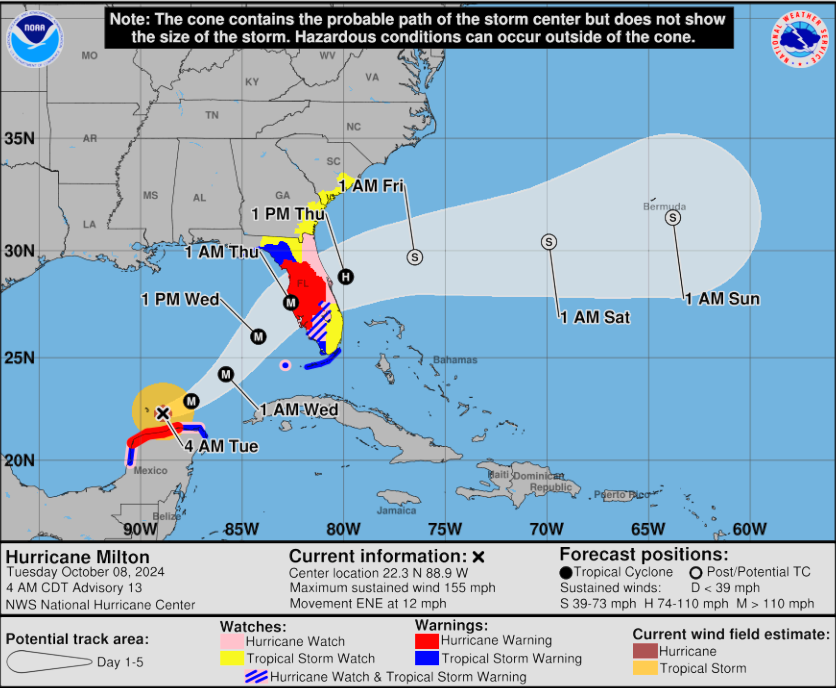
    The Atlantic Hurricane season runs from June 1 to Nov. 30. We know that very well here in New Jersey, as does Colorado State University – yes, landlocked Colorado State University which just put out one of the most anticipated hurricane forecasts of the season.

    On April 9, CSU released its 2026 Atlantic Hurricane Season forecast at the National Tropical Weather Conference in South Padre Island, Texas.

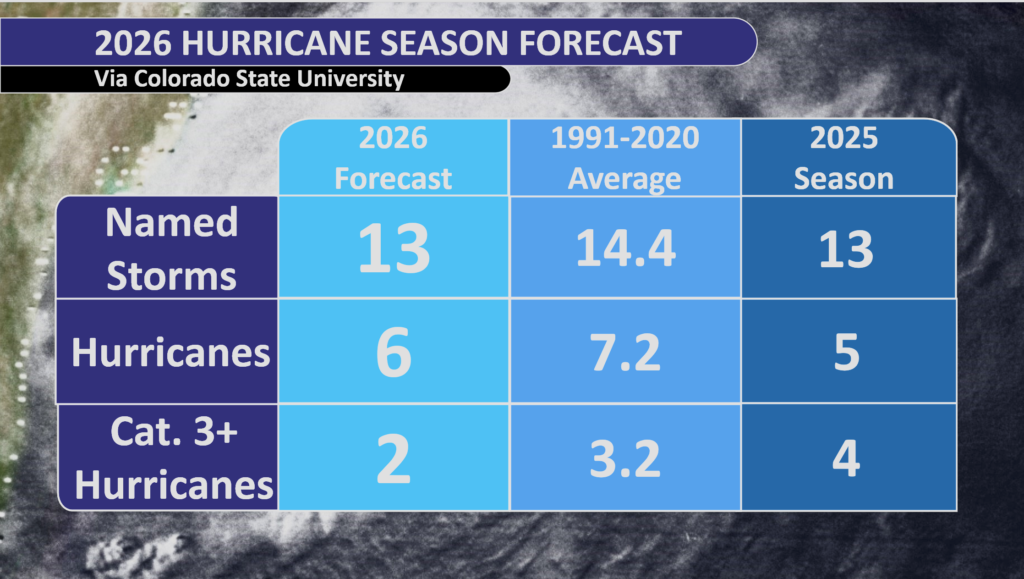
    2026 Atlantic Hurricane Season forecast

    The forecast calls for 13 named storms (a tropical storm or a hurricane) including six hurricanes, two major hurricanes – a Category 3, 4 or 5 with maximum sustained winds of at least 111 mph.

    This is slightly less active than average, and less than last season. The difference is that last season had four major hurricanes, while the forecast for this year calls for two.

    Likelihood of a tropical storm or hurricane

    Colorado State University also breaks down the forecast into probabilities for statewide impacts.

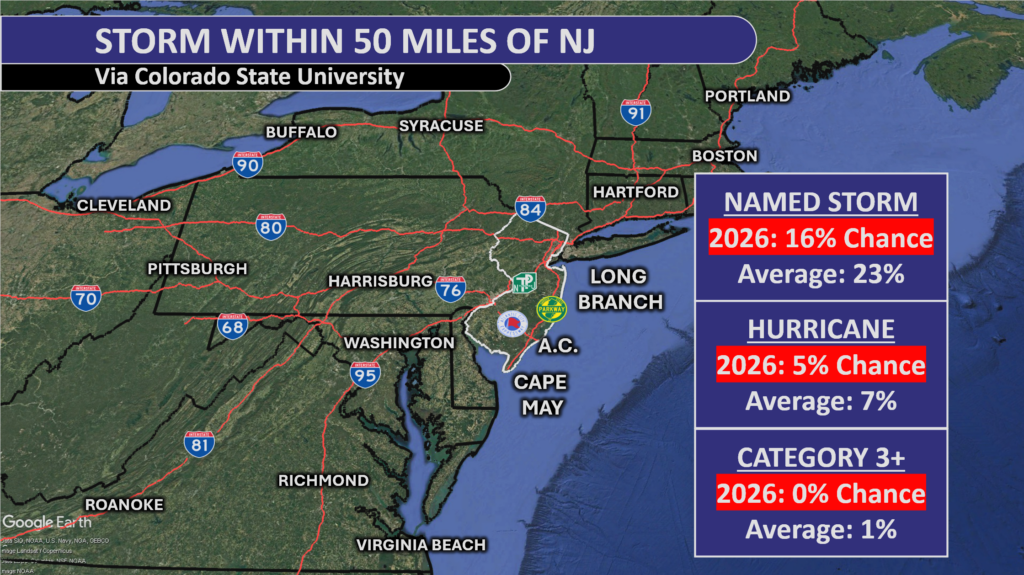
    New Jersey faces a 16% chance of a named storm this season, which is 7% below the historical average. The outlook for hurricanes is also quiet: the 5% probability of a standard hurricane is below average, and the risk of a major hurricane – Category 3, 4, or 5 – is effectively 0%. That isn’t a major departure from the norm as the state’s average risk for a major strike is just 1%.

    Virginia and Massachusetts are the only two states with a double-digit percentage chance of a hurricane being within 50 miles of their states, at 14% and 10% respectively. All other states are in the single digits.

    El Niño, the biggest hurricane season factor

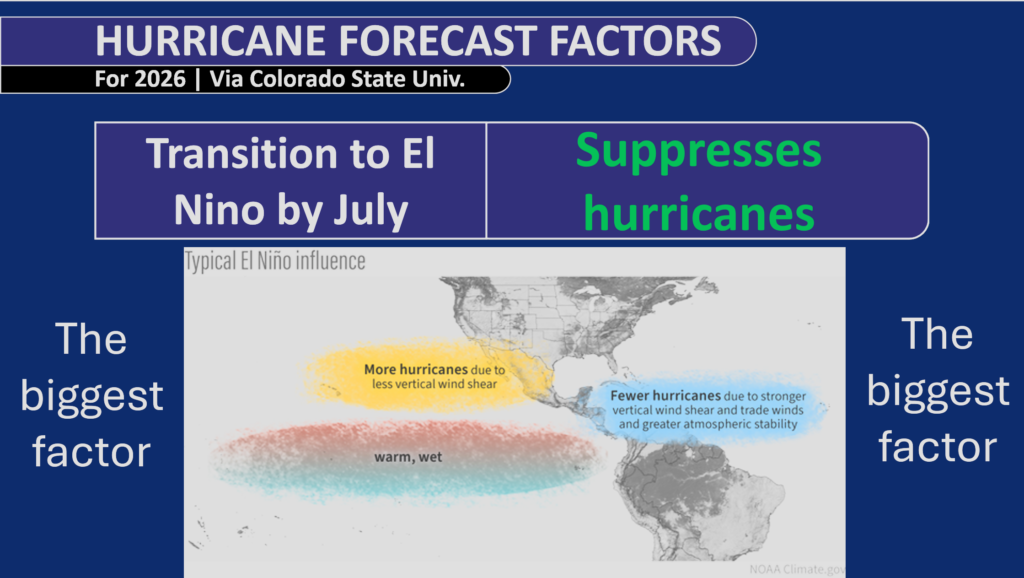
    When we look at the hurricane forecast factors for 2026, the biggest one is the transition to El Niño, which we are expected to have by July. This suppresses hurricanes.

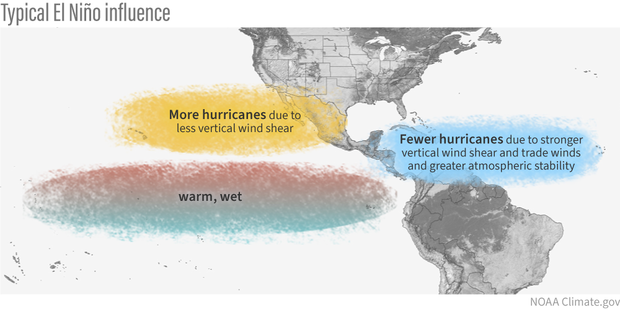
    When you have an El Niño, that means you have warmer-than-average ocean temperatures off the equatorial Pacific Ocean. In other words, the ocean is warmer than average off the coast of South America, extending to about south of Hawaii. That helps rip storms apart as they try to develop and move westward across the Atlantic.

    Secondly, the trade winds that blow from Africa to the Caribbean are stronger. That means more stability in the atmosphere and fewer storms. We are expecting to transition to El Niño during July or August, and we could even see a Super El Niño as we go into the late fall and winter. That impacts on our 2026–2027 winter forecast, which we wrote about in Shore Local April 2.

    Other hurricane season factors

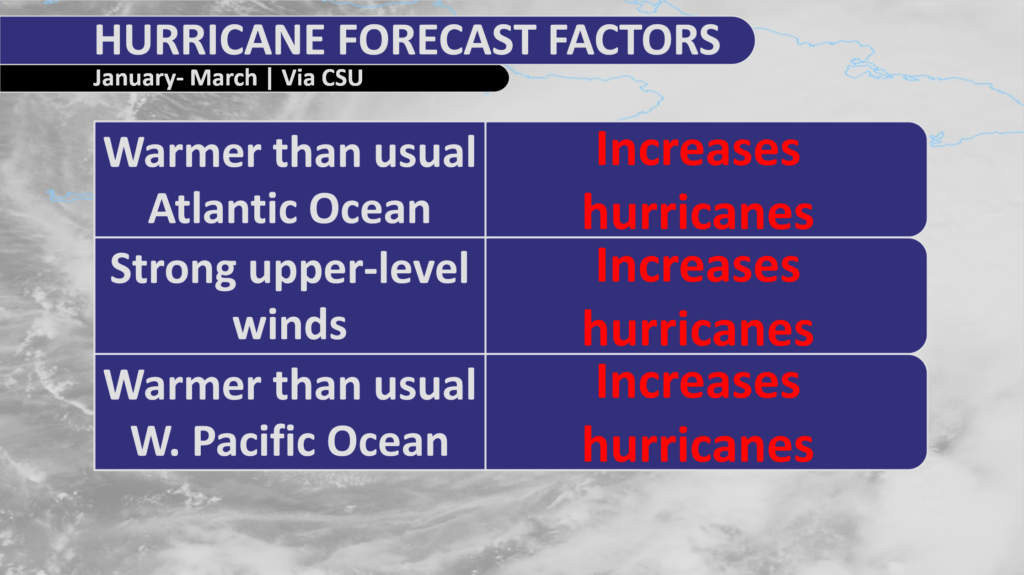
    Beyond El Niño, all other factors point toward more activity than usual.

    From January through March of this year, we had warmer-than-usual Atlantic Ocean waters, stronger upper-level winds and a warmer-than-usual western Pacific Ocean.

    All of that, for different reasons, increases the likelihood of more storms.

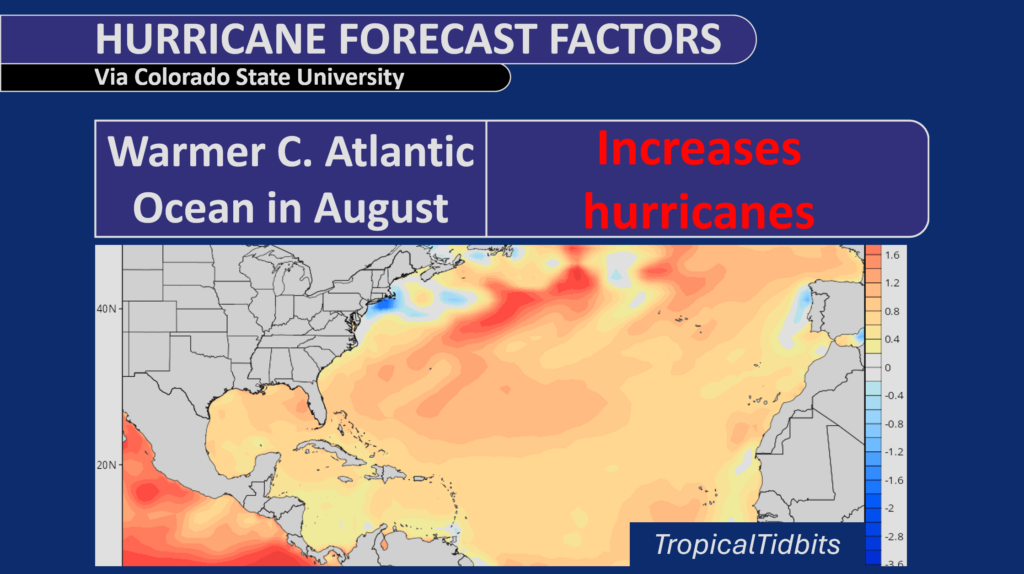
    As we get to August, temperatures are forecast to be warmer than average in the Central Atlantic Ocean. The Central Atlantic is the key breeding ground for the long-track hurricanes that go from Africa to the Caribbean, and possibly up the East Coast of the United States.

    So, imagine a tug of war – let us say one strong person matches up against four children. The El Niño-suppressing hurricane season is usually going to win out. However, you still have four smaller factors, the children, pointing the other way toward a more active season.

    Learning from history

    Colorado State University looks at analog years, or years with similar conditions going into the hurricane season as we have now. Four stood out to them.

    More of the analog years point toward a less active hurricane season.

    Another way to look at hurricane season

    Accumulated Cyclone Energy, or ACE, combines the intensity and duration of a storm into one number. The stronger a storm is, the higher the ACE.

    For example, Superstorm Sandy in 2012 had an ACE of about 13.5 on its entire journey from the Caribbean to a Brigantine landfall.

    Sandy lasted for eight days as a tropical cyclone, peaking as a major Category 3 hurricane. This did not even include ACE potential had Sandy been a tropical cyclone during the time of landfall.

    Meanwhile, Tropical Storm Fay in July 2020, which also made landfall near Brigantine, had an ACE of 1.5. Fay spanned just three days, and it was never more than a mid-range tropical storm.

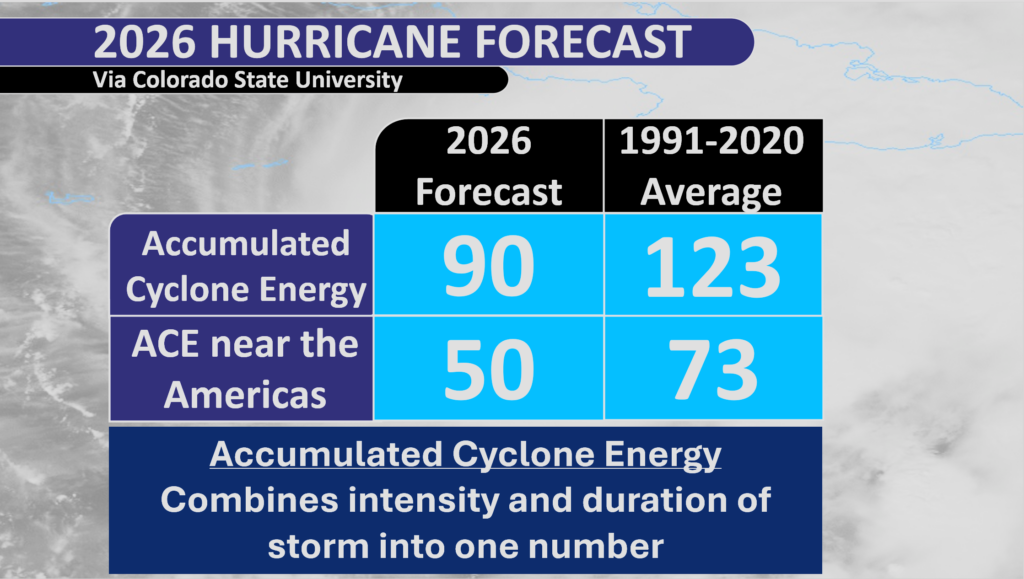
    CSU predicts a below-average year for total storm power, forecasting an Accumulated Cyclone Energy (ACE) score of 90 compared to the historical average of 123.

    Closing thoughts

    This forecast is good news for us at the Jersey Shore and for the entire Atlantic Hurricane Basin.

    But remember, it only takes one storm to hit New Jersey for it to feel like an active season near us. Even last year, where no hurricanes struck the United States, we still had Hurricane Erin bring the highest summertime tide on record for much of the South Jersey shoreline.

    NJ beaches generate billions in revenue, supporting thousands of jobs and businesses. If they erode, our economy collapses. Federal beach funding was cut in 2025. Only the American Coastal Coalition fights 24/7 in DC to restore it. Protect your beach and business. Join today: americancoastalcoalition.org

  • LiveNOW on FOX interviews us about the 2026 Hurricane Season forecast!

    LiveNOW on FOX interviews us about the 2026 Hurricane Season forecast!

    LiveNOW on Fox’s Andy Mac spoke to Meteorologist Joe Martucci about the 2026 hurricane season.

    Researchers at Colorado State University are predicting a somewhat below-average 2026 Atlantic hurricane season, running from June 1 to November 30, with 13 named storms according to their calculations.

    A special thank you to New Jersey’s own Katie Gallagher for the invite to the streaming channel!

    Our 24×7 Jersey Shore Weather Channel

  • How will developing El Niño impact NJ’s weather in 2026?

    How will developing El Niño impact NJ’s weather in 2026?

    Goodbye La Niña and hello El Niño – possibly a “super” El Niño.

    Expected between July and September, this shift in the Earth’s long-term weather patterns will define how we experience the upcoming hurricane season, as well as the snow and cold of next winter.

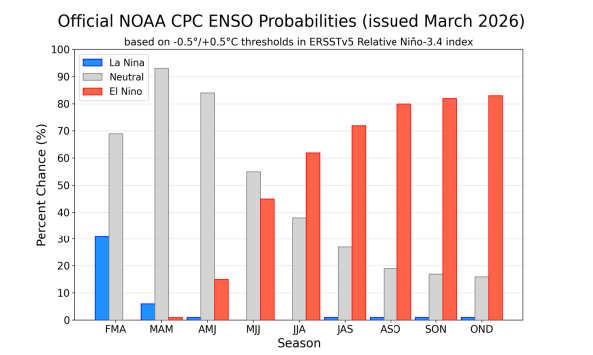
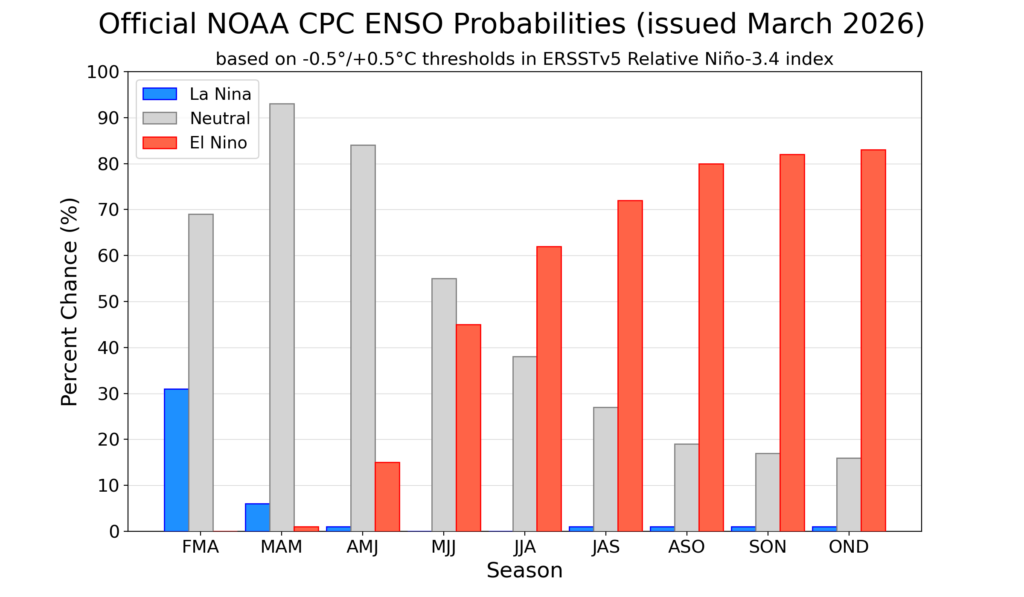
    Forecasters from the National Oceanic and Atmospheric Administration give El Niño a greater-than-60% chance of developing during the summer. By the fall, during the peak of hurricane season, it’s an 80% chance.

    By July, the chances of an El Nino developing are over 50% (via NOAA)

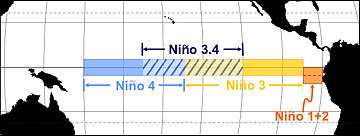
    El Niño or La Niña is part of the El Niño Southern Oscillation (ENSO). This refers to the water temperatures off the Equatorial Pacific Ocean, from roughly Peru westward 7,000 miles. When water temperatures are warmer than average, it’s El Niño. When it’s cooler than average, it’s La Niña.

    Via NOAA

    Meteorologists break this down into four different zones within the ENSO region. I won’t explain it much here, but where those warmer temperatures are this summer and beyond will make a slight difference in what our long-term forecast will be.

    Since the summer of 2024, we have been in La Niña. That typically means milder winters. However, both the 2024-2025 winter, and this past winter, were colder than average.

    The frozen tundra of snow and ice we experienced for weeks this past winter bucked the La Niña trend, too. For hurricane season, 2024 was more active than usual, while 2025 was about average. That checks out with a La Niña pattern.

    Let’s look at what El Niño will mean for both the 2026 hurricane season, and the 2026-2027 winter, plus what a “super” El Niño could mean for New Jersey.

    Quieter hurricane season likely

    When El Niño is present, hurricane activity in the Atlantic Hurricane Basin goes down; it’s that simple. The Atlantic Hurricane Basin averages 14 named storms – seven hurricanes including three major hurricanes (Category 3, 4 or 5) per season, per Colorado State University. Since 1990, there have been 11 hurricane seasons with El Niño. Seven were less active, while two were about average and two were more active.

    More than likely, this hurricane season will be as active or less active than average. With a 24% chance of the eye of a tropical storm or hurricane being within 50 miles of the Jersey Shore, that number should be lower as well. Hurricane season officially runs from June 1 to Nov. 30.

    During El Niño, there is stronger windshear in the tropical Atlantic Ocean. Windshear is a change of wind direction or speed as you go up from the surface. This, in short, rips apart developing cyclones.

    Winter temperatures

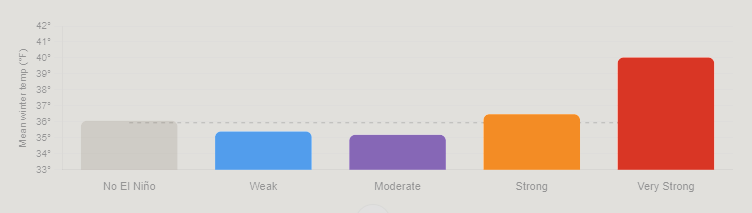
    The stronger the El Niño, the warmer the temperatures. By itself, El Niño doesn’t mean much for our temperatures during the winter. Since ENSO records began in the 1950s, winters with El Niño end up about average at Atlantic City International Airport and the Sen. Frank S. Farley State Marina in Atlantic City.

    However, when you look at the intensity of the El Niño, the pattern becomes clear.

    Very Strong: 4.0 degrees warmer than average

    Strong: 0.5 degrees warmer than average

    Moderate: 0.7 degrees colder than average

    Weak: 0.5 degrees colder than average.

    Mean temperature between December and February for Atlantic City International Airport and Sen. Frank S. Farley State Marina in Atlantic City, based on the intensity of the El Nino (graphic is from Claude Artificial Intelligence, via NOAA data).

    The stronger the El Niño, the warmer the temperatures. That’s because the Pacific jet stream – the river of air about 30,000 feet high that separates two airmasses – pushes into the Northeast. That means more opportunities for us to be south of the jet stream, taking in milder air.

    Winter snow: One clear signal

    Like winter temperatures, using El Niño alone doesn’t produce a big trend in what snow could look like for a winter. Generally, it’s a little less snowy than average. However, when you look at the type of El Niño, there is a trend that screams off the chart.

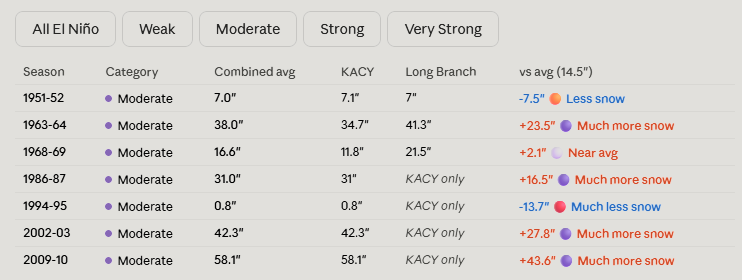
    When El Niño is in a moderate phase, it’s 13 inches snowier than average. For the South Jersey shore, that’s 25 to 30 inches of snow. Farther up the coast, that’s roughly 30 to 35 inches of snow.

    Here’s the snow breakdown for Atlantic City International Airport and Long Branch, by El Niño phase.

    Weak: 3.5 inches below average

    Moderate: 13.2 inches above average

    Strong: 3.4 inches below average

    Very strong: 0.2 inches above average

    Winter snowfall totals for the Jersey Shore, based on the intensity of the El Nino (graphic is from Claude Artificial Intelligence, via NOAA data)

    The last two moderate El Niño winters were 2009-’10 and 2002-’03. Both brought plenty of snow, and winter storms. That included:

    The Dec. 19 to 21, 2009 winter storm, which brought double-digit snowfall across the entire Jersey Shore.

    On Feb. 5-7, 2010, over 20 inches of snow fell roughly south of the Atlantic City Expressway. Meanwhile, New York City experienced less than 4 inches of snow.

    A few days later, the Feb. 9-11 winter storm brought over half a foot of snow to the shore.

    The Feb, 16-18, 2003, winter storm, known as the President’s Day II or PDII storm, dropped over 18 inches of snow on much of the Jersey Shore and ranks as the sixth strongest winter storm on NOAA’s Northeast Snowfall Impact Scale.

    Moderate El Niños sit in a weather sweet spot for winter storms in New Jersey. They enhance the jet stream’s pattern in a way that funnels nor’easters up the coast without warming the region enough to flip precipitation to rain.

    What if a ‘super’ El Niño arrives?

    There is no guarantee that a very strong El Niño, or what people call a “super” El Niño, will come this winter. However, given the confidence of El Niño developing late this year, it’s worth exploring. Severe-Weather.Eu has a nice writeup on it.

    If one does form, expect a mild winter with a low number of nor’easters. However, when nor’easters do hit, expect plenty of rain, wind or even snow.

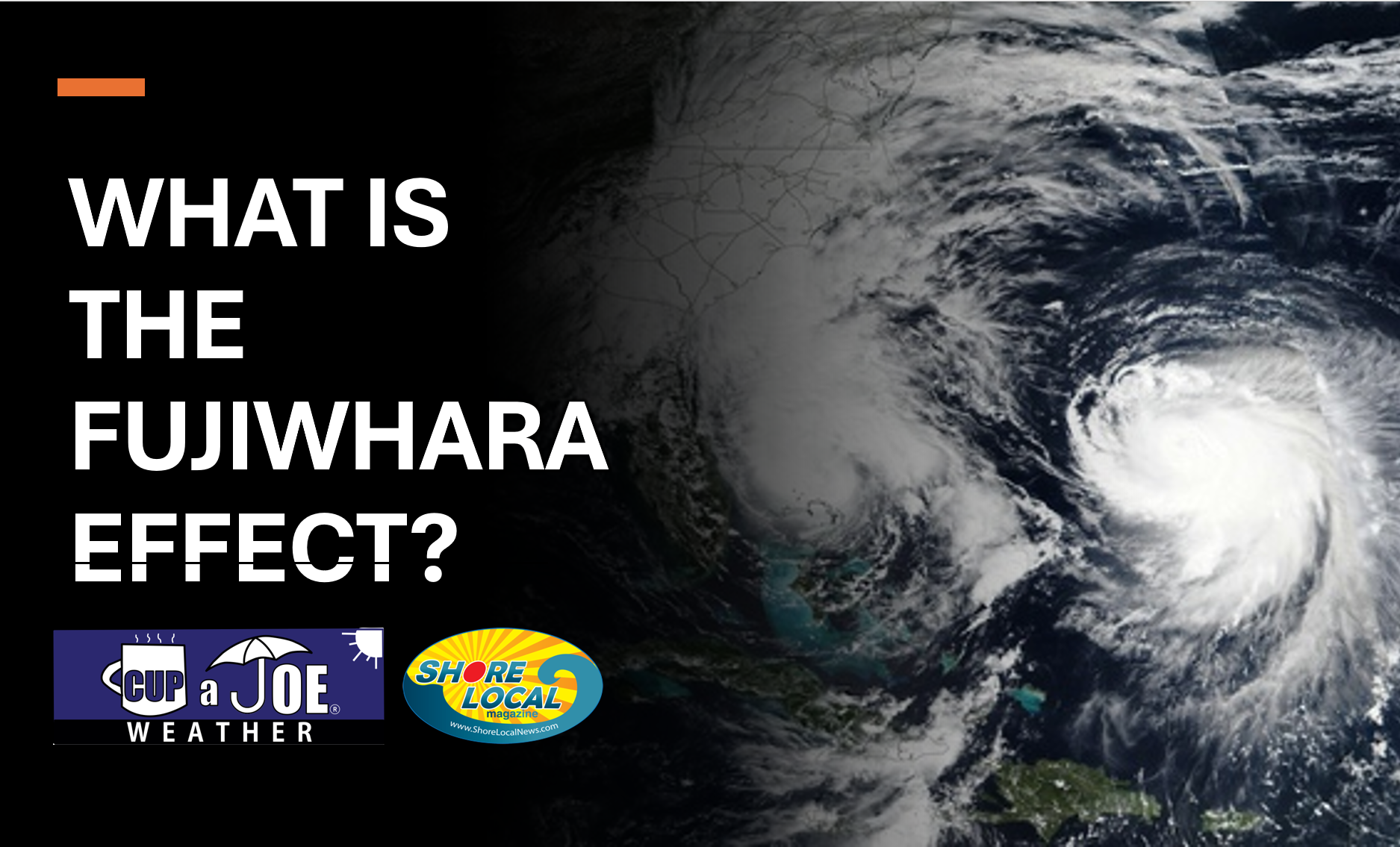
  • The Fujiwhara Effect: When 2 tropical cyclones collide

    The Fujiwhara Effect: When 2 tropical cyclones collide

    This article initially appeared in Shore Local News on 10/2/2025. The article was update to include more current information from Imelda and Humberto on 10/2/2025

    Last week, I mentioned on my digital and social weather channels that Hurricanes Humberto and Imelda could undergo a rare interaction called the Fujiwhara Effect.

    Humberto and Imelda partially made this happen, but not completely. Either way, it doesn’t matter for our Jersey Shore weather forecast. A powerful arctic, high-pressure system kept the rain away from these two storms. However, there were gusts to 40 mph and coastal flooding on Oct. 1 and bad surf continues into the weekend.

    The Fujiwhara Effect, like polar vortex, heat dome and derecho before it, brings a new weather word into public discourse. And for your Shore Local meteorologist, it means I get pumped to explain a new-to-many weather phenomenon.

    What is the Fujiwhara Effect?

    “The tendency of two nearby tropical cyclones to rotate cyclonically about each other as a result of their circulations’ mutual advection,” The American Meteorological Society’s Glossary of Meteorology says. However, let us break that down even more.

    Think of the Fujiwhara Effect as a square dance. Instead of pairs of dancers, they are pairs of tropical storms or hurricanes.

    In square dancing, pairs of dancers spin and move in patterns together. The same is true with the Fujiwhara Effect. Instead of a caller’s instructions, though, storms follow nature’s rules.

    Technically, the Fujiwhara Effect happens when storms are within 900 miles of each other’s circulation. That is the distance from Ocean City, N.J., to Tampa, Fla. That is not much in the vast expanse of the Atlantic Ocean.

    The two storms’ counterclockwise (Northern Hemisphere) or clockwise (Southern Hemisphere) winds will start to spin closer to each other. Once they are about 200 miles apart, one of three scenarios happens:

    1.           The larger storm will absorb the smaller storm into its circulation.

    2.           The two storms will merge, creating one more powerful storm.

    3.           Both storms will weaken due to the increase in wind shear or change of wind direction with height.

    The Fujiwhara Effect is named after Sakuhei Fujiwhara, a Japanese meteorologist who first described this phenomenon as a theory in a 1921 research paper. Turns out his theory was correct.

    Where does the Fujiwhara Effect occur most often?

    The northern Pacific Ocean is the place where it happens the most, the American Meteorological Society reports.

    The Pacific Ocean, specifically the western Pacific Ocean, is the world’s most active tropical cyclone basin, thanks to its very warm water and humidity. Plus, since the Pacific Ocean is the world’s largest ocean, more storms can simply spin around there, and potentially come into contact with each other.

    It is rare to have the Fujiwhara Effect in the Atlantic Hurricane Basin. Records are not kept on them, but they happen only once every couple of years. Compared to the Pacific Ocean, there is less area for tropical storms or hurricanes to develop.

    Also, our ocean has just one main storm track: Off the West Coast of Africa to the Caribbean Islands, turn north between the United States East Coast and Bermuda, and then northeast into the northern Atlantic Ocean. This gives less opportunity for storms to cross paths.

    Notable Fujiwhara Effect storms

    The Fujiwhara Effect likely took place in the Atlantic Hurricane Basin in 2016 when Hurricane Matthew and Tropical Storm Nicole interacted. They did not fully dance with each other, however, Matthew’s path shifted a bit, which brought major flooding to the East Coast of Florida.

    The last time on record that Atlantic storms underwent a full Fujiwhara Effect was in 1995 with Hurricanes Iris and, fittingly for this article, Humberto. On Aug. 23, 1995, Hurricane Iris was on a northern path from the Lesser Antilles in the tropical Atlantic Ocean. Then it interacted with Humberto. The Fujiwhara Effect took place, jolting Iris 300 miles to the east.

    Both storms weakened with the Fujiwhara Effect. After the interaction, Iris was downgraded to a tropical storm, while Humberto was downgraded from a Category 2 to a Category 1 hurricane.

    In the eastern Pacific Ocean, closer to North America, Hurricanes Hilary and Irwin in July 2017 showed a good example of the Fujiwhara Effect when the two made a full pivot around each other as they moved north up the Mexican coastline.

    The storms did not merge. They ended up weakening, in part due to the Fujiwhara Effect, and in part due to moving over cooler water.

    Joe Martucci, a Certified Broadcast Meteorologist and Digital Meteorologist, is the President and Director of Meteorology for Cup A Joe Weather and Drone. You can connect with him at cupajoe.sparkable.opalstacked.com/.