Tag: polar vortex

  • With polar vortex unlocked, NJ likely gets a frigid start to winter

    With polar vortex unlocked, NJ likely gets a frigid start to winter


    Stream the Jersey Shore Live Weather Channel for free!

    The polar vortex has been poked and distributed in the stratosphere. Now it’s a waiting game as rounds of Arctic air run through New Jersey, reload and sweep through the Northeast again for much of December.

    As of Nov. 30, the time of this writing, it was unknown whether the Sudden Stratospheric Warming (SSW) occurred near the North Pole. If the stratospheric polar vortex were disturbed so much that its westerly winds reversed course, causing the SSW, and it happened in November, it would be the earliest in the satellite era (1968).

    Either way, though, the polar vortex’s spinning top at the North Pole was disrupted. Much warmer-than-usual air filled into the Arctic about 100,000 feet high. The stratospheric polar vortex stretched south into North America. Specifically, it moved into Western Canada and Alaska.
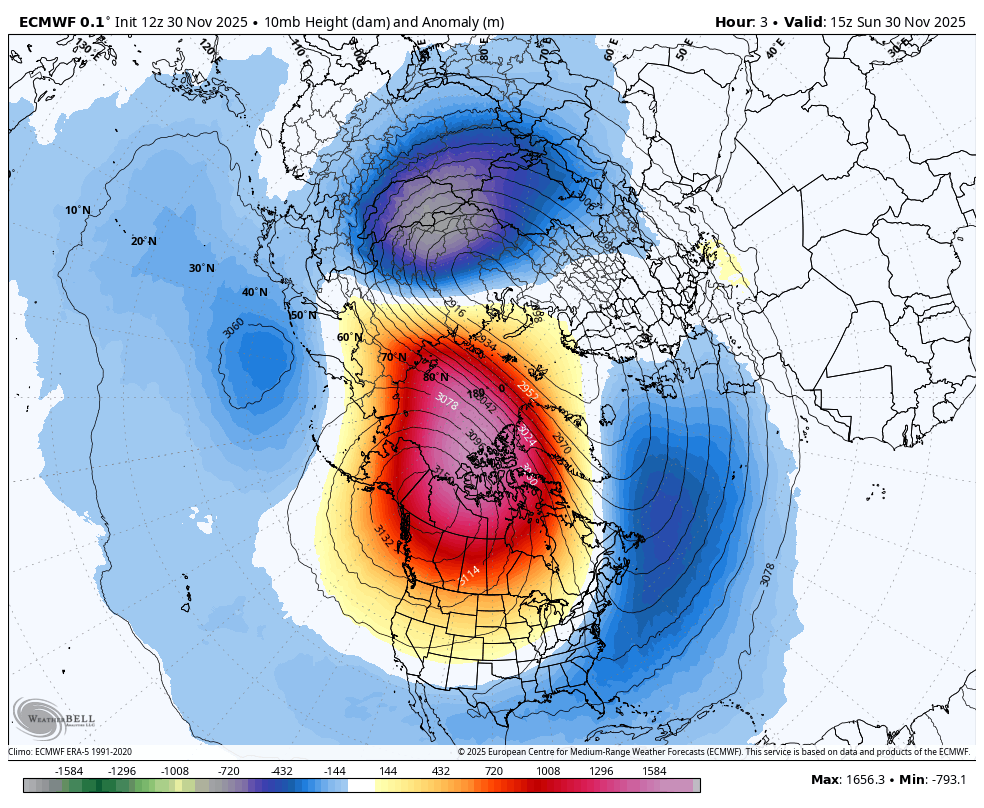
    The height above sea level where you reach 10 millibars of pressure (lines) with its departure from average in blue, yellow or red for Nov. 30. Notice the red area in Western Canada and Alaska. That’s where the center of the polar vortex was (via WeatherBell).

    The extremely cold air in the stratospheric vortex almost never mixes directly down to the surface. Instead, the SSW changes the large-scale circulation, which then allows pre-existing surface-level Arctic air (from northern Canada, Siberia, etc.) to plunge southward in the troposphere.

    As of Nov. 30, that Arctic air had surged south from the North Pole to Hudson Bay and Quebec, Canada, according to Ryan Maue, a meteorologist and climate scientist at WeatherTrader.

    The jet stream, the river of air about 30,000 feet high, which separates polar and tropical air masses, then becomes wavy, moving south to north, to south again. The jet stream is in the troposphere.

    That clash of warm and cold air from the jet stream also causes cold-core storms, like a nor’easter to form at the surface. For now, though, let’s focus on the cold.

    When will cold air outbreaks occur at the Jersey Shore?

    There are three times for colder-than-average temperatures:

    1. A continuation of the current cold through Dec. 6

    2. Dec. 8-10

    3. Dec. 14-18

    These aren’t long stretches of cold, however, it will be 10 or more degrees below average for many of those days. That translates to high temperatures in the upper 30s to low 40s. For low temperatures, this means lows on either side of 20 degrees inland. Meanwhile, the shore would see lows of 25 to 30 degrees.

    Remember that our coldest day of the year, on average, occurs in the second half of January. So, while they don’t sound extremely bitter for late January standards, this is not what it should feel like in early December.

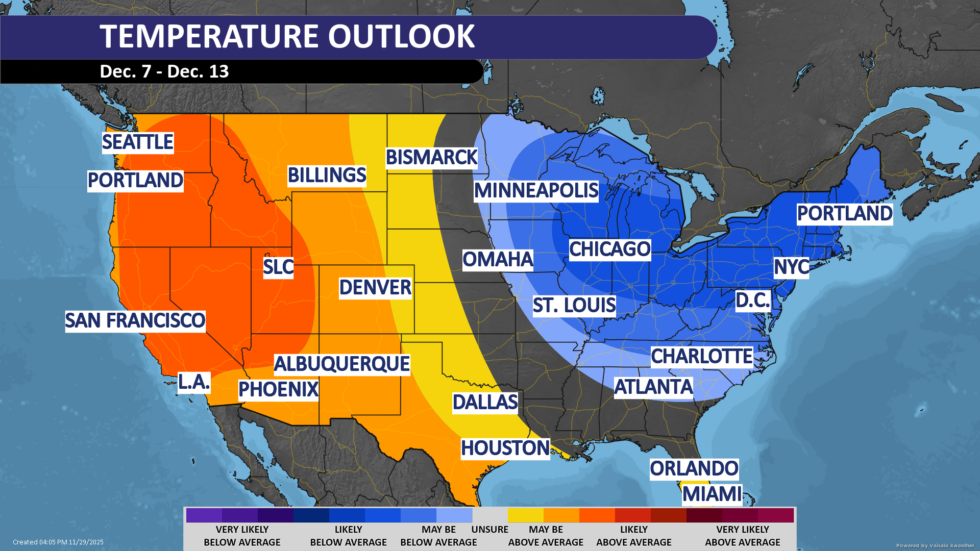
    The National Oceanic and Atmospheric Administration (NOAA), forecasts Dec. 7-13 to be below average for the Northeast and Great Lakes states. However, NOAA has the most confidence on below-average temperatures for every county in New Jersey except for Cape May County – a sign that the Cape May Bubble is still strong year-round.
    All kidding aside, it will be a chilly start to climatological winter, which runs from Dec. 1 to Feb. 28, the coldest three months of the year, on average.

    Forecasting what days snow will fall at the Jersey Shore more than five days out is nearly impossible. I won’t do that. However, there are two forces at play. How much snow we see, or don’t see in December will prove which force was stronger.

    A colder-than-average December is simply better for snow than a warmer-than-average December. It gives you more opportunity for snow. It’s that simple.

    On the other hand, a pattern appeared in November. When it’s dry, it’s colder than average. When there is precipitation, it’s at or warmer than average. That cold and dry, or mild and wet pattern drives snow lovers crazy. It’s a function of the storm track being at or west of New Jersey. That brings more southerly, warmer winds around counterclockwise-spinning storms.

    At the Sen. Frank S. Farley State Marina in Atlantic City, 10 days also had precipitation in November. Eight of them were above average or within a degree of average, according to NOAA. Ten days of precipitation also happened at Atlantic City International Airport; six of them were above average or within a degree of average.

    To see how the polar vortex could interact for yourself, go to a weather forecast model website like WeatherBell (subscription needed) and look at the 2PVU (potential vorticity units) forecast, which looks at the boundary between the troposphere and the stratosphere.

    Where you see the blues and purples indicates the outline of the polar vortex boundary. In a strong polar vortex, it is compact, circular and centered near the Arctic. If it’s not, like the first half of December, that means the polar vortex has weakened, which eventually allows frigid air at the ground to spill places south.

    Joe Martucci, a Certified Broadcast Meteorologist and Digital Meteorologist, is the President and Director of Meteorology for Cup A Joe Weather and Drone. You can connect with him at cupajoe.sparkable.opalstacked.com/.
  • Record setting phenomenon threatens cold, polar vortex in NJ this December

    Record setting phenomenon threatens cold, polar vortex in NJ this December

    Blasts of frigid for December air may be NJ’s reality this December thanks to an unusual chain of events bringing the polar vortex.

    Meteorologists like me are keeping a close eye on the sky above the North Pole. We’re watching for something called a sudden stratospheric warming (SSW). If an SSW happens, it’s like poking a big, spinning cold-air circulation called the polar vortex.

    When you poke it, the vortex can wobble and send frigid air south. That cold air could slide all the way down to New Jersey in the middle of December. If it does, we would get temperatures that are way colder than normal.

    “If a full SSW is achieved in November, as predicted by the ECMWF (European Centre for Medium-Range Weather Forecasts), that would be the first time in the satellite era (post 1979),” said MIT climatologist Judah Cohen in his blog Nov. 18. (Dr. Cohen was also our guest on Tidal Flooding Talk on Nov. 25)

    If this occurs, that means December will be more like “Decembrrr,” with it “beginning to look a lot like Christmas,” as the Perry Como song goes.

    What is sudden stratospheric warming?

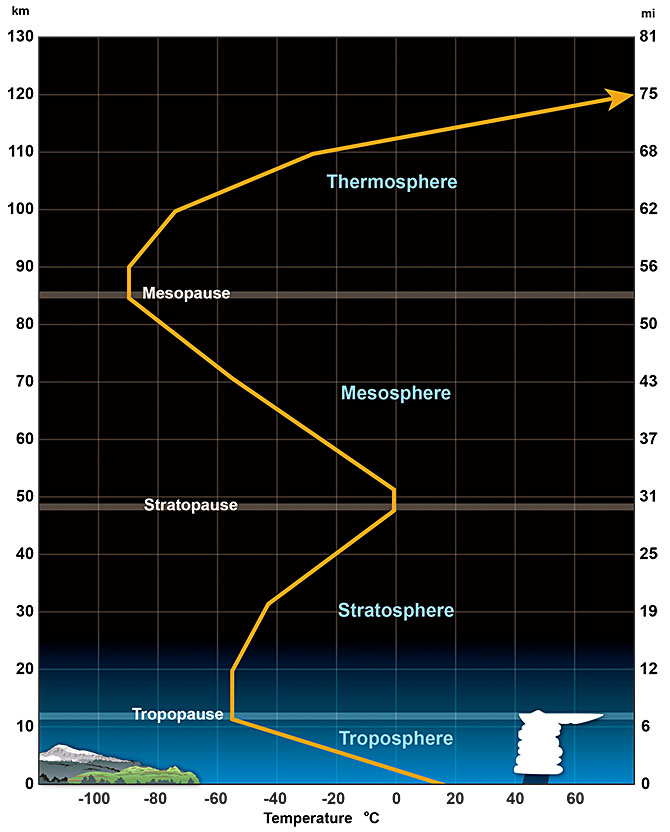
    Sudden stratospheric warming is a process in which the temperature of the stratosphere, the second lowest layer of Earth’s atmosphere, warms quickly. Typically, this is about 30 to 50 degrees within a week.

    The layers of the atmosphere on Earth (Via NOAA)

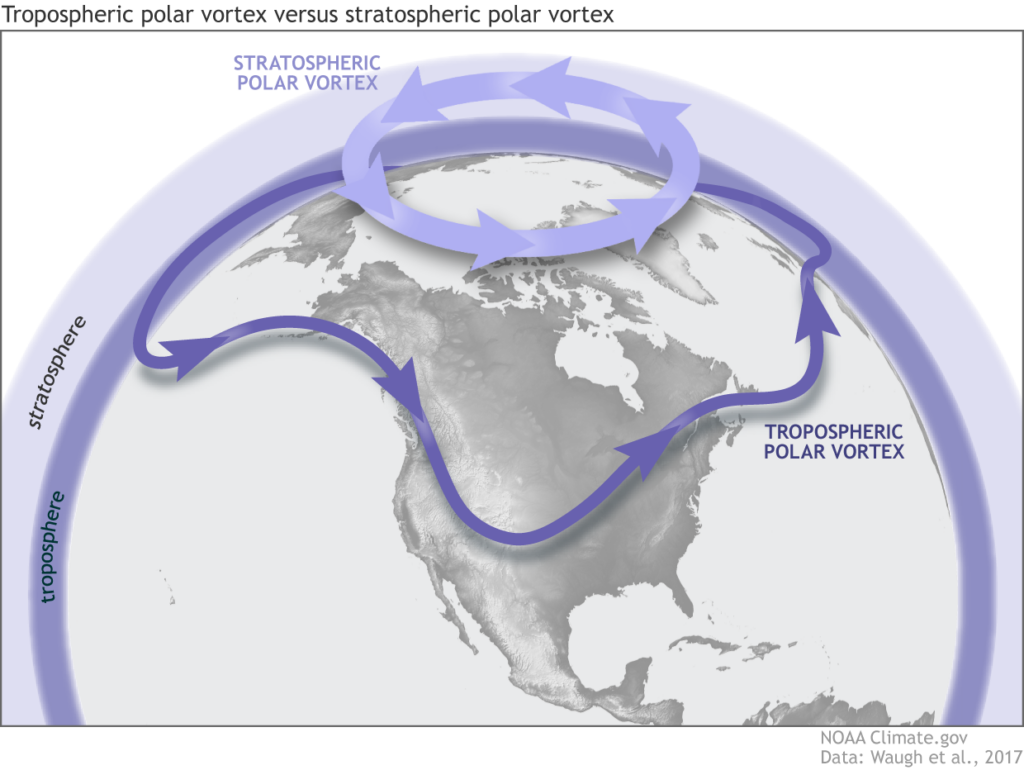
    When this occurs, the polar vortex — the spinning area of very cold, westerly winds in the stratosphere that typically sits over the North Pole — is disrupted. When that happens, it can do one of the following:

    1. Split into two or more pieces, pushing south from the North Pole.
    2. Winds weaken dramatically or even reverse and come out of the east.
    3. Stretch itself farther south.
    When you hear that the polar vortex is disrupted, that means the stratospheric polar vortex. The stratospheric polar vortex likes to spin counterclockwise at the North Pole in the Northern Hemisphere. However, can be disturbed by a SSW event (Via NOAA).

    Note that SSWs can only occur during roughly October to April, when the polar vortex is strong. Outside of this time, the polar vortex is weak and essentially hibernates for the warm season.

    What does polar vortex disruption mean?

    When the polar vortex is disrupted — in this case by sudden stratospheric warming — the stratospheric vortex can shift over parts of the Northern Hemisphere, usually between 40 and 65 degrees north latitude. The Jersey Shore sits between 38.9 and 40.5 degrees north latitude.

    The extremely cold air in the stratospheric vortex almost never mixes directly down to the surface. Instead, the SSW changes the large-scale circulation, which then allows pre-existing surface-level Arctic air (from northern Canada, Siberia, etc.) to plunge southward in the troposphere.

    The jet stream – the river of air about 30,000 feet high which separates polar and tropical air masses – becomes wavy, moving south to north to south again. The jet stream is in the troposphere.

    That clash of warm and cold air from the jet stream also causes cold-core storms, like a nor’easter, to form at the surface. Put that on the East Coast and position the cold air from the jet stream exactly right, and New Jersey has a snowstorm.

    However, not all polar vortex disruptions impact New Jersey, or even the East Coast. The frigid cold can spill into the Great Plains, like it did in February 2021 when much of Texas was without power. It can go to Europe, or Asia, too.

    How often do sudden stratospheric warming events occur?

    SSWs have about a 50% chance of happening in any given winter. The Washington Post says it happens once every other winter, on average.

    When they do happen, they’re typically in January or February. As MIT’s Cohen said, never in the satellite era has an SSW event happened in November. November SSWs were observed in 1958 and 1968, but in an era before high-tech weather satellites, high-altitude airplane observations and more, this isn’t a reliable claim.

    The most recent SSW event in the Northern Hemisphere was in early March of this year. It quickly brought the end of the polar vortex season. In fact, it was the second earliest SSW to end the cool season since 1958.

    However, it didn’t mean much for New Jersey. March was well above average up and down the state. The polar vortex, and its impacts, went to Europe instead.

    What do early sudden stratospheric warmings mean for N.J.’s winter?

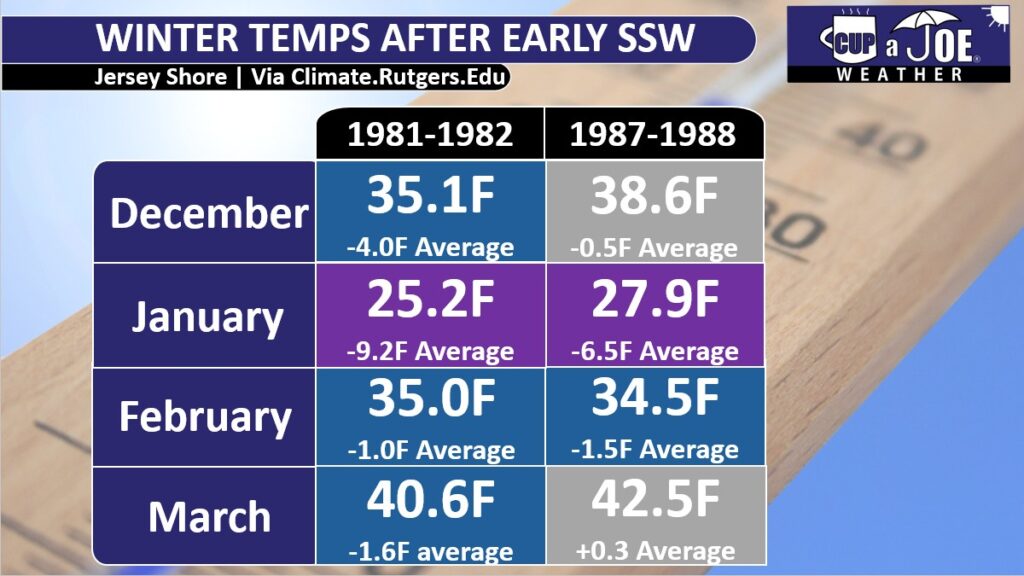
    Two winters had SSWs in early December: 1981-1982, and 1987-1988, according to Cohen.

    Both of those followed the same pattern when it came to temperatures. January was at least 6.5 degrees colder than the current average. January 1982 was the sixth coldest January on record for the Jersey Shore going back to 1895, according to the Office of the New Jersey State Climatologist.

    February was also below average, but less so, between 1 and 2 degrees.

    December and March had differences, too. In 1981-1982, both months were colder than average. December was a whole 4 degrees below average.

    The winter a few years later saw above average temperatures for December and March.

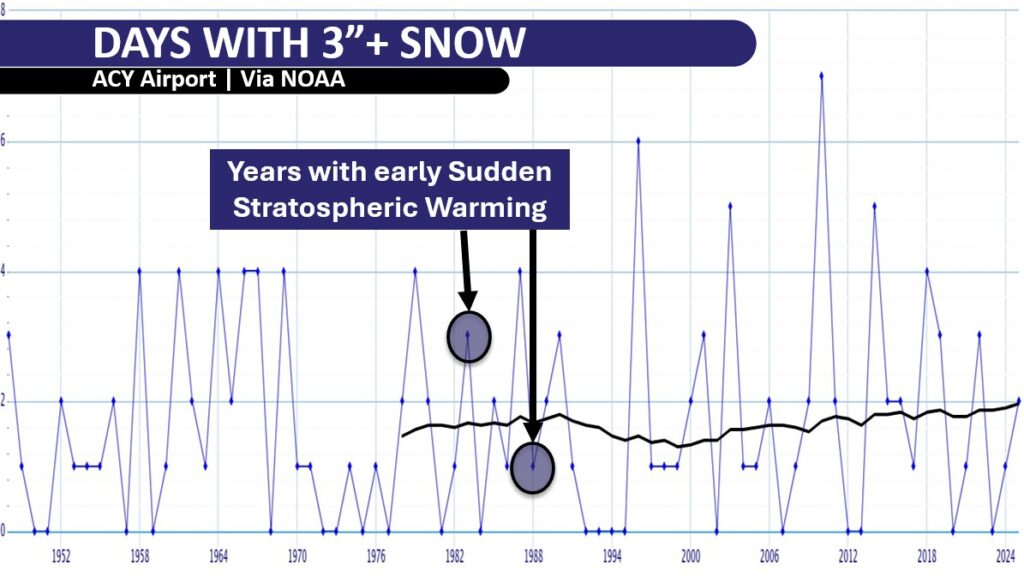
    All that cold doesn’t translate to snow, though. Both the winters of 1981-1982 and 1987-1988 saw two days with more than 3 inches of snow at Atlantic City International Airport, according to the National Oceanic and Atmospheric Administration. That’s about average.

    Other parts of the shore had the same fate. In Lower Township, Cape May County, 3 or more inches of snow occurred on just one day in winter 1981-1982. The 1987-1988 winter had two days.

    Long Branch, Monmouth County, only had data for the winter of 1981-1982. However, even there, 3 or more inches of snow occurred twice, which is below average. Big cold doesn’t always translate to big snow.

    What can we expect this december?

    Like my winter outlook story said, we need to watch for an early start to the cold and perhaps snow in the first few weeks of December. First, we have to wait and see if that sudden stratospheric warming (SSW) happens this week up in the Arctic.

    If it does happen, follow me online for updates. I’ll watch where that super-cold Arctic air will rush down to the ground. We will know by the first few days of December if that cold air is heading for New Jersey or not.

    If it does come to New Jersey, it would mean an extended period, or maybe a few prolonged periods, between Dec. 10 and Dec. 31, when it is much colder than average. We are talking daytime highs only in the 30s. At night along the shore it would drop to the 20s, and inland it would get down to the teens when clear.

    We are still weeks away from the coldest part of winter, so those numbers are pretty cold for December.

    It is still too early to make a clear snow forecast. However, temperatures in the 30s are much better for snow than temperatures in the 50s. So if we get that cold air, I expect at least some snow that sticks to the ground.

    Stay tuned for more updates, and Happy Thanksgiving to you, your friends and your family. Enjoy the free $400 ShopRite turkey.

    Joe Martucci, a Certified Broadcast Meteorologist and Digital Meteorologist, is the President and Director of Meteorology for Cup A Joe Weather and Drone. You can connect with him at cupajoe.sparkable.opalstacked.com/.