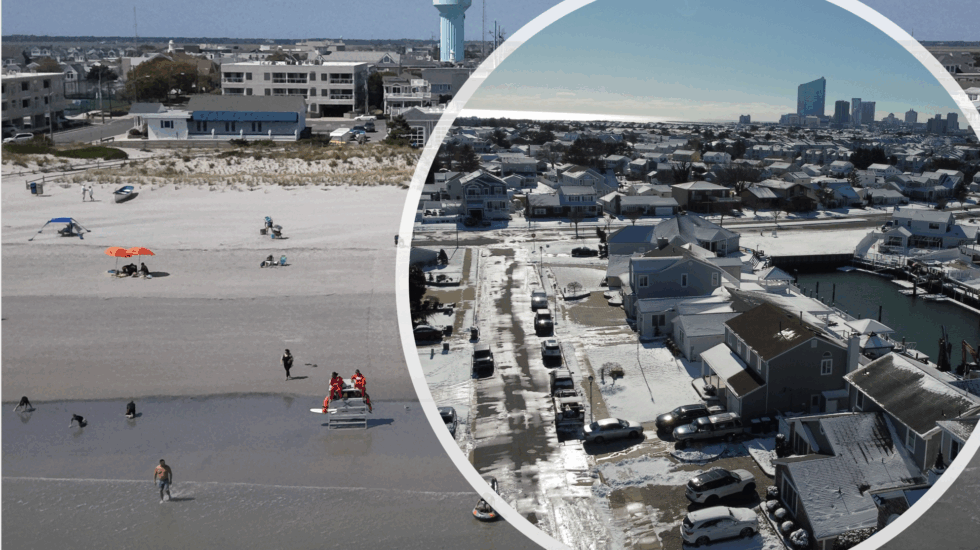
If you’re a summer resident or visitor to the Jersey Shore, it’s possible you’ve never experienced tidal flooding like this in your lifetime.
Margate was the most significant location for flooding on the entire shore. A transformer fire, electrical fire, six vehicle rescues, evacuations out of Sofia’s and Tomatoes, and a gas leak occurred, according to the Margate Fire Department. Water rescues occurred on the Black and White Horse pikes between Atlantic City and the Mainland.
Looking at tide gauges for June, July and August, Hurricane Erin brought the highest storm surge on record to the following locations:
Absecon, Atlantic City (Inside Thorofare), Sea Isle City, Avalon, Stone Harbor, Cape May (bayside) according to the National Oceanic and Atmospheric Administration.
If you weren’t in these locations, then it was the highest summertime flooding since Tropical Storm Irene impacted north up the Jersey Shore in August 2011.
The National Weather Service classifies flooding into three categories: minor, moderate and major. This was at the very high end of moderate.
Moderate flood stage is when traveling around our coast is downright difficult. I was in Sea Bright, Monmouth County on Thursday night, reporting on the storm. Route 36, the main road in town, was washed out going south, causing us to exit the island north, near Sandy Hook instead. It was also bringing water into unraised homes and businesses.
While moderate floods happen during the year, it’s almost always during nor’easter season, October to April, when fewer of us are at the shore. If you are here, it’s likely you’re not going out as much.
Still, even this tide was unusually high, ranked among the top 10 highest tides of any month on record in Atlantic, Cape May and Cumberland counties.
THURSDAY’S FORECAST | Cool. Comfy. Those are the two ways to describe the weather this week so far, and most of the next 7-days, too. One round of rain is in the forecast for Labor Day Weekend and it’s not even much. Let’s talk!
Follow my work: www.cupajoe.live Jolt your brand, advertise with me: joe@cupajoe.live

Rutgers football is back and it feels so good, especially when it’s Thursday, R night! Planet Earth will give us winning weather. Stay until the end to see what historical weather tells us about dry week 1 home games with these temperatures, too. You’re going to love our new weather scenario generator.
Located just 1/3rd of a mile from SHI Stadium, the St. George Greek Orthodox Church is THE place to park and tailgate for Rutgers football games! Lots of space, clean bathroom and excellent service. Reserve your space at www.rutgersparking.com.
WEDNESDAY’S FORECAST | Just in time for Pumpkin Spiced Lattes to come out, our *driest* air of summer comes today, feeling more like Autumn than the waning days of August. Watch and tune in!
Dominate your fantasy leagues and bets with weather-driven data. MeteoOdds gives you innovative tools, player/game weather impacts, and detailed forecasts. Join FF+ by using the code WEATHER and get 50% off, for life! Turn forecasts into fantasy wins — only at www.meteoodds.com.
Today is the first of three bad days for the beaches. A tropical storm warning is in effect for the waters. Meanwhile, on land, we have a variety of surf and coastal flooding alerts out to keep us prepared. Let’s talk about what’s ahead, and the weekend.
Never worry about missing severe weather warnings again. Get a recorded call from me when your location is impacted. WeatherCall ensures you stay informed for just $15 a year. Sign up: https://ngorder.wxriskalerts.com/db_app2.php?station=cajx
I was on the phone with a Beach Patrol Captain Monday morning, talking about what Hurricane Erin would mean for the coastline.
His answer: We get these kinds of storms during the winter, but no one is in the water to experience the fury of the ocean.
Let me get this off the top. Swimming or boating in the ocean will be downright dangerous through Saturday and possibly into Sunday. Two people died in the surf the week of Aug. 11, one in Seaside Heights and one in Belmar. The waves weren’t even that rough. Using a personal watercraft (Jet Ski or Wave Runner) in the inlets will be dangerous, too.
Of less danger but still important, you’ll need to set up your beach chairs and towels closer to the dunes than usual. It’s possible salt water even reaches the dunes at high tides. Coastal flooding will be around each evening through Saturday.
This week’s indirect blow from Hurricane Erin is a good reminder of what the Jersey Shore experiences when the joy of summer here fades away, when the days turn gray and storm season eats at the sand. If you’re not a full-time resident in a beach town, this is what we experience in December or February, when the crowds are thin.
Hurricane Erin became a major hurricane, a category three, four or five hurricane, on Saturday, Aug. 16 with the 5 a.m. National Hurricane Center update.
The Saturday, Aug. 16 5 a.m. update from the National Hurricane Center on Hurricane Erin, the first time she became a major hurricane (via the National Hurricane Center).
Erin was the first Cabo Verde hurricane of the year. Cabo Verde storms are the long track cyclones that originate off the West Coast of Africa, near the Cabo Verde Island. They then move west along the trade winds for days. From there, it either goes into the Caribbean Sea or Gulf. Alternatively, they curl northwest, north than northeast, parallel to the East Coast of the United States (major exception: Superstorm Sandy in 2012).
The Cabo Verde islands are outlined in red on the bottom right of the map. It’s located off the west coast of Africa (via Google Maps)
Erin’s will pass between Bermuda and North Carolina on Thursday, forecast by the National Hurricane Center to remain a major hurricane. It then only slowly weakens as it moves northeast, moving faster when it does so.
By the time it reaches the latitude of the Jersey Shore (roughly 39 to 40 degrees north latitude), it’ll be between 500 and 700 miles to our east. However, the storm will be stronger than usual for our latitude.
There are four reasons why Hurricane Erin will bring the most hazardous waters to New Jersey in years.
1) We won’t see rain. You can’t see the storm.
2) It’ll be breezy through Friday, and windy Thursday. However, it won’t cause wind damage or power outages. If you’re not looking at the ocean, it doesn’t look dangerous out.
3) This week is busier than usual for the coastal communities. Most summer camps are over, and most schools aren’t in session. The Beach Patrol Captain I spoke with said that.
4) The ocean is warm and enticing to go into. It continues to be one of the warmest, if not warmest on record for the Memorial Day to Labor Day period, according to Meteorologist Jim Eberwine of Absecon (also my weather-dad). Water temperatures have been well into the 70s.
For the boaters
Significant wave height forecast forecast from government run computer forecast models (Via Ventusky).
A small craft advisory is in effect until Friday evening by the National Weather Service. It’s possible it will extend to Saturday.
The bays will be better but since smaller boats are in the bay, it will be hazardous, too. Seas will be three to five feet. For reference, the bay is typically one to two feet. There will be a big chop on the water, particularly late in the week.
For the surfers and swimmers
Hurricane Lee’s impacts on the ocean were seen Thursday in Atlantic City. Drone footage over and near the Atlantic Ocean shows high waves with foamy, white seas. Hurricane Lee will make landfall in either Maine, New Brunswick or Nova Scotia Saturday night, but impacts will be felt at the Jersey Shore until early next week. (Via Joe Martucci)
Surf heights will be at or over 5 feet until Saturday. Typically, the surf heights are less than three feet.
Not only will the waves be big, but they’ll have power to them. The wave period, which is the time it takes for two waves to pass one point, will be over 10 seconds through Saturday. It’ll peak for over 15 seconds on Thursday. The longer the wave period, the more ability it has to carry more water, making it more powerful. This also brings a very high risk for rip currents.
For reference, there will usually be a high risk of rip currents at nine seconds and a moderate risk after seven.
Surfers love these big waves. However, with winds in nearly the same direction as the southeast swell through Friday morning, these won’t give the clean waves surfers craving. Again, it’s dangerous and I don’t recommend anyone going in the water.
Your beach may show a red flag for an oceanic “high hazard”. It may also show a double red flag. That means the water is closed for public use.
You can expect to see many red or “red over red” (double red) flags on the beach this week due to Hurricane Erin (via United States Lifeguard Association)
“It’s going to look like a washer machine out there,” Eric Hoeflich, of the National Weather Service in Mount Holly, which covers the Jersey Shore, texted me. That’s true. Hurricane Lee in 2023 did have a white, sudsy look to the waves.
Again, the bay beaches will be the better place to get your sea water fix in.
For all people in a town that borders a bay
Coastal flooding will continue to extend until Saturday. This will mainly be during the evening high tides (find your flood forecast here). For two to three hours, expect up to six inches of salt water on low-lying bayside roads. This is the typical, or nuisance flooding, we see several dozen times a year. However, this is mainly from October to April, when some of you may be away from the Jersey Shore.
The blue areas indicate where you can see salt water at least covering the ground during minor flood stage in Ocean City (via ClimateCentral).
Be aware of Thursday evening’s high tide. Expect four to six hours of flooding here. Furthermore, prepare for moderate flood stage. This is when unraised buildings and homes begin to take on water. Up to ten inches of salt water are on low-lying roads and even roads that don’t typically flood do. In short, moving around the bayside towns is challenging for a stretch.
The blue areas indicate where you can see salt water at least covering the ground during moderate flood stage in Ocean City (via ClimateCentral).
Still, Enjoy the Jersey Shore
The Ventnor City Beach Concert at Ski Beach. The concerts, which take place on Wednesday evenings until the end of August, are a great way to spend time at the shore while the waves churn from Hurricane Erin.
The boardwalks will still be good. Ride the rides, eat the saltwater taffy, have a hurricane at the bar.
Daytime temperatures will be in the low to mid-70s. So, it’ll still be comfortable for a cookout, basketball or long runs.
In short, as long as you stay out of the water, there will be plenty of ways to enjoy this summer week.
FRIDAY’S FORECAST | We need to recap last night’s rain because who did and didn’t rain was a *sharp* gradient. Then, we get to this weekend’s weather, which will be mostly dry, again! Next week gets rough in the water, as Erin gets closer to NJ.
Follow my work: www.cupajoe.live Jolt your brand, advertise with me: joe@cupajoe.live

THURSDAY’S FORECAST | It’ll look like rain, it’ll feel like rain. Heck, it might even smell like rain. However, it’ll only be spotty showers, with a few embedded downpours today. Tune in to see what your generic phone app won’t tell you about our upcoming weather. Follow my work: www.cupajoe.live Jolt your brand, advertise with me: joe@cupajoe.live

It’s a story that is told often in Cape May County.
You’re out by the water and you see storm clouds to the west. Your weather app on your phone flashes in bright oranges and reds, showing the heavy rain. It’s moving toward Ocean City, or Reeds Beach or Cape May Point.
But as the minutes go by the storm never comes. The radar turns light green, or maybe blank as the rain disappears.
That’s the Cape May Bubble at work, and there’s hard, scientific evidence that it’s a real phenomenon in the area. Compared to the rest of the state, the temperatures, and the number of thunderstorms and snow storms, are simply different here.
Cape May County geography matters
Cape May County is on a peninsula, surrounded by water on all three sides (Delaware Bay to the west, Atlantic Ocean to the south and east). Yes, New Jersey is also technically a peninsula, but the vast bodies of water around our southernmost county drive much of the weather we see.
Water warms and cools more slowly here. For the county, this means that towns stay cooler than most of New Jersey during the spring and summer. The extra water acts like extra air conditioning. Meanwhile, during the fall and winter, the county is milder than the rest of the state. County business leaders know this and over the years built tourism marketing campaigns based on it.
“Fall for the Jersey Cape” is one such slogan used in years past, promoting beach days into October, and plenty of comfortable days to explore the rest of the Jersey Cape. The result helped put Cape May County in second out of New Jersey’s 21 counties for tourism spending from 2021 to 2024, with $8.1 billion spent in 2024, according to the Cape May County Tourism office.
Data via Cape May County Government
Powered By EmbedPress
Between October and March, Cape May’s average temperatures are about 1 degree higher than Atlantic City International Airport in Egg Harbor Township, according to the National Oceanic and Atmospheric Administration. Data shows that Cape May air temperatures stay warmer through May, like the water on the peninsula’s three sides.
By June and July, temperatures in both places level out. In fact, Cape May has cooler high temperatures from around Memorial Day weekend until early August.
Cape May County has fewer thunderstorms
The Cape May Bubble phenomenon I hear about most often is fewer thunderstorms. Turns out, that’s true. Most of New Jersey experiences roughly six hours of heavy rain falling overhead between May and August — peak storm season.
The one exception? The Cape-May-to-Vineland corridor. Only four hours of that type of rain falls here, on average, according to research led by Frédéric Fabry, director of radar observation at McGill University in Canada.
Frequency of radar detecting rain heavy enough to be classified as a thunderstorm during the research period by Fabry et. al. Notice the lower percentages in far southeastern New Jersey than the rest of the state (Via Bulletin of the American Meteorological Society).
If storms pass west to east, as they typically do, the relatively cooler Delaware Bay during these months stabilizes the storms, weakening them to below the thunderstorm threshold used in the Fabry’s study. Not only are there fewer thunderstorms, but they occur later in the day, on average.
Cape May County, along with Atlantic and southern Ocean counties, has a preferred thunderstorm time of 6 to 8 p.m. The rest of the state is between 4 and 6 p.m.
Fabry and his team took all radar scans across the Lower 48 of the United States to detect how many precipitation (A), thunderstorm-heavy rain (B) and hail (C) occurred over any given location. Echoes refer to the intensity of the radar beam that bounces off the precipitation and returns to the radar site. In New Jersey, that is either the radar site at Fort Dix, NJ or Dover Air Force Base, DE. (Image via the Bulletin of the American Meteorological Society)
Thunderstorms can happen any time of the day, but fewer and generally later thunderstorms lead to more time outside. That means a healthier South Jersey Shore economy.
There is no scientifically proven reason for this. However, conversations with Fabry and Dave Robinson, the New Jersey State climatologist, in years past suggest that the near daily seabreeze influences the later timing.
The shape of the coastline runs southwest to northeast from Cape May to Long Beach Island. It’s then positioned south to north from Island Beach State Park to Sandy Hook. Furthermore, Cape May County is just more southeast. Storms begin many times during the day on the east side of the Appalachian Mountains. By the time they get to Sea Isle City, it’s later than the time they got to Philadelphia.
Cape May County has less rain
The southern (or lower) part of Cape May County is also among the driest in the state. Here’s a look at the average annual precipitation for our major weather reporting stations.
Lower Township, Cape May County: 43.84 inches
Atlantic City, Atlantic County: 43.62 inches
Egg Harbor Township, Atlantic County: 45.96 inches
Long Branch, Monmouth County: 52.53 inches
Trenton, Mercer County: 45.63 inches
Newark, Essex County: 46.60 inches
Belvidere, Warren County: 48.21 inches
Average annual precipitation in New Jersey in the year 2000. While the annual precipitation is slightly different in 2025, Cape May County still remains the driest place in the state on any given year (Via Oregon State University).
The reason, in part, for the drier weather is the water being on three sides.
Seabreeze fronts are common here from March to August. Once the seabreeze front passes from the coastline, inland, the air is more stable. That means it’s less likely to rain.
Furthermore, Cape May County is the county farthest removed from the process known as upsloping, which brings rain to the foothills of mountains. In this case, that’s the Appalachian Mountains.
Cape May County has less snow
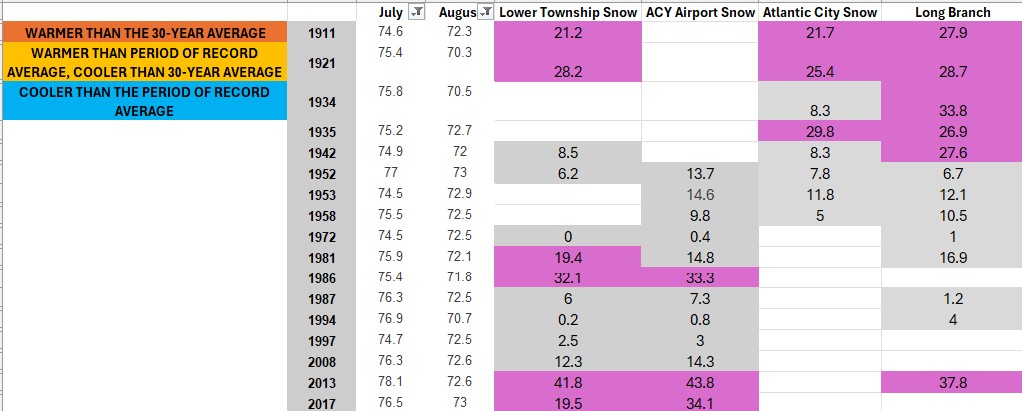
Cape May County is the state’s flattest and southernmost county. Therefore, having the least amount of snow just comes with the territory. The long-standing Cooperative Observer Station in Lower Township averages 14.8 inches of snow in a year.
From December to March, snow season, the water temperature in Cape May Harbor is between 39 and 45 degrees, according to the National Oceanic and Atmospheric Administration. Nor’easters, and the northeast winds they bring, funnel this above-freezing ocean air into the county. How many times has Trenton or Hammonton been covered in 6 inches of snow, while Marmora or Ocean City barely has a flake? The relatively mild water is the reason.
Are there other bubbles in New Jersey?
Given the data, you can make the case that the Cape May Bubble is really an Atlantic City Bubble, a Somers Point Bubble and a Millville Bubble. This far southeastern corner of New Jersey experiences different weather than the rest of the state.
I had the opportunity to meet Fabry at the American Meteorological Society conference in Baltimore in January 2024. He still remembers when we first talked about the phenomenon in 2019. He was kind and laughed when I explained just how much people talk about the bubble down here.
The man who proved the Cape May Bubble is real, Frederic Fabry, along with myself at the 2024 American Meteorological Society Annual Meeting in Baltimore, MD.
Given Quebec’s deep-rooted history with tourism in Cape May County, it might be time we welcome him for a visit. Expect the storms to stay away if he comes.
Joe Martucci, a Certified Broadcast Meteorologist and Digital Meteorologist, is the President and Director of Meteorology for Cup A Joe Weather and Drone. You can connect with him at cupajoe.sparkable.opalstacked.com/.
News 12 did an excellent job covering the dramatic rescue of 10 people as a sailboat sank off of Avalon on July 25. Tom Kronsowski had me on to discuss the water and weather conditions that led to the rescue.