Category: Shore Local Magazine

  • State of emergency declared after weather causes $300M in crop losses

    State of emergency declared after weather causes $300M in crop losses

    This article initially appeared in Shore Local magazine on May 28, 2026

    A series of hard freezes hit farms and bogs hard in New Jersey and beyond during late April, causing an estimated $300 million in crop losses, with crop damage exceeding 30% in many parts of the state.

    On May 20, Gov. Mikie Sherrill declared a state of emergency for all 21 counties in the state. She also sent a letter to U.S. Secretary of Agriculture Brooke Rollins to unlock federal funding relief for New Jersey farms.

    “This freeze was unlike anything our growers have experienced in decades, and the damage is staggering,” said Sen. Cory Booker. “An entire season of peaches, apples and grapes were almost entirely decimated in a matter of hours. Many other fruits are also suffering significant losses. New Jersey farmers urgently need federal support to recover from this disaster.”

    Maybe you know of a farmer who had losses. After all, there were over 600 farms between Cape May and Atlantic counties in 2022, according to the U.S. Department of Agriculture. That’s over 38,000 acres responsible for $167 million in products sold. Tourism, agriculture and fishing are the top three economic engines at the South Jersey shore. All are dependent on weather.

    Freezes in late April are common for inland New Jersey. The average last freeze of spring at Hammonton is April 18, according to the National Oceanic and Atmospheric Administration. Atlantic City International Airport’s is April 19. In the deeper Pinelands, the last freeze on average is near the end of the month.

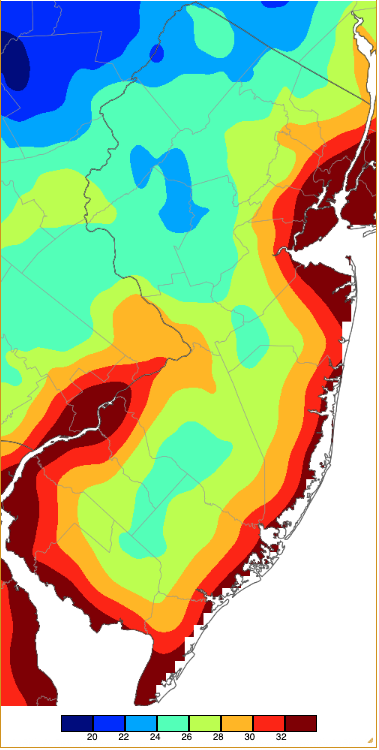
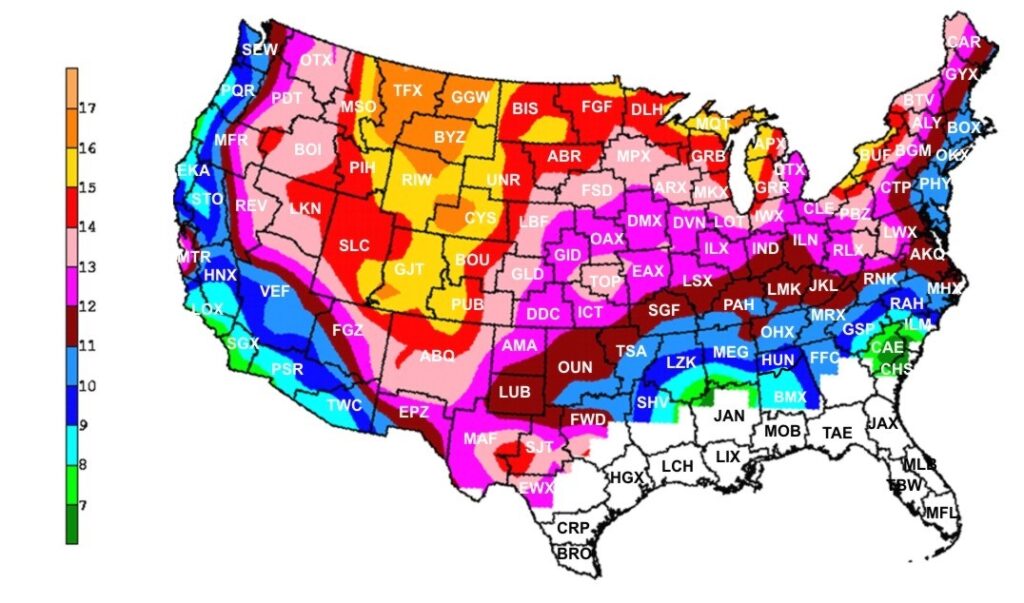
    But what happened on April 21 was not normal for two reasons and may be more of a sign of things to come. First is just the sheer cold of that morning. Not only were inland low temperatures for the coastal counties below freezing, but they were at or below 28 degrees in spots. That’s considered a hard freeze which destroys most seasonal vegetation, especially the young, tender crops that were just starting to grow.

    • Berkeley: 21 degrees
    • Vineland: 24 degrees
    • Woodbine: 25 degrees
    • Estell Manor: 27 degrees
    • Dennis: 27 degrees
    • A.C. Airport: 28 degrees
    April 21, 2026 low temperatures, when a killing freeze impacted the state (via Oregon State University)

    “Suffice it to say that this is one of the most widespread disasters on record to strike almost every fruit-growing tree, bush, or vine in the state. The horticultural industry also appears to have taken a notable hit,” said Dave Robinson, the New Jersey state climatologist, in his monthly report for April.

    It wasn’t just the cold temperatures that made the agricultural loss devastating, prompting the state of emergency. It was the weather that led up to it.

    It was warm. Really, it was hot. Temperatures sizzled between 85 and 95 degrees between April 14 and April 17, according to NOAA. Overnight lows stayed in the 50s and 60s.

    That kind of warmth drove crops and plants to open and grow faster than usual for that time of the year.

    When the freeze came on April 21, the plants were left exposed and many were killed. This will surely be a top 10 weather event for the year.

    The executive order issued by Gov. Sherrill provides for increased coordination between state agencies to help farmers with what they may need. State Police Superintendent Jeanne Hengemuhle will lead the effort.

    Federal crop insurance which, like the National Flood Insurance Program many of us are aware of at the shore, is backed by the Federal Government to protect against losses that many private insurers won’t take on. The problem is it has a cap of $325,000. For large farms, that’s just a percentage of what they could have lost.

    While frosts and freezes during the growing season are fairly common, most are minor issues for farmers. The last significant one was in 2012. That year, a hard freeze hit on April 28, about a dozen days after a stretch of warm weather with lows in the 50s and highs in the 80s.

    This year’s killing freeze arrived much sooner after the warm weather ended than it did in 2012 – and it was also a bit colder.

    In our climate-changing world, sharp, hard freezes after days of plant-growing heat are expected.

    The date of the last freeze of the year hasn’t changed much over the decades. In fact, at Atlantic City International Airport, the average last freeze is three days later now (April 18) than the average was in the 1970s (April 15-16). In Hammonton, it’s been roughly the same – around April 15.

    However, hot days are occurring earlier. Three days or longer of high temperatures of at least 80 degrees in April has about a 20% chance of occurrence in the 2020s. In the 1970s, it was about 5%. The result is more growth in our fruits, vegetables and crops before a killing freeze.
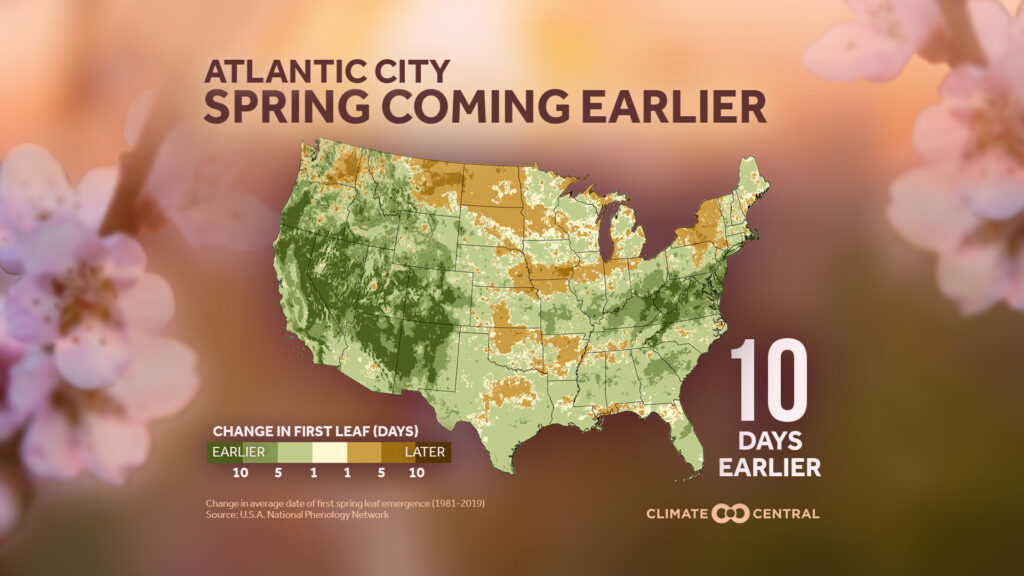
    The last freeze is barely changing because the ingredients for a cold spring night aren’t as influenced by a changing climate. It requires a clear sky, light wind and low dew points.

    Meanwhile, warmer spring days are driven by the greenhouse effect. The more greenhouse gases in the air, the more solar radiation from the sun is trapped near the surface, where we live.

    Finally, not to rub salt in the wound with this article, but I gave Memorial Day Weekend a “D” in the Shore Summer Weekend Weather Report Card. The first weekend of our eighth edition earned the barely passing grade, mainly because of Monday. Temperatures finally got out of the 50s at the beach and it wasn’t an all-day washout. Better luck this weekend.
  • How do those cooling sea breezes form at the Shore?

    How do those cooling sea breezes form at the Shore?

    This article appeared in Shore Local News on May 14.

    We live by the sea breeze and die by the sea breeze.

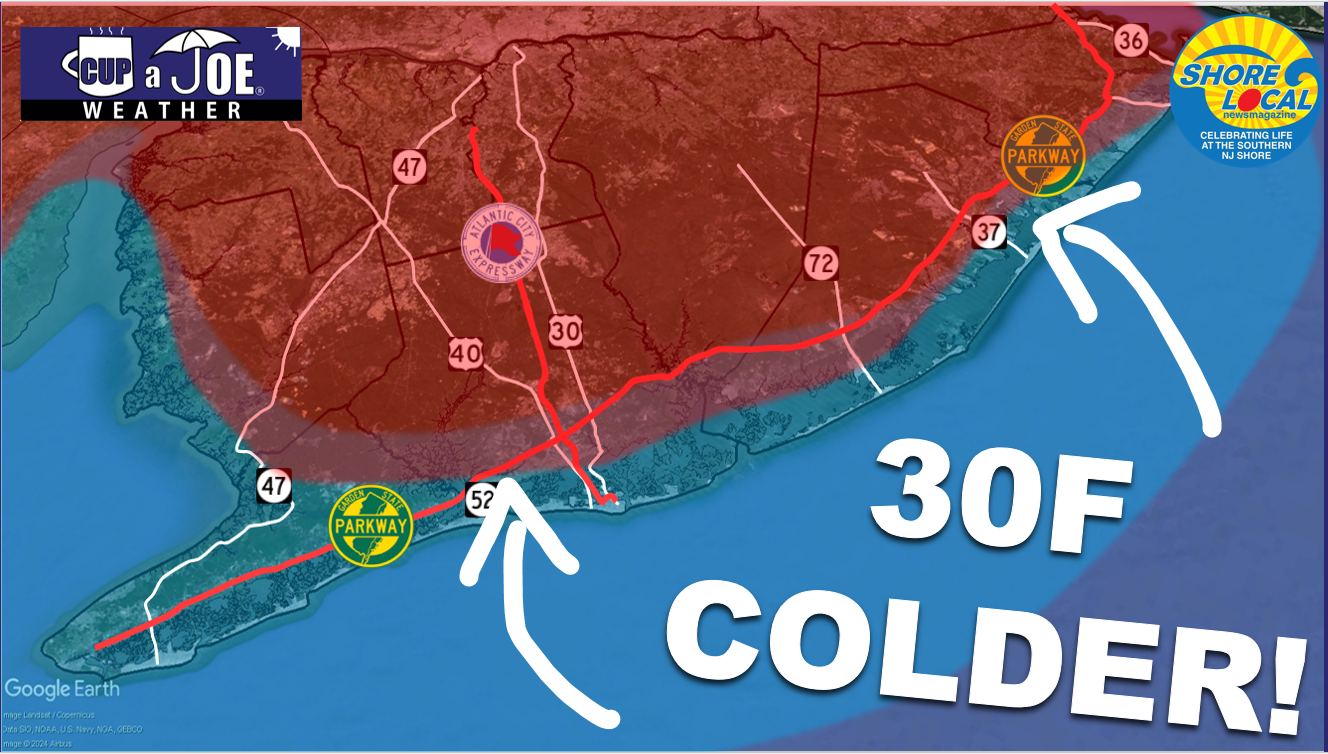
    Figurately, of course, but only kind of. How often has it been 95 degrees in Hammonton or Trenton, only to fall to 78 degrees in Ocean City or Atlantic City? That kind of change would make you feel alive if you made that trek to the beach.

    Alternatively, take May 4, 2026. It was 72 in Hammonton and Trenton. Atlantic City was 58 degrees. I have a feeling that took the life out of some outdoor plans.

    Even if you’re at the beach all day, how many times has it felt hot in the late morning? Then, you cool off with a refreshing breeze for the afternoon.

    Sea-breezes are a near daily occurrence of our lives for the Jersey Shore from roughly March to August. May is typically home to the strongest sea breezes and strongest differences between inland and coastal areas.

    The sea breeze makes the Jersey Shore the $20 billion economic engine it is according to the New Jersey Department of Tourism (2023). Doctors would prescribe patients time at the water’s edge to take in the cleaner air coming in from the ocean. Before air conditioning, the Camden and Atlantic Railroad, the West Jersey Railroad, Tuckerton Railroad and more opened the dream of refreshing summer air to the masses. Even today, the thought of a beach chair on the sand with the warm sun and cool breeze in your face is a pleasant sight.

    Why do sea breezes happen?

    In short, the sea-breeze is Planet Earth’s way to bring equilibrium to the atmosphere. The Earth is always trying to stay balanced against the constant change in the Earth’s tilt, orbit around the sun and more.

    In more detail, the sea breeze is caused by the sun warming up the land much faster than the body of water. It takes roughly 4.2 times more energy to heat up water a degree versus heating up land. Mainly, it’s because water, a liquid, can mix around, shifting its temperature around, faster than a patch of beach or forest can. The scientific phrase for this is heat capacity.
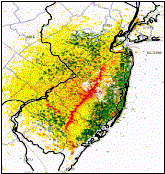
    Warmer air also brings lower air pressure. Cooler air brings higher air pressure. Winds always move from high pressure to low pressure. Due to physics, cooler air up to about 3,000 feet high will actually move onto land. That warmer air rises into the atmosphere. The line between the land breeze and sea breeze can create clouds. If there’s a lot of upward motion, it’ll even create rain showers.
    The red line in the spine of New Jersey are birds, insects and bugs being pushes east to west by the sea-breeze front (via the Office of the NJ State Climatologist)

    Sea breezes are localized features we call mesoscale features. It’s different than the widescale, synoptic winds that blow. If winds are blowing out of the northeast, off the water, due to a nor’easter, that is not a sea breeze. That’s just the way the wind’s blowing.

    Sea breezes typically blow at 10 to 20 mph.

    Mini cold fronts

    The cooling sea breezes we see in New Jersey are actually mini cold fronts moving in from the east. Typically, most cold fronts we think of in New Jersey come from the west or north. The drier, typically cooler air that follows the cold front are west or north winds. That is blowing in air from the larger area of high pressure in, say, Canada, replacing the lower pressure air.

    In New Jersey, the sea breeze cold fronts are stronger than other areas of the United States. That’s because of the Pine Barrens. The sandy soil of the Pinelands means the land heats up faster than other landmasses. It’s common for Egg Harbor City or Batsto to be the hottest place in the state. That creates a bigger air pressure gradient, which creates a stronger sea breeze.

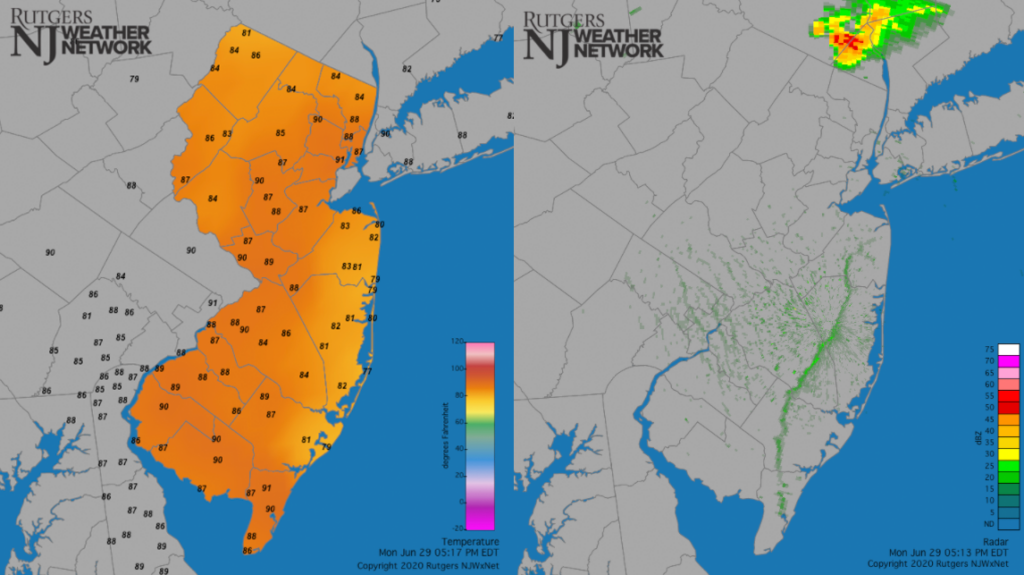
    A typical sea breeze look at temperatures (left) and radar. Note that Cape May County’s beaches are also in the 70s but there are no weather stations on the beach at this time.

    How to spot a sea breeze in NJ

    Keep in mind that northeast, east or southeast winds that blow for days at a time are not the sea breezes we’re talking about here.

    To have a real sea breeze, winds need to start out from an offshore direction and then shift onshore as the day goes on.

    First, you’ll need the sun to heat the ground for a few hours. A cloudy sky can bring a sea breeze during the late spring and summer, too, thanks to how strong the sun is.

    The strength of the wind matters, too.

    If winds are constantly blowing under about 15 mph, there’s a good chance the sea breeze will form during the late morning or midday if the large-scale winds are from offshore at first.

    As an example, if 10 mph from the southwest start off the morning, you’ll get a sea breeze to develop by noon.

    If winds are over about 15 mph, whether you see a sea breeze depends on the direction that large-scale wind is blowing.

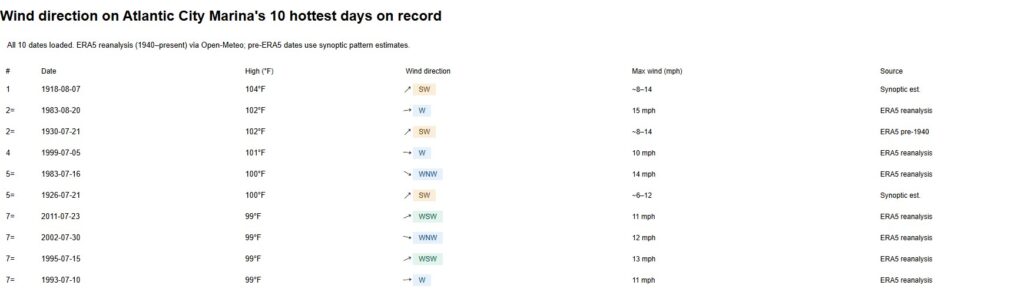
    Winds from the west or northwest will be too strong for the sea breeze to develop. They directly push back against it. These are the days that are the hottest on sand and inland. In fact, seven of the top 10 hottest days at Sen. Frank S. Farley State Marina in Atlantic City had a wind out of the westerly or northwesterly direction, according to Open-Meteo and ERA5 data.

    Claude.ai helped with this analysis of Atlantic City’s hottest days on record, and their wind direction.

    Sadly, it’s also the days when the bugs swarm the shore all day long.

    However, winds from the southwest or north at those higher speeds don’t directly push against the developing sea breeze. Typically, they’ll still form.

    The Delaware Bayshore also gets cooling sea breezes, but they’re not as noticeable since the bay temperature is more in line with the land temperatures nearby. There isn’t as much as an air pressure gradient that creates that cooling wind.

    Still, for Cumberland and Salem counties, any wind that isn’t pushing directly against the coastline or with it can cause a sea breeze.

    For Cape May County’s Bayshore, a south or north wind can still develop those localized sea breezes.

  • Why this snowy winter was NOT enough to cure NJ’s 2026 drought

    Why this snowy winter was NOT enough to cure NJ’s 2026 drought

    This article initially appeared in Shore Local News on April 30, 2026

    It’s unanimous, according to the state and federal agencies in charge of keeping track of drought conditions.

    Since November, New Jersey has been in drought, according to the state Department of Environmental Protection. Then, on April 14, the Jersey Shore was put into drought by the United States Drought Monitor, only to cover the entire state a week later.

    When I talk about this in my weather videos, or post about it on social media, some variation of the same question comes up.

    “How could the Jersey Shore be in drought? We had so much snow last winter.”

    While yes, we did have well-above-average snowfall (26.1 inches at Atlantic City International Airport, 18.6 inches in Margate, and 39.2 inches in Long Branch), but lots of snow doesn’t necessarily cure a drought. The correlation is pretty weak.

    Drought is defined as “a period of abnormally dry weather sufficiently long enough to cause a serious hydrological imbalance,” according to the American Meteorological Society. In other words, if the water going into the environment is less than the water being taken out of the environment (by humans, animals, evaporation, etc.) for a long period of time, you go into drought.

    Water comes into the environment by precipitation. Snow is precipitation, so is rain. However, on average in New Jersey, it takes 11 inches of snow to get 1 inch of precipitation. Meanwhile, 1 inch of rain equals 1 inch of precipitation.

    Snow to liquid ratio climatology. On average for New Jersey, it takes 10 to 11 inches of snow to produce one inch of precipitation. (via the National Weather Service)

    Here’s a look at how much snow, precipitation and average precipitation fell at Atlantic City International Airport from December to February:

    In December, there were 2.2 inches of snow, 3.03 inches of precipitation, vs. 3.76 inches of average precipitation.

    January saw 6.7 inches of snow, 3.78 inches of precipitation, vs. 3.44 inches of average precipitation.

    February recorded 17.2 inches of snow, 3.53 inches of precipitation, vs. 3.12 inches of average precipitation.

    Snowfall was about 75% above average during this time. Precipitation was about 5% below average.

    What about the snowpack?

    This winter probably felt extra long because the snow was on the ground for so long. Twenty-nine days had at least 1 inch of snow covering the ground at Atlantic City International Airport, according to the National Oceanic and Atmospheric Administration, the sixth longest since records began in 1945.

    default

    Snow on the ground helps prevent drought from worsening. It allows for snow to slowly melt and seep into the ground. It also prevents the sun from pulling water from the ground and evaporating into the atmosphere.

    However, the snowpack wasn’t deep enough nor did it hang around long enough to have a significant impact on the drought.

    All things considered, it was a lack of precipitation in March that slid the Jersey Shore into a deeper drought.

    Drought outlook for NJ

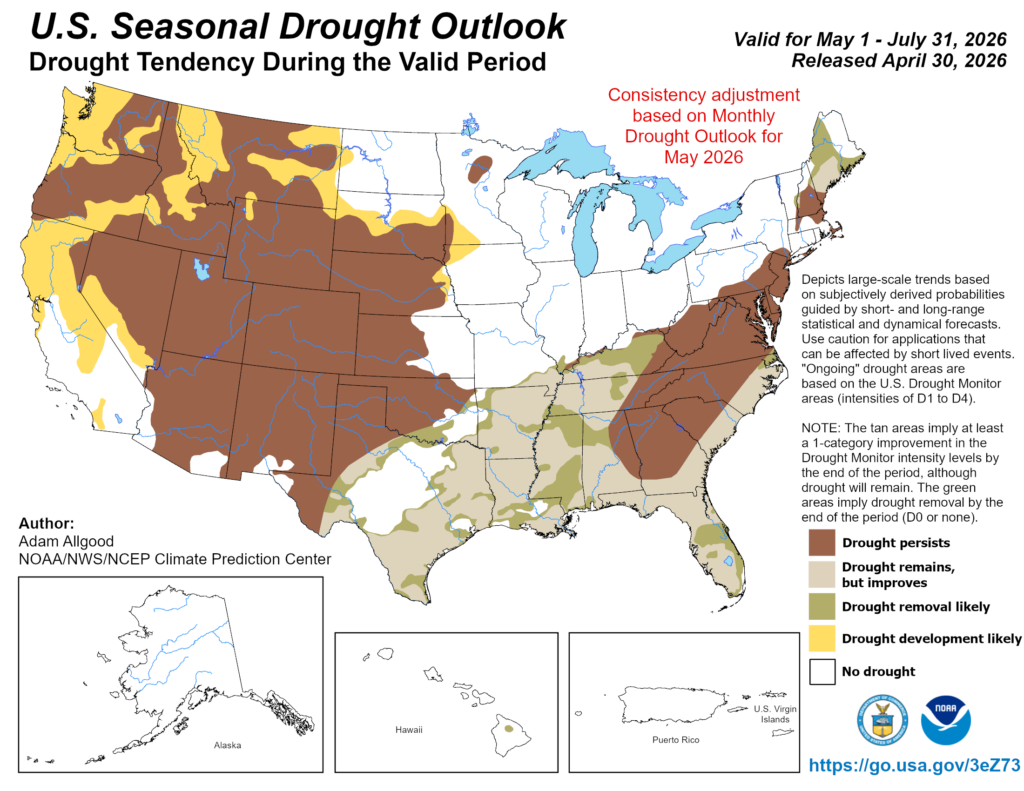
    NOAA is forecasting that drought conditions will persist through the end of July, according to its April 30 update.

    Precipitation across the Jersey Shore, not just in a town or two, needs to average at least 5 inches during this time in order to drown out the drought. More than 4 inches of evaporation occurs during June and July.

    We’ll need a few coastal storms, or a very gloomy next month or two, in order to do that. If not, don’t be surprised to see mandatory water restrictions by the end of the summer.

  • 🌀How likely is a hurricane, tropical storm in NJ in 2026? Forecast released.

    🌀How likely is a hurricane, tropical storm in NJ in 2026? Forecast released.

    This article initially appeared in Shore Local Newsmagazine on April 16

    The Atlantic Hurricane season runs from June 1 to Nov. 30. We know that very well here in New Jersey, as does Colorado State University – yes, landlocked Colorado State University which just put out one of the most anticipated hurricane forecasts of the season.

    On April 9, CSU released its 2026 Atlantic Hurricane Season forecast at the National Tropical Weather Conference in South Padre Island, Texas.

    2026 Atlantic Hurricane Season forecast

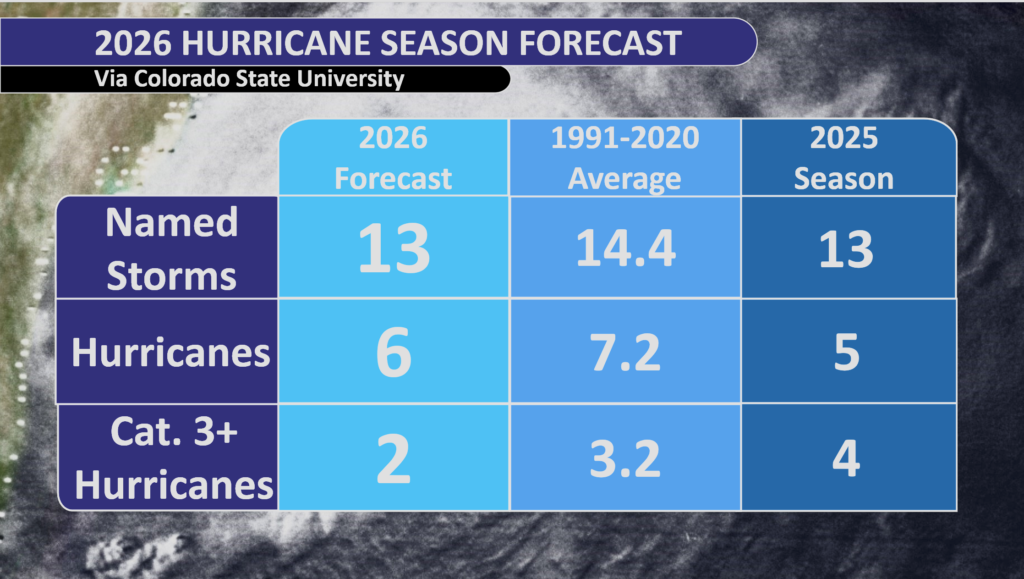
    The forecast calls for 13 named storms (a tropical storm or a hurricane) including six hurricanes, two major hurricanes – a Category 3, 4 or 5 with maximum sustained winds of at least 111 mph.

    This is slightly less active than average, and less than last season. The difference is that last season had four major hurricanes, while the forecast for this year calls for two.

    Likelihood of a tropical storm or hurricane

    Colorado State University also breaks down the forecast into probabilities for statewide impacts.

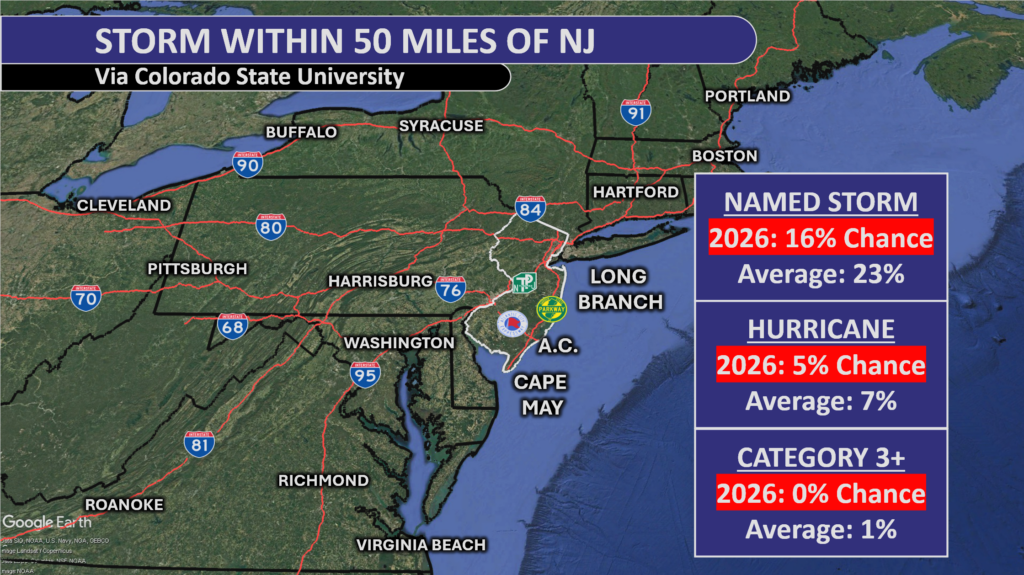
    New Jersey faces a 16% chance of a named storm this season, which is 7% below the historical average. The outlook for hurricanes is also quiet: the 5% probability of a standard hurricane is below average, and the risk of a major hurricane – Category 3, 4, or 5 – is effectively 0%. That isn’t a major departure from the norm as the state’s average risk for a major strike is just 1%.

    Virginia and Massachusetts are the only two states with a double-digit percentage chance of a hurricane being within 50 miles of their states, at 14% and 10% respectively. All other states are in the single digits.

    El Niño, the biggest hurricane season factor

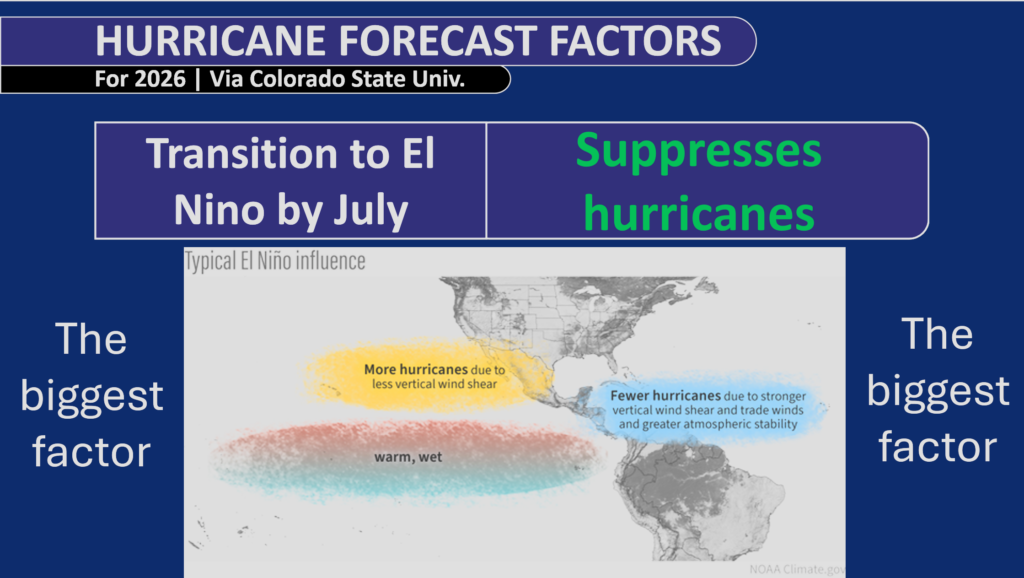
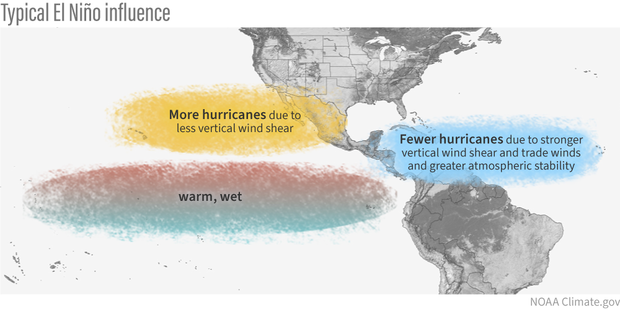
    When we look at the hurricane forecast factors for 2026, the biggest one is the transition to El Niño, which we are expected to have by July. This suppresses hurricanes.

    When you have an El Niño, that means you have warmer-than-average ocean temperatures off the equatorial Pacific Ocean. In other words, the ocean is warmer than average off the coast of South America, extending to about south of Hawaii. That helps rip storms apart as they try to develop and move westward across the Atlantic.

    Secondly, the trade winds that blow from Africa to the Caribbean are stronger. That means more stability in the atmosphere and fewer storms. We are expecting to transition to El Niño during July or August, and we could even see a Super El Niño as we go into the late fall and winter. That impacts on our 2026–2027 winter forecast, which we wrote about in Shore Local April 2.

    Other hurricane season factors

    Beyond El Niño, all other factors point toward more activity than usual.

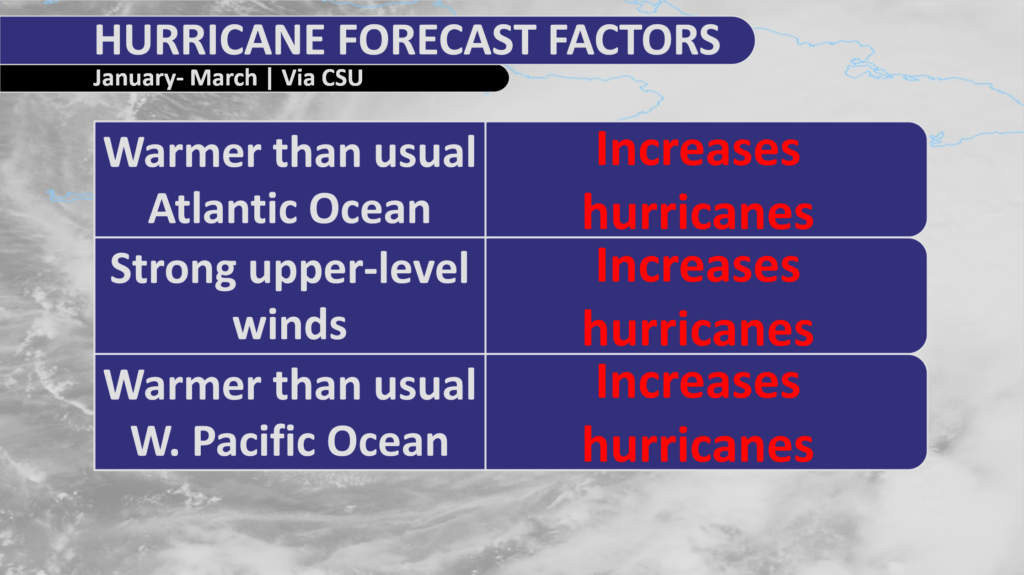
    From January through March of this year, we had warmer-than-usual Atlantic Ocean waters, stronger upper-level winds and a warmer-than-usual western Pacific Ocean.

    All of that, for different reasons, increases the likelihood of more storms.

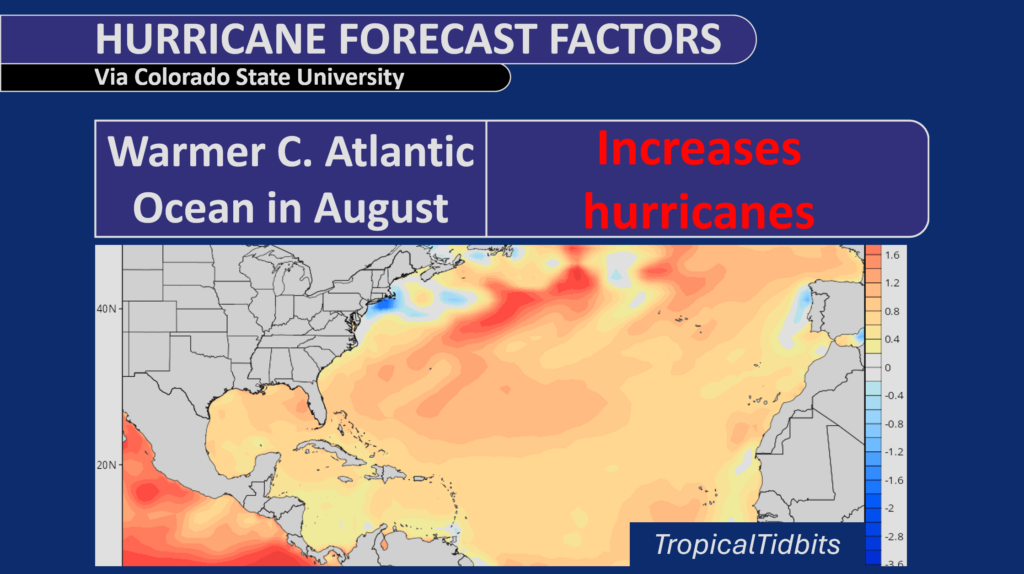
    As we get to August, temperatures are forecast to be warmer than average in the Central Atlantic Ocean. The Central Atlantic is the key breeding ground for the long-track hurricanes that go from Africa to the Caribbean, and possibly up the East Coast of the United States.

    So, imagine a tug of war – let us say one strong person matches up against four children. The El Niño-suppressing hurricane season is usually going to win out. However, you still have four smaller factors, the children, pointing the other way toward a more active season.

    Learning from history

    Colorado State University looks at analog years, or years with similar conditions going into the hurricane season as we have now. Four stood out to them.

    More of the analog years point toward a less active hurricane season.

    Another way to look at hurricane season

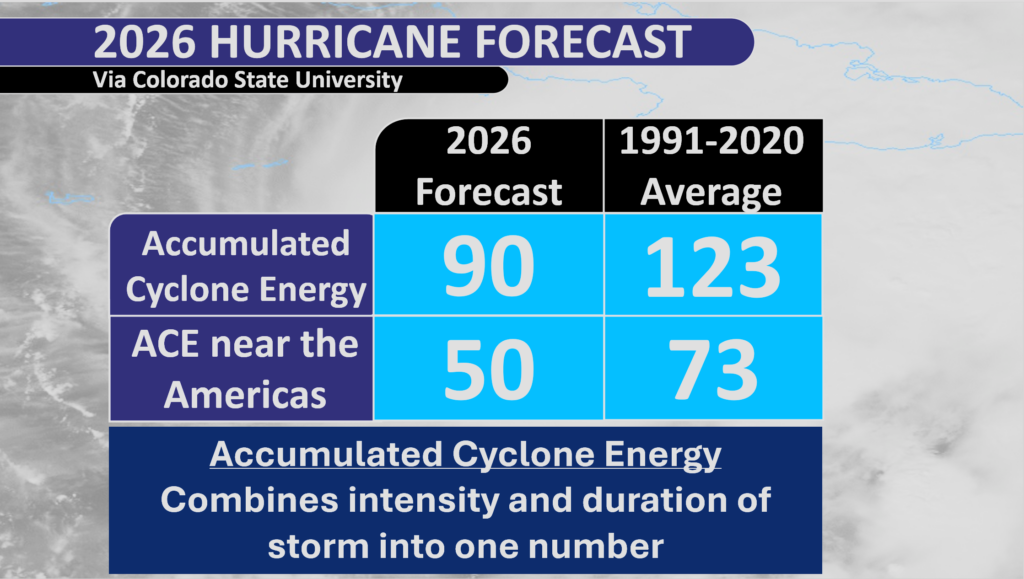
    Accumulated Cyclone Energy, or ACE, combines the intensity and duration of a storm into one number. The stronger a storm is, the higher the ACE.

    For example, Superstorm Sandy in 2012 had an ACE of about 13.5 on its entire journey from the Caribbean to a Brigantine landfall.

    Sandy lasted for eight days as a tropical cyclone, peaking as a major Category 3 hurricane. This did not even include ACE potential had Sandy been a tropical cyclone during the time of landfall.

    Meanwhile, Tropical Storm Fay in July 2020, which also made landfall near Brigantine, had an ACE of 1.5. Fay spanned just three days, and it was never more than a mid-range tropical storm.

    CSU predicts a below-average year for total storm power, forecasting an Accumulated Cyclone Energy (ACE) score of 90 compared to the historical average of 123.

    Closing thoughts

    This forecast is good news for us at the Jersey Shore and for the entire Atlantic Hurricane Basin.

    But remember, it only takes one storm to hit New Jersey for it to feel like an active season near us. Even last year, where no hurricanes struck the United States, we still had Hurricane Erin bring the highest summertime tide on record for much of the South Jersey shoreline.

    NJ beaches generate billions in revenue, supporting thousands of jobs and businesses. If they erode, our economy collapses. Federal beach funding was cut in 2025. Only the American Coastal Coalition fights 24/7 in DC to restore it. Protect your beach and business. Join today: americancoastalcoalition.org

  • How will developing El Niño impact NJ’s weather in 2026?

    How will developing El Niño impact NJ’s weather in 2026?

    Goodbye La Niña and hello El Niño – possibly a “super” El Niño.

    Expected between July and September, this shift in the Earth’s long-term weather patterns will define how we experience the upcoming hurricane season, as well as the snow and cold of next winter.

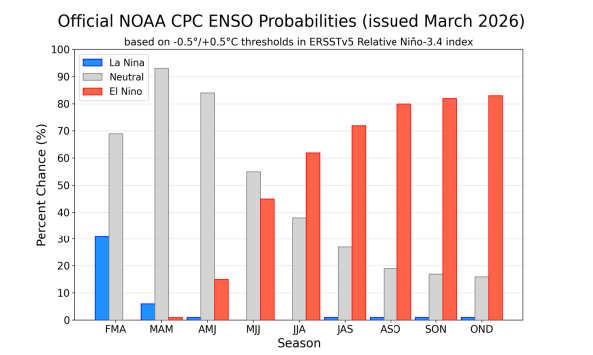
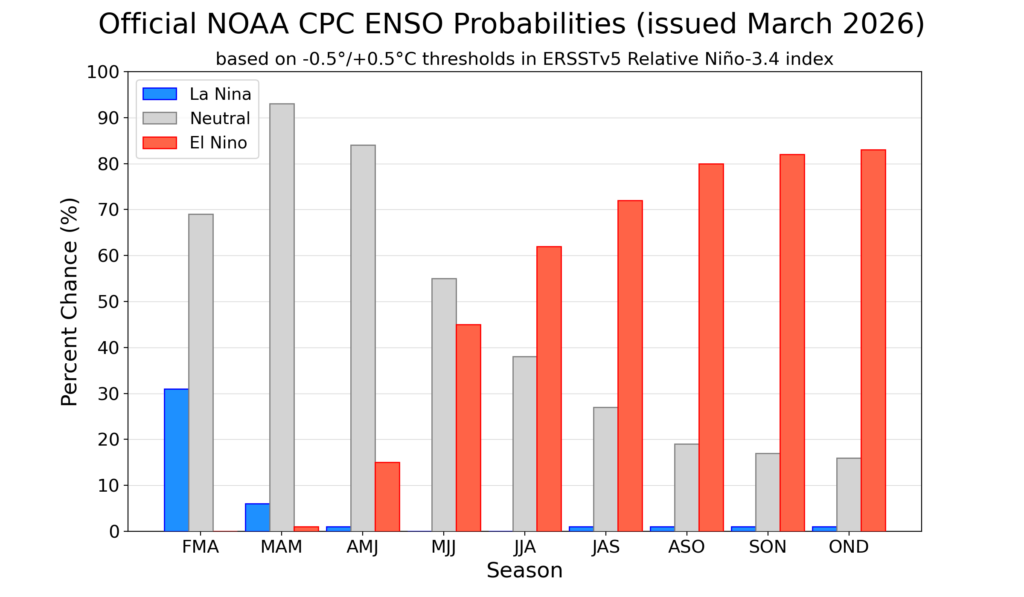
    Forecasters from the National Oceanic and Atmospheric Administration give El Niño a greater-than-60% chance of developing during the summer. By the fall, during the peak of hurricane season, it’s an 80% chance.

    By July, the chances of an El Nino developing are over 50% (via NOAA)

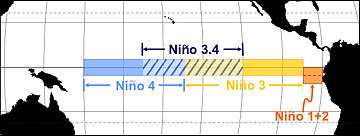
    El Niño or La Niña is part of the El Niño Southern Oscillation (ENSO). This refers to the water temperatures off the Equatorial Pacific Ocean, from roughly Peru westward 7,000 miles. When water temperatures are warmer than average, it’s El Niño. When it’s cooler than average, it’s La Niña.

    Via NOAA

    Meteorologists break this down into four different zones within the ENSO region. I won’t explain it much here, but where those warmer temperatures are this summer and beyond will make a slight difference in what our long-term forecast will be.

    Since the summer of 2024, we have been in La Niña. That typically means milder winters. However, both the 2024-2025 winter, and this past winter, were colder than average.

    The frozen tundra of snow and ice we experienced for weeks this past winter bucked the La Niña trend, too. For hurricane season, 2024 was more active than usual, while 2025 was about average. That checks out with a La Niña pattern.

    Let’s look at what El Niño will mean for both the 2026 hurricane season, and the 2026-2027 winter, plus what a “super” El Niño could mean for New Jersey.

    Quieter hurricane season likely

    When El Niño is present, hurricane activity in the Atlantic Hurricane Basin goes down; it’s that simple. The Atlantic Hurricane Basin averages 14 named storms – seven hurricanes including three major hurricanes (Category 3, 4 or 5) per season, per Colorado State University. Since 1990, there have been 11 hurricane seasons with El Niño. Seven were less active, while two were about average and two were more active.

    More than likely, this hurricane season will be as active or less active than average. With a 24% chance of the eye of a tropical storm or hurricane being within 50 miles of the Jersey Shore, that number should be lower as well. Hurricane season officially runs from June 1 to Nov. 30.

    During El Niño, there is stronger windshear in the tropical Atlantic Ocean. Windshear is a change of wind direction or speed as you go up from the surface. This, in short, rips apart developing cyclones.

    Winter temperatures

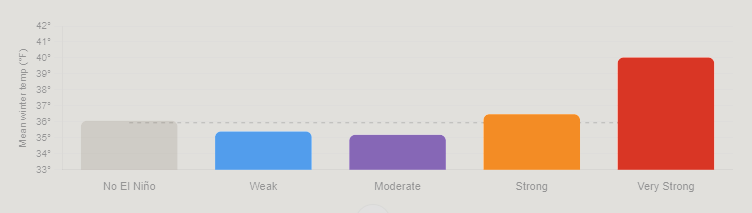
    The stronger the El Niño, the warmer the temperatures. By itself, El Niño doesn’t mean much for our temperatures during the winter. Since ENSO records began in the 1950s, winters with El Niño end up about average at Atlantic City International Airport and the Sen. Frank S. Farley State Marina in Atlantic City.

    However, when you look at the intensity of the El Niño, the pattern becomes clear.

    Very Strong: 4.0 degrees warmer than average

    Strong: 0.5 degrees warmer than average

    Moderate: 0.7 degrees colder than average

    Weak: 0.5 degrees colder than average.

    Mean temperature between December and February for Atlantic City International Airport and Sen. Frank S. Farley State Marina in Atlantic City, based on the intensity of the El Nino (graphic is from Claude Artificial Intelligence, via NOAA data).

    The stronger the El Niño, the warmer the temperatures. That’s because the Pacific jet stream – the river of air about 30,000 feet high that separates two airmasses – pushes into the Northeast. That means more opportunities for us to be south of the jet stream, taking in milder air.

    Winter snow: One clear signal

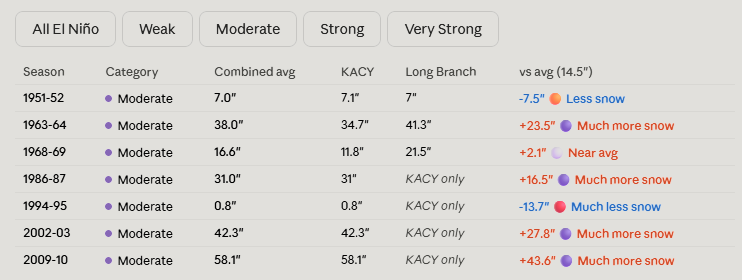
    Like winter temperatures, using El Niño alone doesn’t produce a big trend in what snow could look like for a winter. Generally, it’s a little less snowy than average. However, when you look at the type of El Niño, there is a trend that screams off the chart.

    When El Niño is in a moderate phase, it’s 13 inches snowier than average. For the South Jersey shore, that’s 25 to 30 inches of snow. Farther up the coast, that’s roughly 30 to 35 inches of snow.

    Here’s the snow breakdown for Atlantic City International Airport and Long Branch, by El Niño phase.

    Weak: 3.5 inches below average

    Moderate: 13.2 inches above average

    Strong: 3.4 inches below average

    Very strong: 0.2 inches above average

    Winter snowfall totals for the Jersey Shore, based on the intensity of the El Nino (graphic is from Claude Artificial Intelligence, via NOAA data)

    The last two moderate El Niño winters were 2009-’10 and 2002-’03. Both brought plenty of snow, and winter storms. That included:

    The Dec. 19 to 21, 2009 winter storm, which brought double-digit snowfall across the entire Jersey Shore.

    On Feb. 5-7, 2010, over 20 inches of snow fell roughly south of the Atlantic City Expressway. Meanwhile, New York City experienced less than 4 inches of snow.

    A few days later, the Feb. 9-11 winter storm brought over half a foot of snow to the shore.

    The Feb, 16-18, 2003, winter storm, known as the President’s Day II or PDII storm, dropped over 18 inches of snow on much of the Jersey Shore and ranks as the sixth strongest winter storm on NOAA’s Northeast Snowfall Impact Scale.

    Moderate El Niños sit in a weather sweet spot for winter storms in New Jersey. They enhance the jet stream’s pattern in a way that funnels nor’easters up the coast without warming the region enough to flip precipitation to rain.

    What if a ‘super’ El Niño arrives?

    There is no guarantee that a very strong El Niño, or what people call a “super” El Niño, will come this winter. However, given the confidence of El Niño developing late this year, it’s worth exploring. Severe-Weather.Eu has a nice writeup on it.

    If one does form, expect a mild winter with a low number of nor’easters. However, when nor’easters do hit, expect plenty of rain, wind or even snow.

  • The 7 reasons why the 2026 nor’easter was memorable in NJ

    The 7 reasons why the 2026 nor’easter was memorable in NJ

    This article initially appeared in Shore Local magazine on Feb. 26

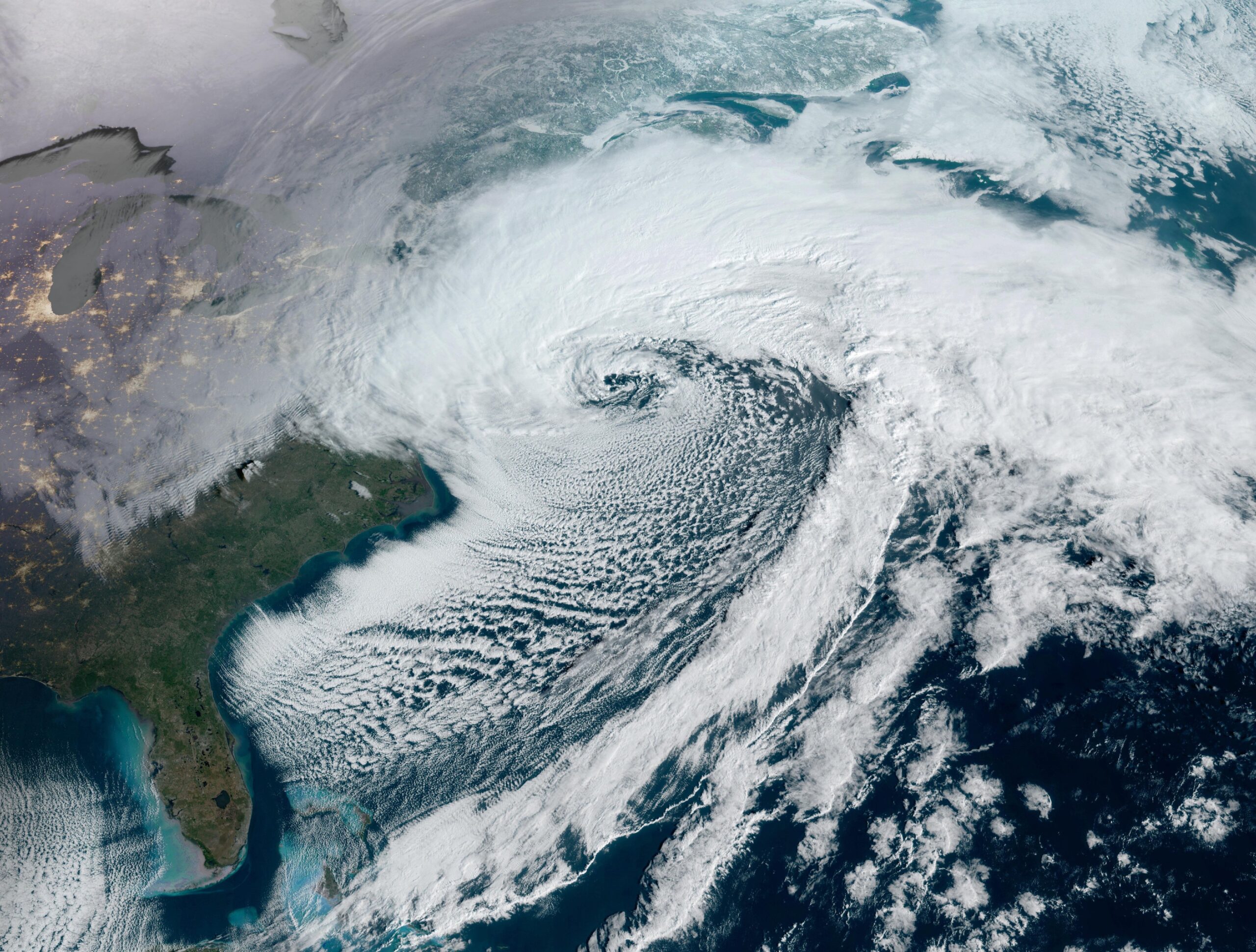
    Just as a generational run of snowcover was starting to go away, a fresh nor’easter piled near historic snow amounts onto our lawns, beaches, cars and streets Feb. 22-23.

    While nor’easters at the Jersey Shore are feared most for their tidal flooding, it was the snow that was most impactful this time.

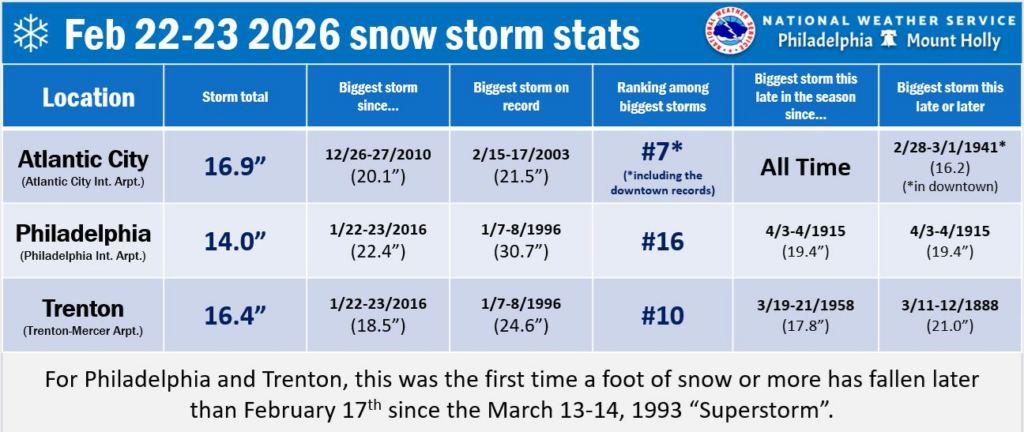
    Nearly everywhere at the Jersey Shore had double-digit snow reports. Atlantic City International Airport picked up 16.9 inches of snow over the two-day stretch, according to the National Oceanic and Atmospheric Administration (NOAA). It was the biggest snowstorm this late in the winter season since records began in 1943, and the sixth largest two-day snowfall. Other Jersey Shore totals, measured in inches, included:

    Cape May County

    • Ocean City: 16.0
    • Lower Twp.: 12.5
    • North Wildwood: 8.7

    Atlantic County

    • Mays Landing: 19.0
    • Somers Point: 18.2
    • Egg Harbor Twp.: 18.0
    • Minotola: 17.0
    • Buena Vista Twp.: 16.5
    • Egg Harbor City: 15.3
    • Hammonton: 10.7

    Ocean County

    • Jackson: 25.2
    • Lakewood: 24.0
    • Toms River: 22.0
    • Lakehurst: 21.8
    • Manahawkin: 19.0
    • Brick: 18.5
    • Ship Bottom: 18.0
    • Lanoka Harbor: 17.0
    • Tuckerton: 17.0

    Monmouth County

    • Marlboro: 26.5
    • Middletown: 25.0
    • Freehold Twp.: 25.0

    Wind Speeds

    • Atlantic City International Airport: 61 mph
    • Cape May: 58 mph
    • Tuckerton: 56 mph
    • Harvey Cedars: 54 mph
    • Pleasantville: 53 mph

    Here are seven reasons why this nor’easter will be talked about for years.

    It was a bomb cyclone

    It wasn’t just a nor’easter; it was a bomb cyclone, as the National Weather Service confirmed after it rapidly intensified through a process known as bombogenesis.

    While sources vary, this storm saw a roughly 40 millibar drop in air pressure between Sunday morning and Monday morning. You need at least a 24-millibar drop in air pressure within 24 hours to be a “bomb.” This is the hallmark of a strong nor’easter.

    It achieved that and then some.

    It ‘generated’ its own cold air

    It was mild in the days leading up to the nor’easter. High temperatures on Feb. 20-21 – Friday into Saturday – were in the upper 40s to low 50s. Even Sunday morning, temperatures were 35 to 40 degrees, and it was raining.

    Then, as the storm underwent bombogenesis, there was a large amount of upward motion and air expansion. As the air expands, fewer molecules bump into each other, and you get cooling. In other words, it cooled down and rain turned to snow.

    Temperatures hung on above freezing, with snow late Sunday afternoon not sticking much to roads and sidewalks. That happened later than I expected.

    But once the sun set, temperatures sank below 32 and snow accumulated rapidly.

    Light rain fell along the South Jersey Shore on Sunday night and Monday, but that was not often and the northern part of the shore stayed locked in as snow.

    A multi-state ‘mega band’ of snow

    The 15-inch or greater totals in most of Atlantic County and points north at the coastal counties were helped by heavy snow that fell for hours Monday morning.

    The nor’easter generated two large bands of snow. We had the western one, which extended from western Massachusetts to the Hudson Valley and down the Garden State Parkway to Atlantic County.

    If you were in it, you had snowfall rates of 1 to 2 inches per hour. It was roughly from around 2 a.m. to 10 a.m. So, if you do the math, that adds up.

    While the storm underperformed my forecast Sunday afternoon, it made up for it Monday morning.

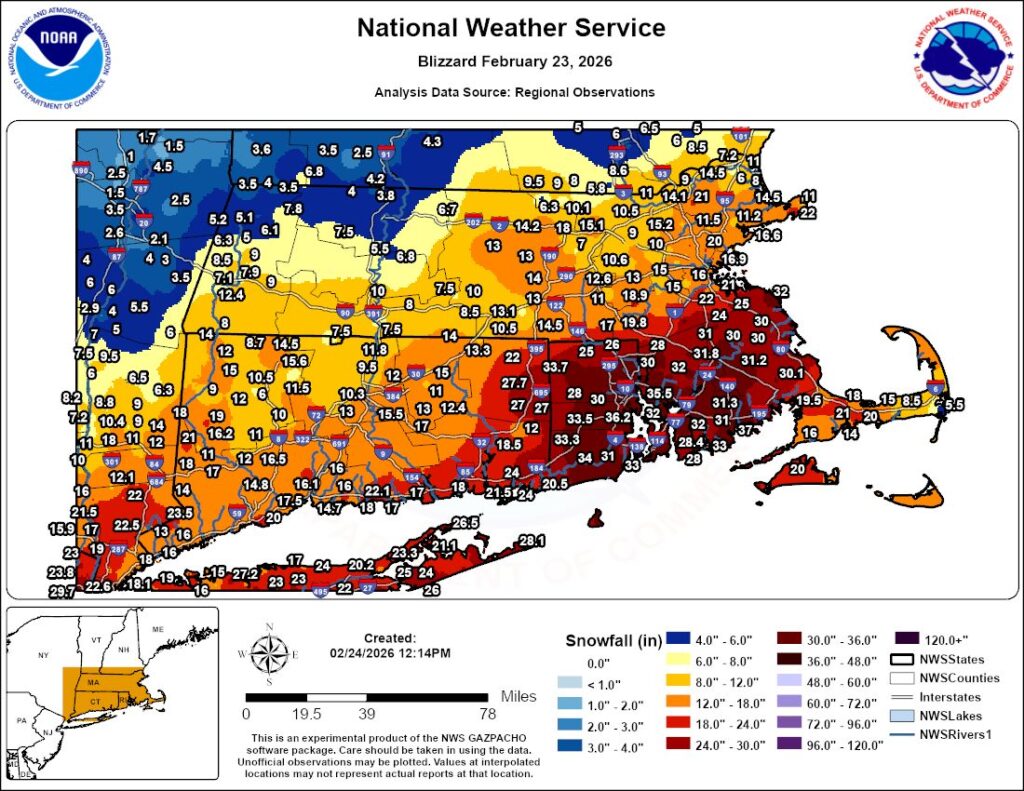
    For what it’s worth, the eastern band was responsible for bringing Rhode Island’s largest snowstorm on record – 37.9 inches of snow fell in Providence, according to WPRI-TV and other outlets.

    The snow was very wet

    Heavy, wet snow piled up feet high in Avalon (courtesy of Avalon Public Works, a ShorelySafe client of our company)

    The amount of precipitation that fell during this event ranged from 1.7 to 2.3 inches. We had a lot of snow, but a lot of liquid as well.

    In New Jersey on average, 11 inches of snow falls for every inch of liquid. This was lower.

    Woodbine likely had 18 inches of snow on 1.97 inches of liquid, according to the Community Collaborative Rain Hail and Snow Network (CoCoRaHS). That’s a snowfall ratio of roughly 9:1.

    At Atlantic City International Airport, 16.9 inches of snow occurred with 1.97 inches of liquid. That’s a snow ratio of 8.6:1.

    You noticed it. The snow was very hard to shovel or snowblow, and not just because of the amount. The snow stuck to my narrow windshield wipers. If the snow was fluffy, that wouldn’t happen.

    Drought concerns eased

    The 1.7 to 2.3 inches of liquid brought February’s precipitation back to average. That was much needed and reduced the risk of worsening drought going into wildfire season.

    https://www.facebook.com/JoeMartWx/posts/pfbid0Jr443T8ZiK8GoQdDNfH8g2wfictJ7TGdiqanXaBiTdYKn2CA7aD4dRJuGHHjBKjtl

    The United States Drought Monitor Feb. 26 update, which includes data through Feb. 24, showed an improvement in drought in parts of Cape May, Atlantic and Monmouth counties. It fact, drought was removed in Upper Cape May County and southern Atlantic County.

    Probably the windiest snowstorm in decades

    Atlantic City International Airport reported a 61 mph wind gusts at 3:13 a.m. Monday, Feb. 23. The National Weather Service said no major snowstorm or blizzard since 1978 had a gust as high as this one.

    Record amount of Sunday winter snow

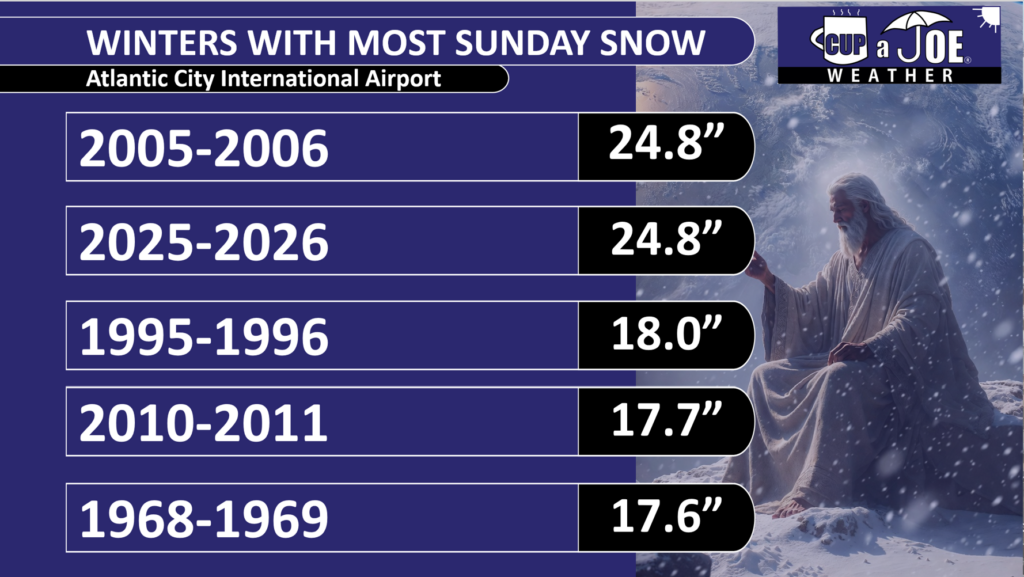
    It may have taken divine intervention, but with 6.9 inches of snow at ACY Airport on Feb. 22, this winter is now tied with 2005-2006 for the winter with most Sunday snow on record.

    Data via NOAA

    With a brutally cold shot of air expected to begin in March, it’s still possible that 2025-2026 could claim the top spot for itself. Who said Sunday was a day of rest?

    Thank You

    I know you have other options for weather and appreciate that you stick here with Cup A Joe Weather. From Feb. 17-24, we had 2.005 million social impressions, 450,000 video views and a website audience of over 10,000 people.

    A big thank you to our advertisers for making this possible. Without them, we can’t cover the shore like no where else.

  • Here’s how cold the Jersey Shore was in January

    Here’s how cold the Jersey Shore was in January

    This article initially appeared in Shore Local Magazine on Feb. 5

    With temperatures much colder than average around here, the depths of winter have been feeling more like New England than the Jersey Shore.

    From Jan. 18 to 31, temperatures at Atlantic City International Airport were what the same typical two-week period would be in Portland, Maine, according to the Southeast Regional Climate Center. From Jan. 25 to 31, the mean temperature at Atlantic City International Airport was just 18.6 degrees. You’d have to travel far north to find similar readings. Anchorage, Alaska, is the closest match. The same is true at the Sen. Frank S. Farley State Marina.

    Days of sub-freezing temperatures and nights with sub-zero windchills are certainly bitterly cold. However, you don’t have to look that far back to find Januarys just like it.

    Believe it or not, January 2026 was milder than last January at both the airport and the marina, according to the National Oceanic and Atmospheric Administration (NOAA).

    At Atlantic City International Airport, the average temperature for January was 30.8 in 2026, compared to 30.6 during the same period in 2025. Both readings fall a little below the mean of 33.0. At the Atlantic City Marina, the average was 32.7 in 2026, up from 32.1 in 2025, but still below the 34.5 mean. Even up the Jersey Shore at Long Branch, Monmouth County, 2025’s January was just 0.7 degrees milder.

    In other words, January 2025 was colder. However, I hear you, 2026 just felt more frigid.

    Maybe it’s because of the snow. Last January experienced a South Jersey Snow Special on Jan. 6. Six to 10 inches of snow fell in Lower Cape May County, with a plowable snow south of the Atlantic City Expressway. However, it was gone a week later. Meanwhile, our winter smorgasbord from Jan. 25 to 26 continues to be an icy glacier more than 10 days later.

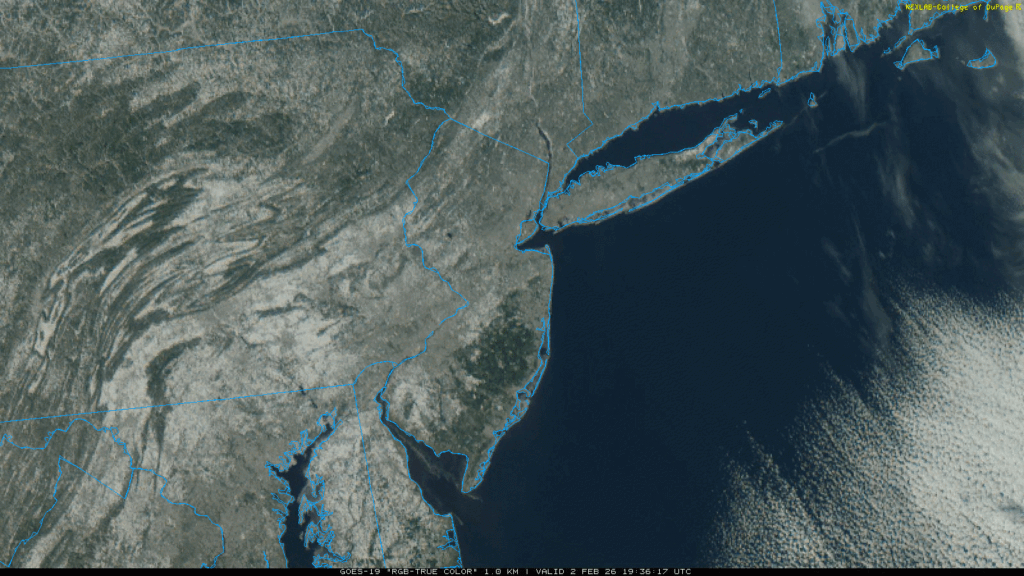
    A snow covered Mid-Atlantic from Feb. 2, 2026 on the visible satellite image. Note the green area in eastern New Jersey. That’s the dense forest of the Pine Barrens. There was still snow on the ground there. (College of DuPage)
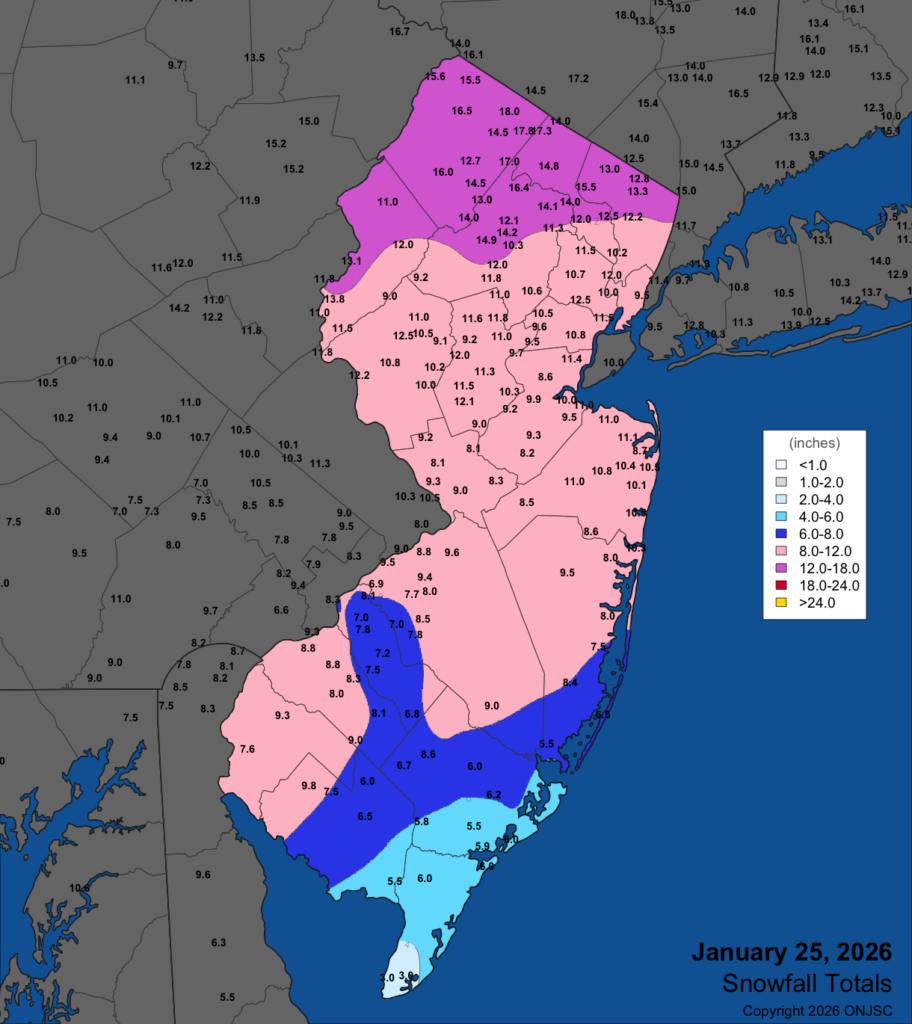
    Snow and sleet totals from the Jan. 25, 2026 Winter Storm (Office of the New Jersey State Climatologist)

    Maybe it’s because, compared to average, New Jersey is among the coldest places in the United States this winter, according to Ben Noll of the Washington Post.

    Maybe it’s because our coldest days were colder. Five days were 15 or more degrees below average at ACY Airport this year. Last year, there were three. It was nearly the same in Atlantic City.

    Otherwise, maybe it’s just because we remember only what happened to us lately. Last January had more days with gusts over 45 mph, according to NOAA, compared to this January.

    Bay ice concentration in the Mid-Atlantic last January, at its peak (48.72%), was double what it was at its peak this January on Jan. 29 (20.5%).

    Compared to the rest of recorded history, this January was just a little colder than average. In our climate-changing world, it’s been harder to achieve long stretches of bitterly cold temperatures.

    Last month, the only cold temperature records that occurred within our four, long-standing Jersey Shore weather stations (Lower Township, Atlantic City International Airport, Atlantic City Marina and Long Branch) were:

    Atlantic City Marina tied a record cold maximum temperature of 22 degrees on Jan. 30. Long Branch broke the cold maximum temperature record with 18 degrees on Jan. 31.

    That’s not much. New Jersey had the 39th coldest January of 132 years of record keeping, Dave Robinson, the New Jersey state climatologist said on my Monthly Weather Roundup show. The coastal zone, which is generally anywhere east of the Garden State Parkway, was the 41st coldest.

    December and January are as cold as the 1960s at Atlantic City Marina. ACY Airport was like an average one in the 1980s.

    The climate is changing at a rate not seen since the end of the Paleozoic period 250 million years ago, according to research reported in Science magazine.

    Looking ahead, February looks like it will be a colder-than-average month. That would be our first meteorological winter (December-February) colder than the long-term average in quite some time. However, if you’re done with the cold, keep in mind that the days are getting longer and it’s a little light past 6 p.m. now.

    The more bitterly cold time of the year is behind us. Warmer days are on the way.

  • January 2026 Jersey Shore winter storm brought it all

    January 2026 Jersey Shore winter storm brought it all

    This article initially appeared in Shore Local magazine on Jan. 28

    The biggest New Jersey winter storm of the 2025-’26 season so far brought the roads, rails and skies to a halt on Sunday.

    An atmospheric river from the South Pacific collided with an Arctic air mass, creating near-perfect conditions for a significant winter storm on Jan. 25. However, this was not a pure snowstorm.

    A layer of above-freezing temperatures roughly 5,000 to 14,000 feet high eventually turned powdery snow into sloppy sleet late morning and early afternoon. This transition, though, came after several inches of snow was recorded around the area.

    Atlantic City International Airport recorded 6.2 inches of snow and sleet by the time the storm ended Sunday night, according to the National Oceanic and Atmospheric Administration (NOAA). Other totals in Cape May and Atlantic counties included:

    • Buena Vista – 6.7 inches
    • Hammonton – 6.3 inches
    • Ventnor – 6.0 inches
    • Ocean City – 6.0 inches
    • Woodbine – 6.0 inches
    • Cape May – 5.0 inches

    Similar to the Dec. 14 storm, the northern half of the Jersey Shore cashed in on the snow and sleet. Point Pleasant reported 10.3 inches, Long Branch had 10.5 inches and Brick reported 10.9 inches.

    Snow and sleet totals for the Jan. 25, 2026 storm, via the Office of the New Jersey State Climatologist.

    The highest totals were in far northwest New Jersey. Not only was it all snow, but it was powdery snow. That was thanks to unusually cold temperatures during the snow. It was in the single digits with heavy snow. You just don’t see that often in New Jersey.

    Also unusual was the split in precipitation type across the state. The Jersey Shore warmed from the teens to the upper 20s by late Sunday morning. It was snowing. However, along the New Jersey Turnpike corridor in South Jersey, it was sleeting, despite temperatures in the mid-teens. It could have been much snowier, too.

    When you look at coastal storms you look at the track to give you an idea of who will receive snow, a mix or rain. Typically, when low pressure systems go over 40 degrees north latitude, 70 degrees west longitude, that brings all snow to the I-95 corridor, with mixing where we are, farther east. This low pressure system was farther west, though, roughly 74 degrees longitude at 40 degrees north latitude.

    Meteorologists call this the “benchmark.” However, the center of the storm was only about 50 miles east of Atlantic City at one point. Yet, we snowed and got sleet, with rain only falling in Cape May, Atlantic and Ocean counties. That was because of the brutally cold air mass we had Saturday. High pressure to the north was feeding in Arctic air. If the low pressure went over the typical benchmark, it would have been fair to say that 12 to 20 inches of snow and sleet would blanket the coastal counties, similar to the Blizzard of 2022.

    Snowfall was mostly in line with expectations and road conditions remained treacherous into Monday.

    Remember, generic weather apps are not human curated and can change on a dime, as it just spits out whatever blend of computer models they use.

    Meteorologist Jon Rocco created most of this report. You can follow him on Facebook or X.

  • Winter Storm Jonas, 10 years later

    Winter Storm Jonas, 10 years later

    I was going to write this column anyway, but with the 2016 Challenge spreading throughout the internet, this came at a perfect time.

    The Blizzard of 2016 happened Jan. 22 to 24 of that year. The Weather Channel named it Winter Storm Jonas, which is how many of us know it today.

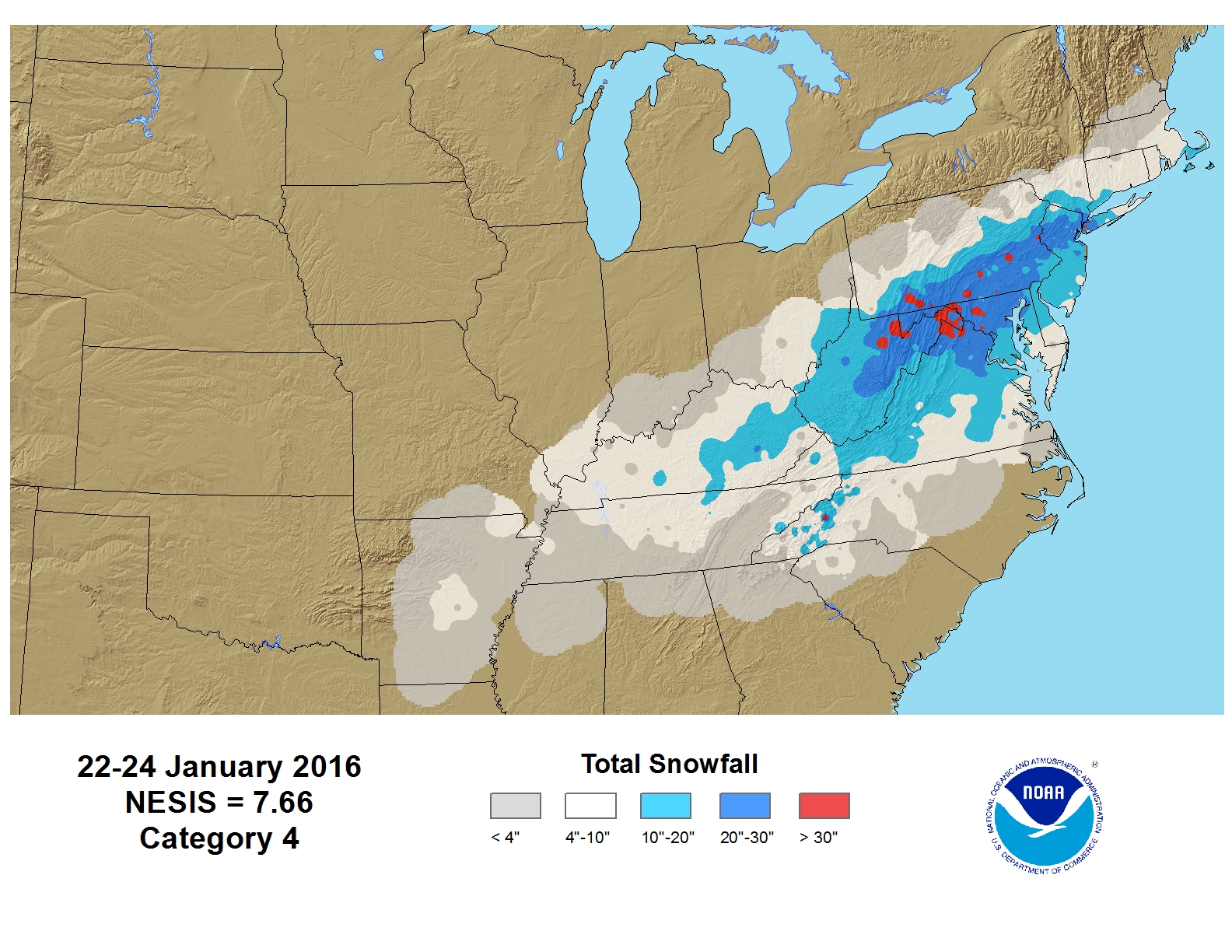
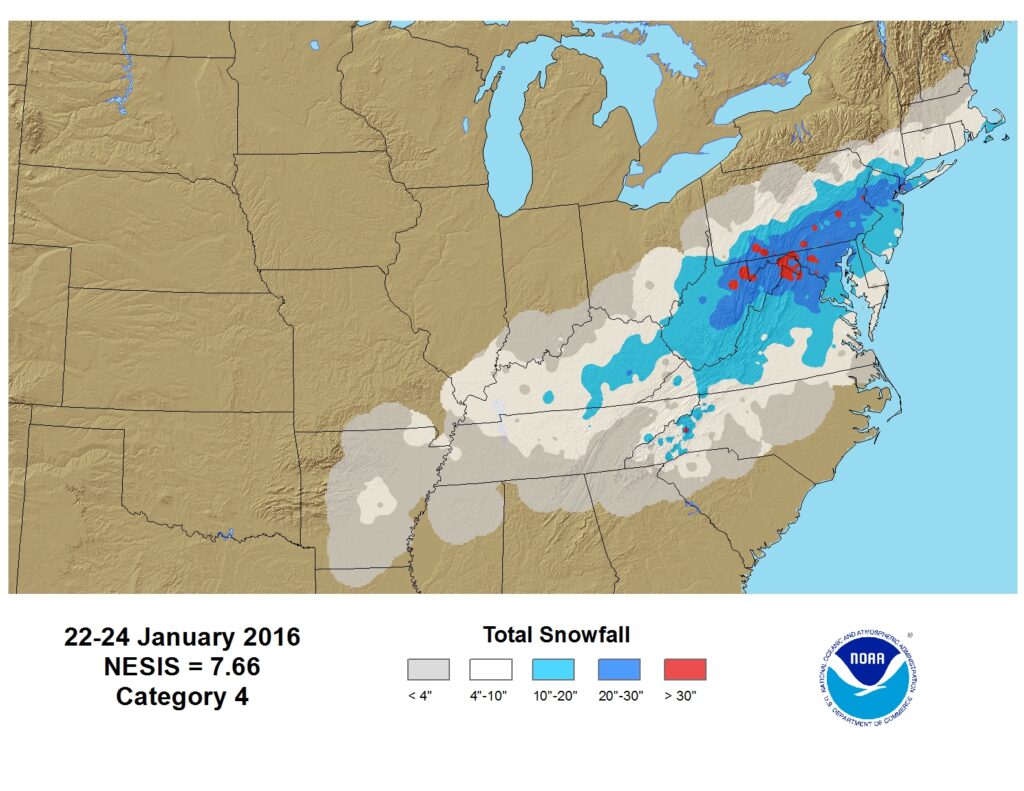
    It came with high winds, rounds of significant coastal flooding, extreme cold and, of course, snow. This nor’easter had it all, enough to make this the fifth most impactful northeast winter storm since records began in 1956, according to the National Oceanic and Atmospheric Administration (NOAA). For context, that’s between the slightly weaker Presidents Day II Blizzard of 2003 and the much stronger Blizzard of 1996.

    Regional wide snowfall totals from the Blizzard of 2016 (via the National Oceanic and Atmospheric Administration)

    Sadly, at least eight people died, according to NJ.com, and over 100,000 homes and businesses were without power. Moody’s Analytics estimated $4 billion in damage on the East Coast, in December 2025 dollars.

    Jonas is a good reason why my weather dad, Jim Eberwine, always says that we have a 12-month hurricane season here at the shore. Nor’easters around here are feared more for their flooding and wind than the snow itself.

    Flooding rivaling Sandy

    For those south of Brigantine, where Superstorm Sandy made landfall four years earlier in 2012, the Blizzard of 2016 brought even more significant flooding.

    Two rounds of flooding affected the Jersey Shore the mornings of Jan. 23 and 24. The combination of powerful, onshore winds, and the near-full moon drove feet of saltwater into beach towns in some locations.

    In Cape May Harbor, the NOAA tide gauge reached a record 9.36 feet above mean lower low water. That was more than a half foot higher than Sandy. Below are others that had a higher crest than Sandy.

    Delaware Bay (Cape May):

    • 8.98 feet in Jonas
    • 8.89 feet in Sandy
    • North Wildwood:
    • 9.44 feet in Jonas
    • 8.9 feet in Sandy

    Nearly every tide gauge, from Cape May to Tuckerton, was in major flood stage on Jan. 23. That made travel nearly impossible around the high tide (snow and ice aside) and brought water into homes and businesses that rarely see it.

    Farther north through Sandy Hook saw moderate flooding, similar to the flooding we had during the October 2025 nor’easter. Generally the flood level was 3 to 4 feet above normally high ground along the South Jersey shoreline.

    There were concerns about saltwater freezing on the roads on the nights of Jan. 23 and 24, as temperatures fell into the 20s. However, that mostly did not occur.

    Whipping winds

    Power outages were a problem for many at the Jersey Shore. Onshore winds were fierce and drove tidal flooding.

    Strathmere had the highest gusts at the South Jersey Shore, topping out at 64 mph at 6:28 a.m. on Jan. 23, according to the National Weather Service. Several places gusted at or over 60 mph, including Ocean City, Cape May and Pleasantville.

    However, the strongest winds were in Ocean County. Good Luck Point in Bayville took the top mark statewide at 72 mph. Good luck standing in that. Other Ocean County gusts on Jan. 23 included:

    • Tuckerton: 68 mph
    • Harvey Cedars: 64 mph
    • Beach Haven: 62 mph
    • Lakewood: 61 mph
    • Seaside Heights: 61 mph
    • Holgate: 61 mph
    • Beach Haven: 60 mph

    Beyond that, many beach towns, from Sea Bright to Cape May, gusted to at least 50 mph once.

    A decent amount of snow

    The fierce winds blew and snow drifted feet high. However, snow was more of a concern for inland folks rather than people in shore and beach towns.

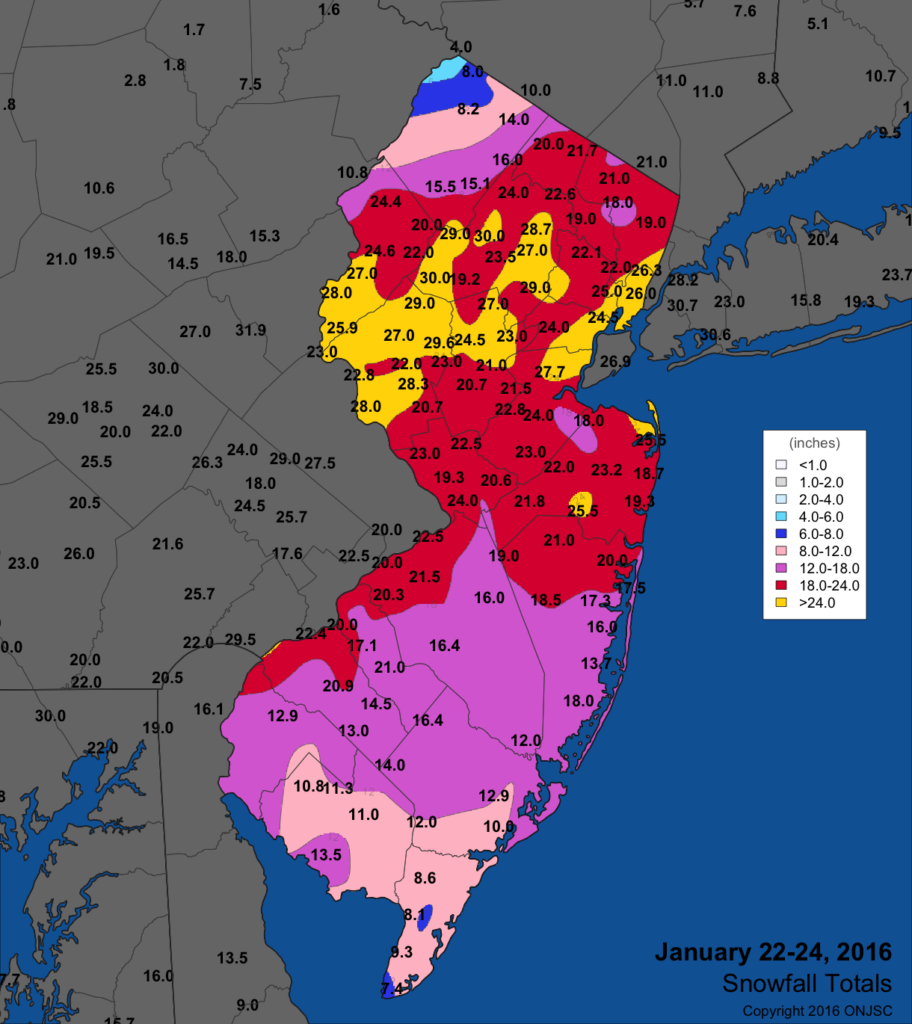
    The highest snowfall totals reported in Atlantic and Cape May counties were 17.5 inches in Buena Vista Township. Closer to the coast, Atlantic City International Airport picked up 12.9 inches. Wildwood Crest had 11.3 inches and Woodbine had 8.6 inches, according to data gathered by the Office of the New Jersey State Climatologist.

    In typical Jersey Shore fashion, we had a smorgasbord of precipitation types.

    “Snow began falling in the south during the early evening of the 22nd, moving steadily northward,” said Dave Robinson, the New Jersey state climatologist at the time.

    “The intensity of the storm grew overnight, with heavy snow falling by the morning of the 23rd, winds howling and ocean waters pouring into coastal communities at times of high tide… Early snow turned over into a mix of snow, sleet and rain in… coastal areas, before turning back to snow toward the storm’s end.”

    Snowfall totals from the Blizzard of 2016, via the Office of the New Jersey State Climatologist

    Farther north, it was a high-end snowstorm. Ocean County picked up 12 to 21 inches of snow. Monmouth County’s lower snowfall total was just 16.5 inches in Colts Neck. Rumson picked up 25.5 inches while on the beach, Long Branch saw up to 21 inches. NOAA’s fifth-place ranking aside, the Jersey Shore hasn’t had a winter storm bring quite the combination of snow, wind and tidal flooding since.

    For reference, The Blizzard of January 2022 saw 12 to 21 inches up and down the Jersey Shore. Drifts of snow were all around. Thankfully, there was no tidal flooding.

    Just a few weeks before that, there was significant flooding and wind in the snowy nor’easter of Jan. 3, 2022 (I was freezing in my rain boots in a foot of water off the White Horse Pike in Atlantic City). Snowfall totals of 9 to 15 inches buried South Jersey in snow. Once you got to Exit 88 on the Garden State Parkway, barely an inch fell.

    Is a big snow expected this winter?

    I don’t believe so. As mentioned in our winter outlook column, this looks more like the season for medium-sized snows without major tidal flooding, like the one 1/25 to 1/26 for the Jersey Shore. The prevailing storm track doesn’t favor the types of low-pressure systems that form off the Florida or Georgia Coast, and increase in strength as they move north.

    That being said, another bitterly cold outbreak is expected late in January through the first half of February. This may be a case of it being too dry to snow much. We’ll keep you updated.

    Joe Martucci, a Certified Broadcast Meteorologist and Digital Meteorologist, is the President and Director of Meteorology for Cup A Joe Weather and Drone. You can connect with him at cupajoe.sparkable.opalstacked.com/.

  • Tidal flooding continues upward trajectory

    Tidal flooding continues upward trajectory

    This article initially appeared in Shore Local News on Jan. 15, 2026

    The Jersey Shore had two memorable tidal flooding events in 2025 – August’s Hurricane Erin, and an October nor’easter. New analysis shows that while tidal flooding in 2025 was generally lower than in 2023 and 2024, most of the South Jersey shoreline still flooded more than it had in decades past.

    A plethora of smaller storm systems and astronomical high tide cycles also brought minor, or nuisance flooding. Despite the intensity of the flooding, the amount of coastal flooding events in 2025 saw a split, familiar to many, between North and South Jersey (I will not get into the merits of Central Jersey in this column).

    National Oceanic and Atmospheric Administration tide gauges from Ship Bottom down to Cape May, and out to the Delaware Bay show the number of 2025 coastal flooding events was above the period of record average, according to PJ Hondros of Stockton University’s Coastal Research Center in Port Republic. Here are a few examples:

    Ship Bottom, 35 floods in 2025. Long-term average of 28.

    Margate, 49 floods in 2025. Long-term average of 35.

    Ocean City, 34 floods in 2025. Long-term average of 31.

    This marks at least the third year in a row with the number of coastal flooding events above the long-term average. That average, mind you, is increasing as the number of yearly events increases.

    So, why are we seeing an uptick in coastal flooding events in South Jersey?

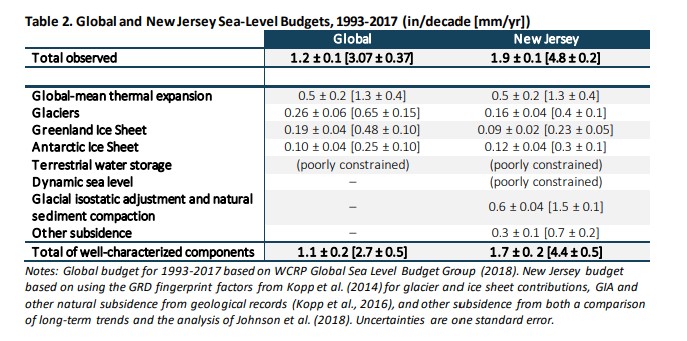
    Sea level rise is a great start and is one of the key coastal flooding components. Between 1911 to 2019, New Jersey’s sea level rose at more than twice the world’s rate – and 40% of it is directly due to man-made, greenhouse gas climate change, according to the Rutgers Scientific and Technical Advisory Panel.

    Sea level rise caused for the globe and New Jersey (via Rutgers Scientific and Technical Advisory Panel)

    This is primarily because water expands as it gets warmer, along with glacier melt. However, this rise in sea level cannot be entirely blamed on human-caused climate change. There are other unique factors that contribute to our rapid rise in sea level compared to the rest of the world.

    Most of South Jersey’s beaches are on barrier islands, surrounded by the back bays and the Atlantic Ocean. In addition, a lack of topography makes it easier for water from both sides (the ocean and the bay) to come into the streets where towns do not already protect the coastline.

    With or without a storm, many of these communities experience some degree of coastal flooding monthly during astronomical high tide cycles. Given that, any storm system traveling along or up the coast will only worsen flooding, especially during high tide. Thus, barrier island beaches are the biggest victims of coastal flooding.

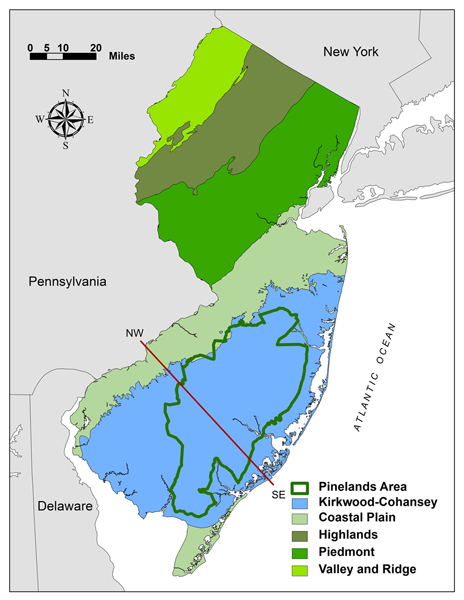
    Greenhouse gas emissions are a factor in sea level rise, but not most of the reason at the Jersey Shore. Depletion of the underground Kirkwood-Cohansey Aquifer, from Brick Township in Ocean County to Dennis Township in Cape May County, is a prime contributor, too. Increasing population at the Jersey Shore over the years has created a greater demand for water.

    Via the State of New Jersey.

    This depletion of water from the aquifer has caused the ground above it to sink. As a result, decreasing elevation levels are magnifying sea-level rise, making the Jersey Shore more susceptible to coastal flooding.

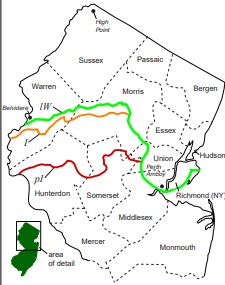
    Furthermore, there’s glacial rebound. From roughly 25,000 to 18,000 years ago, a glacier went as far south as present-day Raritan River in North Jersey. The glacier is long gone, however the land is still shifting around from that glacier retreat. That’s also elevating sea levels.

    Southward extent of NJ glaciers from 25,000 to 18,000 years ago.

    The opposite is true for the northern Jersey Shore beaches. From Sandy Hook to Ship Bottom, tidal flooding was lower than average. Regardless, coastal flooding still brought its fair share of impacts to some of Monmouth and Ocean counties’ most vulnerable spots.

    Year-to-year fluctuations in the number of coastal flooding events are to be expected at specific shore locations. Yet, looking at the Jersey Shore as a whole, one cannot deny the upward trend in coastal flooding events, and the reasons behind them.

    As for this year, there has been no tidal flooding yet. Let’s hope it stays that way for a while.