Category: Shore Local Magazine

  • The 7 things NJ should know about weather in 2026

    The 7 things NJ should know about weather in 2026

    This article first appeared in Shore Local News on Jan. 8

    I can’t forecast the Jersey Shore weather 365 days out, but given a full year of a new president, and the recent election of a new governor, expect behind-the-scenes, policy-side changes when it comes to meteorology.

    Overall, 2025 was a pretty quiet year for big weather and climate events at the Jersey Shore. We need to keep it that way. Here’s what to keep an eye out for in the year ahead.

    How bad will the drought get?

    It’s No. 1 on my list of top 10 weather events of 2025, and we’ll carry this over into our lookahead column for 2026.

    The fifth wettest May on record going back to 1895, according to the New Jersey State Climatologist, pulled New Jersey out of the most significant drought since 1999-2002.

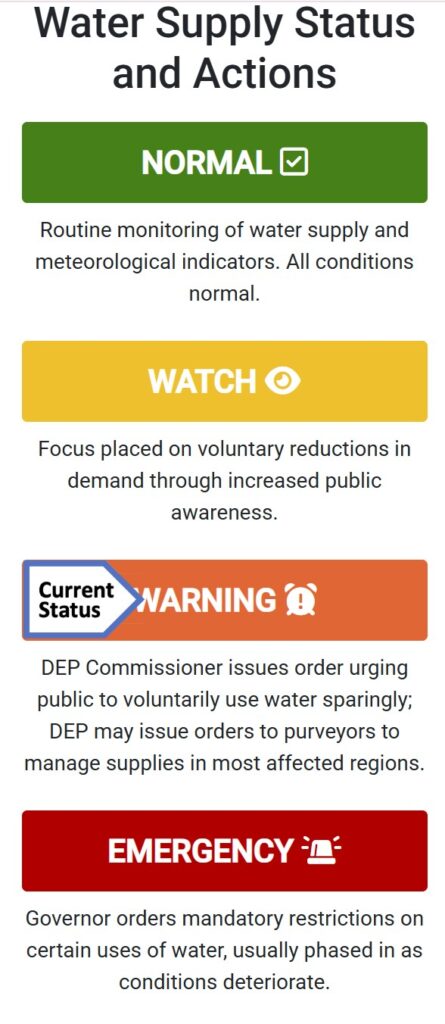
    However, it was brief. Summer was dry and on Dec. 5, the New Jersey Department of Environmental Protection returned the state to Drought Warning status. That brought voluntary water conservation.

    The United States Drought Monitor has the Lower Cape, the Delaware Bayshore and essentially the western half of the state in one of the four drought stages. A dry January may be good for your health, but it will hurt the heartbeat of New Jersey’s nature.

    The Climate Prediction Center gives “equal chances” for either a wetter or drier rest of the winter. Hopefully, it will get wetter. If it doesn’t, expect an active forest fire season. Don’t be surprised if the state issues its first Drought Emergency, with mandatory water restrictions by the governor.

    Will NJ REAL laws pass?

    Speaking of governor, New Jersey will have a new one in 2026. Mikie Sherill takes the top spot in New Jersey government on Jan. 20. Also in January is the “anticipated adoption” of the Resilient Environments and Landscapes (REAL) rules to change environmental land use regulations by the New Jersey Department of Environmental Protection.

    The NJ REAL rules will mandate a variety of changes. Most notably for the shore, however, would adjust the Base Flood Elevation (BFE) level upward. That’s the height floodwaters are expected to reach with a 1% chance in any given year. If you live in a flood zone with a federally backed mortgage, your lowest floor must be at or above the BFE.
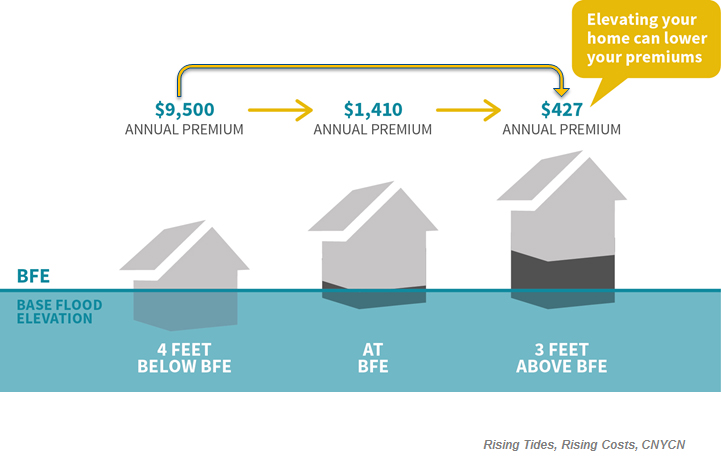
    BFE stands for Base Flood Elevation. In 2026, BFE could increase in New Jersey, raising the height homes with federally backed mortgages would have to be.

    Right now, the state requires structures in flood zones to be one foot higher than BFE. The NJDEP first proposed this to go up to five feet above BFE, based on a 17% chance sea levels will rise that amount by 2100. However, after public feedback, it was revised to four feet.

    The current DEP commissioner is Shawn LaTourette, who’s served since 2021. At the time of this writing (Jan. 8), Gov.-Elect Sherill had not announced whom the DEP commissioner will be.

    If she keeps LaTourette, expect new homes at the Jersey Shore to go higher to protect against flooding. If a different commissioner comes in, you may see a quick change, or removal, of the NJ REAL rules.

    How will NOAA look?

    Over 2,400 National Oceanic and Atmospheric Administration employees departed from NOAA during the first months of 2025. Losing the 27,000 years of combined experience was a byproduct of the Department of Government Efficiency (DOGE)’s cost-cutting crusade. That was a 20% cut.

    NOAA helps keep people safe in the United States by providing daily weather forecasts, warnings of dangerous storms and information about long-term climate changes through its National Weather Service.

    Since then, some jobs have come back. NOAA is hiring again. President Donald Trump and the Senate also tapped Dr. Neil Jacobs to be administrator. He held the “acting” role from 2019-2021.

    Jacobs is generally seen as a good pick by the NOAA employees, although he got in trouble for violating NOAA’s code of ethics in September 2019 during Hurricane Dorian.

    One of the major changes in the new year is that the National Weather Service, which is under NOAA, can hire for positions directly. This allows our local office in Mount Holly, for example, to act quickly to fill vacancies.

    Can AI weather models progress more?

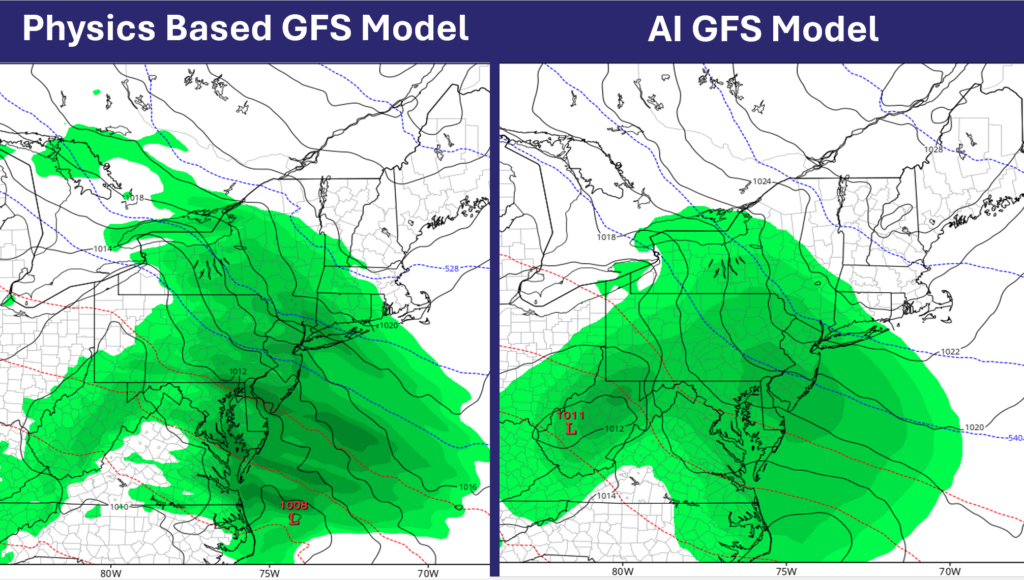
    Speaking of the United States Government, NOAA took a big leap forward at the end of 2025 with the announcement of three new artificial intelligence weather models.

    The AI models are different. They take the current and recent state of the atmosphere, but they look for similar patterns in the weather that have happened before, with some physics. It then uses what happened in the past as a basis for what will happen in the future.

    American, European and Google weather computer models have been better over their traditional physics-based counterparts. A downside has been the resolution of the forecast is lower than the physics-based models. If we can improve that in 2026, the old way of computer model forecasting will probably be out.

    Changes at the National Hurricane Center

    Each year, the NOAA’s National Hurricane Center, based in Miami, Fla., releases a list of updates and changes to the way they conduct business. Last year brought six changes. This always involves updating the size of the forecast track cone, which shows an area with a 66% chance of the storm’s eye to be in.

    We’ve seen drastic improvements in the size of the forecast cone over time, allowing emergency managers, mayors, police, fire and meteorologists to tell you more accurately if you’ll be in harm’s way or not. Expect to see another slight improvement this year.

    Easier to understand National Weather Service forecast discussions

    The National Weather Service in Mount Holly, our local office, is hoping you will read more of their forecast reasonings this year.

    The “Area Forecast Discussion,” the NWS office’s way of explaining why the forecast will be the way they predict, switches from chronological order to severe impact order. If a nor’easter is hitting five days from now, that will be talked about first, not the forecast for tonight.

    They will also include a “What Has Changed” section. This is an easier way to see their updates than before.

    This change began on Jan. 6. So, you can see it now by going to www.weather.gov/phi and clicking on the “forecast discussion” link.
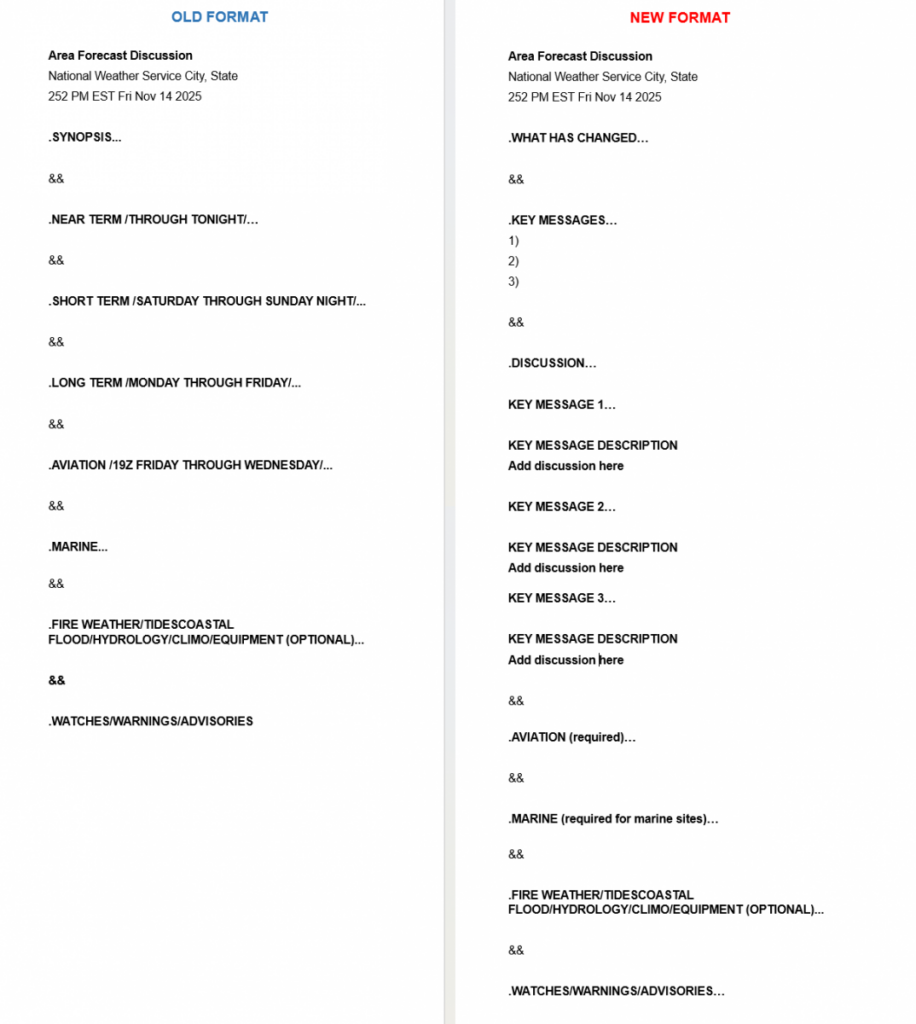
    Via the National Weather Service

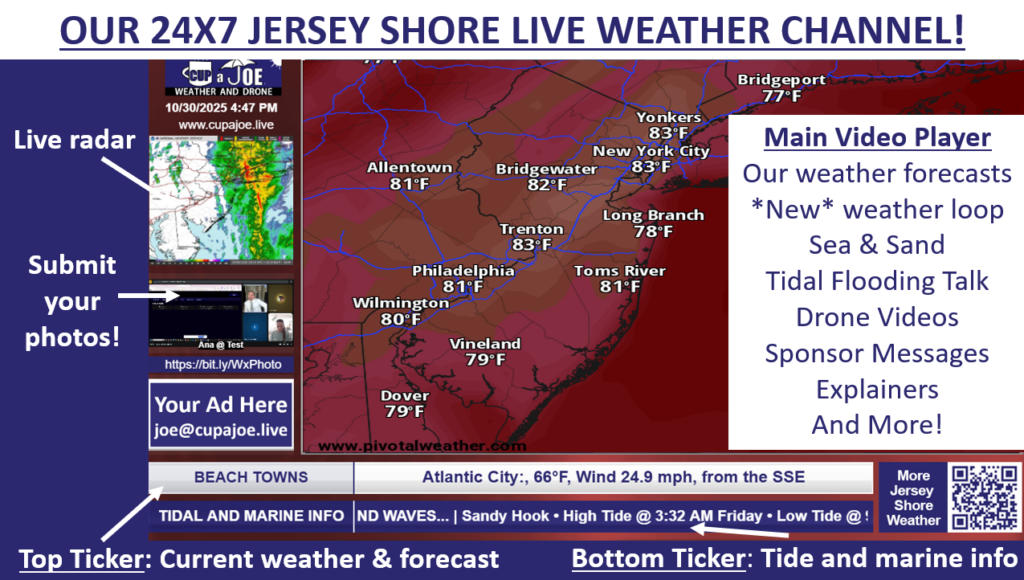
    Updates to Jersey Shore Streaming Weather Channel

    Ok, a little self-promotion here. The Jersey Shore’s 24×7 streaming weather channel launched on YouTube in November. I do have improvements for 2026, though.

    Soon, you’ll get a better-looking radar loop, which shows blue for snow, green for rain and is labeled with towns. You’ll also have more Jersey Shore local weather in the main player with automated, up-to-the-minute conditions. Plus, we’re looking to add webcams to the feed. So, if you have a webcam you’d like to share with us for the channel, reach out!

  • The Jersey Shore’s Top 10 Weather Events of 2025

    The Jersey Shore’s Top 10 Weather Events of 2025

    This article initally appeared in Shore Local magazine on Dec. 30, 2025

    A variety of weather and near weather events grace my Jersey Shore top 10 events of 2025 list. However, there are two notable absences.

    Snow did not make my list, at least not directly. The snow on Dec. 14 did peak at the Jersey Shore, but the highest totals were only in northern Ocean and Monmouth County. Feb. 11-12 was the opposite. Atlantic and Cape May counties picked up five to nine inches of snow. The northern part of the shore had less, while typically snowy Sussex County barely had a flake. There was no unifying Jersey Shore storm like the blizzard of 2022.

    Also absent is yearly warmth. For the first time since 2014, the Jersey Shore will fall outside of the top 20 for hottest years since reliable records began in 1895, according to Dave Robinson, the New Jersey State Climatologist, while also my “weather dad” and May 13 birthday buddy.

    However, a stretch of extremely hot days did make the top 10, so did muggy weather, severe weather, frigid weather, nor’easters, tropical systems, among other things.

    Note that the data below is from the National Oceanic and Atmospheric Administration, unless written otherwise.

    Let’s get into it.

    10) Fortescue’s stifling high dew point on July 25

    Fortescue juts out into the Delaware Bay in Cumberland County, allowing the sometimes very warm water to come onto the marshy land. Bay waters in the 80s paired with a very sultry wind from the Deep South brought the dew point to an astounding 88 degrees at 4 and 5 p.m. that day. That makes for extremely uncomfortable heat indices:

    2 p.m.: 106 degrees

    3 p.m.: 112 degrees

    4 p.m.: 121 degrees

    5 p.m.: 118 degrees

    6 p.m.: 120 degrees

    7 p.m.: 118 degrees

    8 p.m.: 109 degrees,

    9 p.m.: 97 degrees.

    A heat index of 109 degrees at 8 p.m. here is rare. A 121-degree heat index maybe happens three times a year in New Jersey, and it’s only for one town.

    Most places in New Jersey never experienced a dew point that high in their record. So, while this only happened in one small community, its impact is might enough to be number 10.

    9) Severe heat to severe weather on July 25

    Inland high temperatures were as high as 100 degrees (Toms River) with everyone else in the mid to upper 90s. Couple that with high dew points and it was sweltering in the sun.

    As is often the case, though, big-time heat means big time thunderstorms.

    During the evening, a cold front pushed in from the northwest. The result was a line of thunderstorms that brought many downed trees and powerlines to Ocean and Monmouth counties. Beach Haven, in Long Beach Island had a waterspout. Further north, Seaside Park registered a wind gust of 66 mph.

    8) White Christmas drought continues

    For the fifteenth year in a row, most of the Jersey Shore went without a White Christmas, the longest on record. Officially, a definition of a White Christmas is at least one inch or snow on the ground Christmas morning. Here were the last White Christmases, by location.

    Atlantic City International Airport: 2009

    Long Branch, Monmouth County: 2009

    Lower Township, Cape May County: 2000

    Well inland parts of the northern coastal counties did have a White Christmas in 2024 but for most of our area, it’s been a while. Sorry, Santa.

    7) Impressive late winter cold

    February 18-20 was the latest three-day streak of sub-freezing temperatures in decades.

    At Atlantic City International Airport, Sen. Frank S. Farley State Marina in Atlantic City and Lower Township, the last time this happened this late or later in winter was in 1993.

    ACY airport and Long Branch were below 30 degrees all three days. That hasn’t happened since 1980, at the very end of February and beginning of March.

    6) June 21-25 Heat Wave

    We just went from one of the latest cold snaps on record to one of the earliest streaks of 100-degree heat.

    At Atlantic City International Airport, the temperature hit a hot 102 degrees on two days in a row, June 24 and June 25. The last time the airport had two days in a row reaching 100 degrees or higher was during the big heat wave in July 2011. These 100-degree days were the third earliest on record. When looking only at days that reached 102 degrees, they were the second earliest.

    Of course, those two days broke the daily records for June 24 and 25. The airport also set a daily record on June 23 with 98 degrees.

    Even the beaches felt the heat. At the Atlantic City Marina, June 23 was the first day of 90 degrees since 2022, reaching 93 degrees and breaking a daily record. Two days later, it tied another record high at 95 degrees.

    During the six-day heat wave from June 21 to 26, both the airport and the marina set records for the warmest low temperatures at night.

    5) October 12-13 Nor’easter

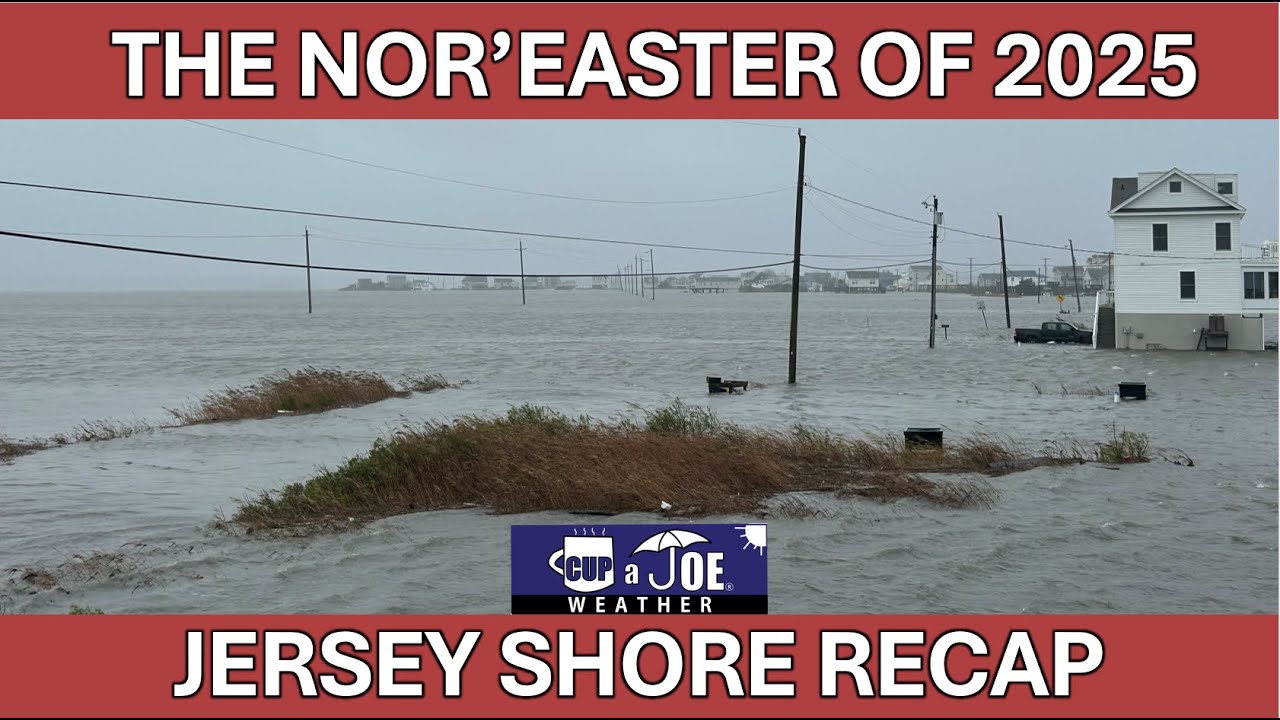
    This is the first of two big tidal flooding events of the year.

    Powerful onshore winds stacked the bays, bringing flooding conditions to five consecutive high tides. In the back bays, the constant onshore wind prevented the salt water from fully draining out before the next high tide.

    Waretown, Ocean County, reported its highest tide on record. That being said, records only go back to 2018. Several gauges reported top 10 tidal heights since at least the year 2000. Numerous roads were closed due to tidal flooding and places that do not usually have tidal flooding did.

    The most northern Jersey Shore town, Sea Bright, had 18 occupants removed from 12 flooded vehicles on Ocean Avenue, the only main road in town.

    Atlantic City, Harvey Cedars, Little Egg Harbor and Seaside Heights had gusts over 50 mph on both Oct. 12 and 13. Sea Girt gusted to 51 mph on Oct. 13. Even Oct. 13 gusted over 40 mph in a few beach towns.

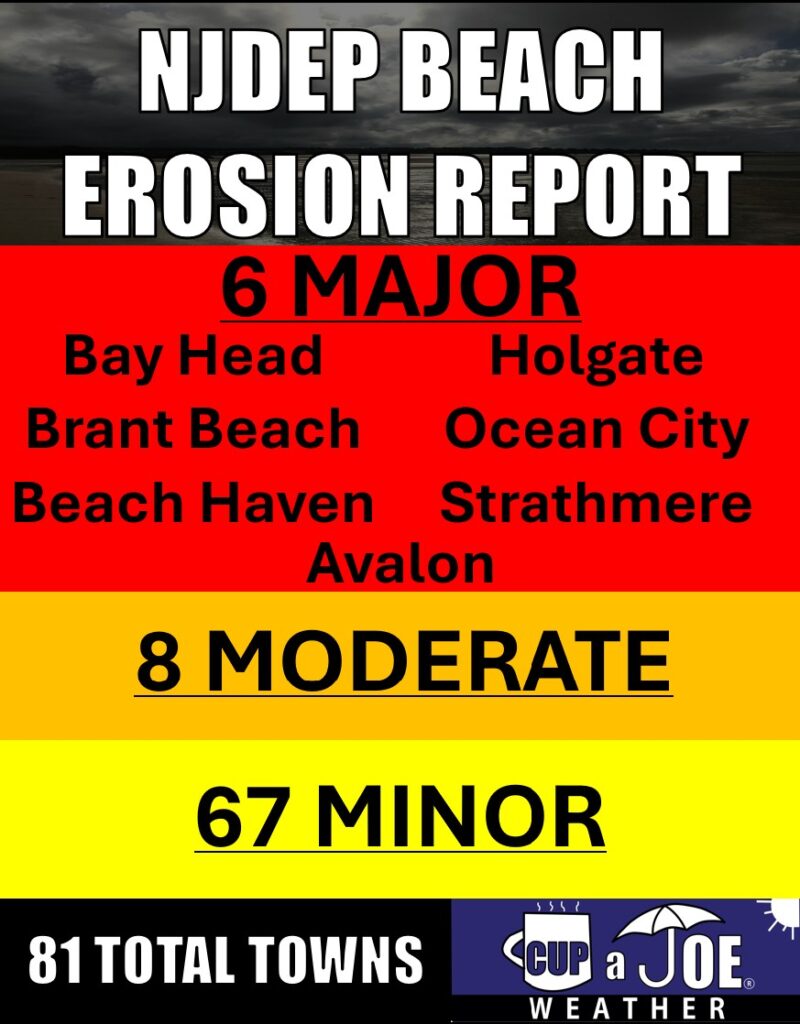
    Six of the 81 beaches inspected by the New Jersey Department of Environmental Protection had major erosion. Another eight had moderate erosion.

    4) Whipping Winter Winds

    I cheated for this one, but since the strongest winds were after December 2024, I’ll count it for 2025.

    The average December-March wind speed at Atlantic City International Airport and Ocean County airport was the highest since the winter of 2010-2011. Lower Township had the breeziest wind since 2017-2018.

    Bad hair days and frigid faces were common all winter long. January 2025 had 16 days with gusts over 40 mph somewhere within the New Jersey Weather Network stations, run by Robinson and the state climate office. That was a record high for the network

    The winter also was the most or was tied for the greatest number of wind advisory for 46-57 mph wind gusts for Atlantic and Cape May counties since we started keeping track in 2006.

    A few days were extremely windy.

    Feb. 16-17: ACY Airport had the second highest wintertime gust on record, since 1943. It clocked in at 71 mph. Most shore counties gusted over 45 mph. Over 200,000 thousand people were without power throughout the state.

    March 5-7: Winds gusted over 50 mph in Fortescue and Woodbine, with many others in the 40s.

    People have asked me for years if it’s been windier at the Jersey Shore in recent years. While it’s a hard sell after this winter, the answer is still no, it’s not gotten windier.

    3) Hurricane Erin August 20-22

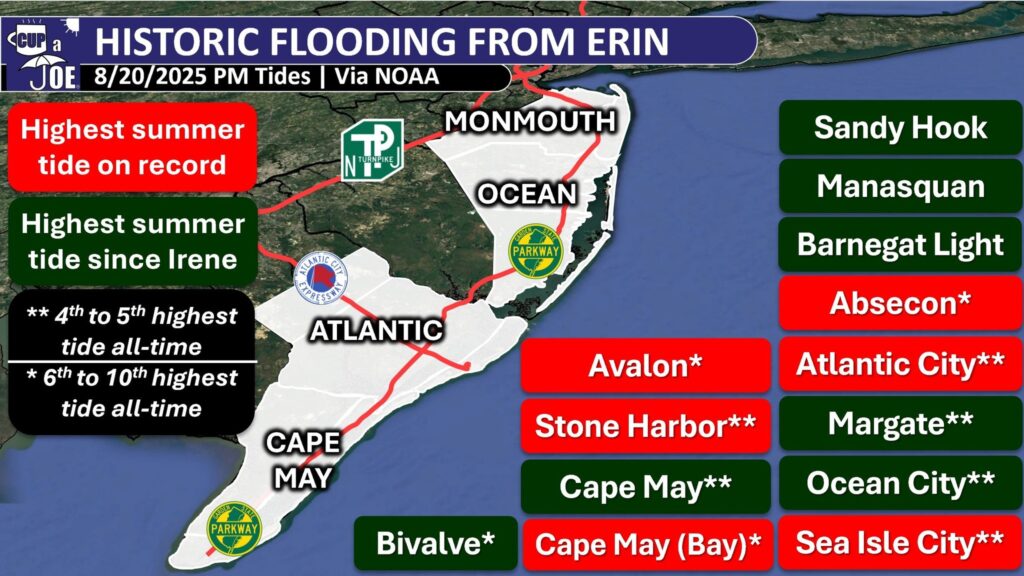
    This is probably the most significant hurricane with virtually no meaningful rainfall in the shore’s history. Hurricane Erin’s eye always stayed at least 400 miles away. Yet, the following happened Let’s go through the stats:

    The highest summertime tide on record for Atlantic City, Absecon, Sea Isle City, Stone Harbor, Cape May (bayside).

    The highest summertime tide since Tropical Storm Irene in 2011 for virtually every other tidal station on the Jersey Shore.

    Closed beaches on Aug. 20, 21 and 22. 50 water rescues due to tidal flooding in Margate.

    Water rescues on the Black Horse Pike and White Horse Pike between Atlantic City and the mainland.

    Ocean wave heights of 10 to 15 feet.

    Wave periods at an extremely long 15 seconds or more.

    Nine beaches had moderate beach or dune erosion.

    Thankfully, no deaths from the high surf and rip currents occurred.

    While many of us typically associate hurricane season in New Jersey in September and October, this was a good reminder that hurricane season runs during our busiest time of the year at the coast, the summer.

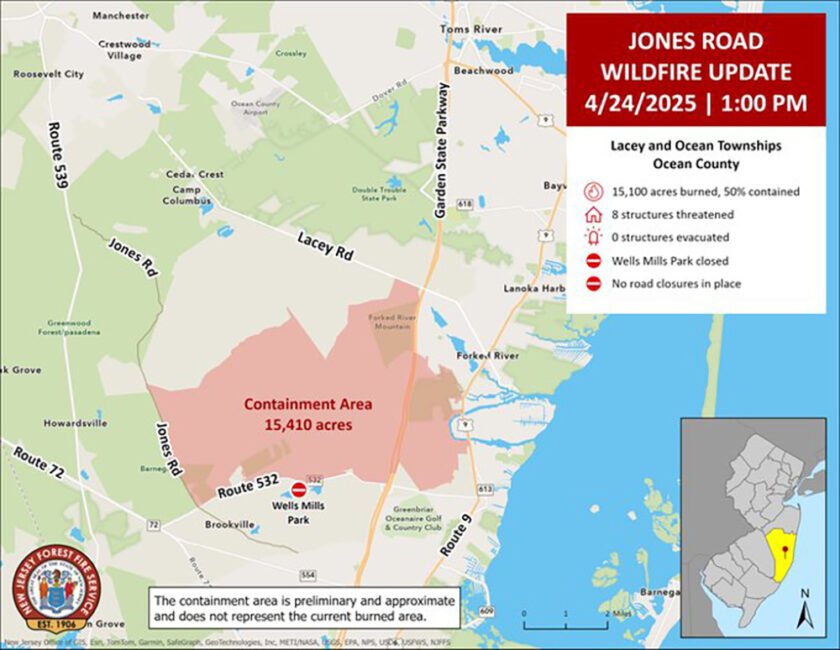
    2) The April Jones Road Fire

    Via NJ Forest Fire Service

    The Jones Road Fire, which was first spotted at 9:45 a.m. on April 22, was the fourteenth largest fire in the state’s period of record. It swallowed up 23 square miles in Ocean County, or a little over 15,000 acres, according to the NJDEP.

    It started on April 22, 2025, from a bonfire that two teenagers did not put out all the way. Dry weather, strong winds, and low humidity helped the fire spread quickly.

    Thousands of people had to leave their homes for safety, the Garden State Parkway closed, and smoke made the air bad even in New York City.

    One commercial building and some outbuildings were destroyed, but no homes were lost and no one was hurt. Firefighters worked hard and stopped the fire completely on May 12, 2025.

    From Jan. 1 to April 25, 662 wildfires occurred in New Jersey.

    Last year through April 25, about half as many wildfires occurred.

    The difference was drought. When the Jones Road Fire began, that area was in a transitionary state between drought and no drought, known as abnormally dry conditions, according to the United States Drought Monitor.

    1) Drought

    The Jones Road Fire was caused, in part by the drought. The first four months of 2025 continued the significant drought that ramped up severely during the driest Fall on record in 2024.

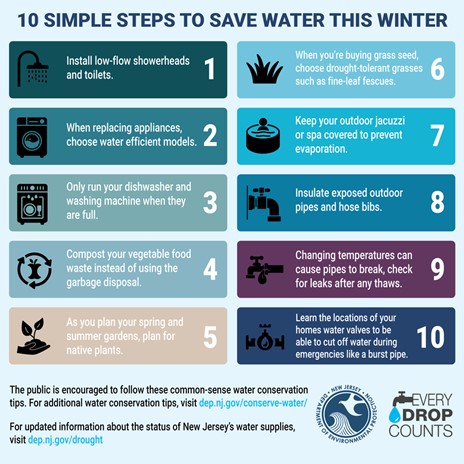
    Voluntary water restrictions were in place. New Jersey American Water urged customers to reduce water usage.

    Via NJ Department of Environmental Protection

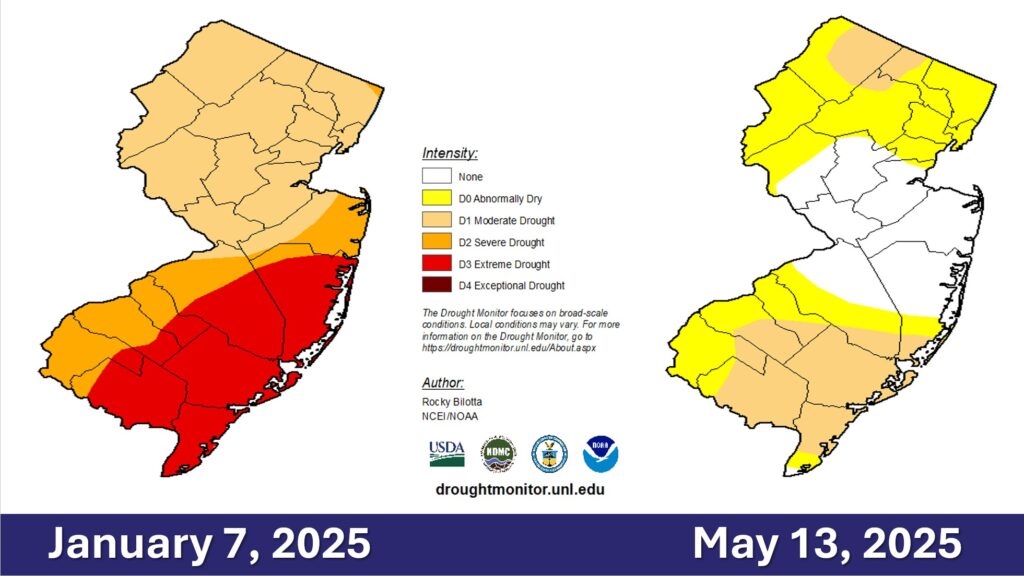
    The United States Drought Monitor had at least part of the Jersey Shore in one of the four stages of drought until May 20. An ‘extreme drought,’ the second highest level of drought gripped Ocean County south to Cape May until early March.

    Via the United States Drought Monitor

    Groundwater from the Kirkwood-Cohansey aquifer in the southern half of the shore counties was ‘extremely dry” through May. Streamflows at the Jersey Shore were ‘extremely dry’ for 32 weeks in a row to start off the year.

    The NJDEP continued the Drought Warning in the state on June 11. Even then, Cape May, Atlantic and most of Ocean counties were downgraded just to a Drought Watch, instead of normal conditions like the rest of the state.

    The fifth wettest May on record dating back to 1895 busted the drought. However, it was only temporary.

    A Drought Warning returned to the state on Dec. 5. Voluntary water restrictions are in place. Extremely dry streamflows and groundwaters returned during the Fall for most of the Jersey Shore. Most of Cape May County joins the western half of the state in drought according to the United States Drought Monitor.

    More than likely, December will wind up drier than average across the coastal counties. That puts a lot of pressure on January and February to have more precipitation than average.

    If not, more fires like the Jones Road one threatens going into Spring.

    Finally…

    Dave Robinson, the state climatologist, and I will compare our top weather events of the year during our Monthly Weather Roundup. Look for that on the Cup A Joe Weather and Drone website as well as social media channels on Dec. 30.

    He put the October nor’easter above Hurricane Erin, but our number one and two events are the same. What do you think of the list? Leave me a note.

    Have a fun, safe New Year. Looking forward to sharing more with you on Shore Local in 2026.

  • America just developed 3 AI forecast weather models, including 1 bold new one

    America just developed 3 AI forecast weather models, including 1 bold new one

    Following in the footsteps of the European weather community, Google, and others, the National Oceanic and Atmospheric Administration (NOAA) has entered the artificial intelligence weather forecast model arms race, and it may have done enough to become the leader.

    The government agency, responsible for the National Weather Service and the authority for weather alerts in this country, released three different AI models in a press release on Dec. 17.

    “NOAA’s strategic application of AI is a significant leap forward in American weather model innovation,” said Neil Jacobs, NOAA administrator. “These AI models reflect a new paradigm for NOAA in providing improved accuracy for large-scale weather and tropical tracks, and faster delivery of forecast products to meteorologists and the public at a lower cost through drastically reduced computational expenses.”

    Until now, if I wanted to use an American weather forecast model that is publicly accessible, I would use a physics-based model like the Global Forecast System, or the High-Resolution Rapid Refresh model. In short, it takes the current and recent state of the atmosphere, and runs it into a long math equation. The solution is generated and then we turn it into pretty graphics.

    The AI models are different. They also take the current and recent state of the atmosphere, but they look for similar patterns in the weather that have happened before, with some physics. It then uses what happened in the past as a basis for what will happen in the future.

    The European computer models, Google, etc., have all created deterministic models, which give the highest likelihood scenario, as well as an ensemble forecast, which gives a range of reasonable scenarios.

    However, this new announcement from the United States government puts an important twist on these, one that may well put the U.S. in first place for the best forecasts. The United States just launched a new weather forecasting system called the Hybrid Global Ensemble Forecast System, or HGEFS for short.

    The coolest part is how it works. It mixes two different kinds of forecasts to make one super-strong one. It takes predictions for a new AI ensemble model (AIGEFS), and combines them with predictions from the older, traditional physics-based model (AIGFS). Together, they aggregate a huge, 62-simulation “super team” of forecasts.

    According to NOAA, this new HGEFS beats both the traditional system (called GEFS), and the pure AI system (AIGEFS) in almost every important test of accuracy.

    “As far as we know, NOAA is the first weather organization in the world to run a system like this that blends regular, physics-based forecasts with AI ones,” according to NOAA.

    Free computer weather model websites like TropicalTidbits.com or PivotalWeather.com (which you see in my weather videos) have these on their websites, free to view.

    Now, to be fair, artificial intelligence has always existed in computer weather models, just a more primitive form.

    Those physics-based models, like the GFS, used machine learning – a form of AI – to support the physics equations on the supercomputers. The AIGFS, and the other NOAA models, launched the use of “deep learning” to lead the way.

    Secondly, the AI models – not just with NOAA, but with the Europeans – have less resolution than their physics-based counterparts. For example, the physics-based GFS starts with finer detail (about 13 km early on), which helps with local features like storms.

    The AI version of the American GFS computer model has benefits, but still forecasts for the globe at a lower resolution than the physics based GFS computer model (via TropicalTidbits.com)

    The AIGFS sticks to 28 km globally, coarser than GFS’s best. The AIGFS only forecasts out in six-hour intervals whereas the GFS does so at three-hour intervals for the first 10 days.

    Still, when matching up the new wave of AI models to the old ones, there’s a lot of promise to make your Jersey Shore forecast even more accurate.

    For example, adding the new AI-based forecast to the mix lets us make reliable predictions a full day further into the future than we could with the traditional physics-based models alone.

    For meteorologists and weather weenies alike, these AI models will come out more often. The physics-based GFS runs four times a day. This can run more than 24 times a day, giving us that critical data more quickly.

    Finally, these forecasts mean little if they’re not in the hands of a degreed meteorologist. This AI computer model news from NOAA gives us an ever sharper, easy-to-access tool in our toolbox. However, we are the ones who fit the data into your local forecast and communicate clearly to you what it means.

    Those with the American Meteorological Society’s Certified Broadcast and Certified Digital Meteorologists do so at the highest level.

    Joe Martucci, a Certified Broadcast Meteorologist and Digital Meteorologist, is the President and Director of Meteorology for Cup A Joe Weather and Drone. You can connect with him at cupajoe.sparkable.opalstacked.com/.

  • For the 16th year in a row, no White Christmas forecast at the Jersey Shore

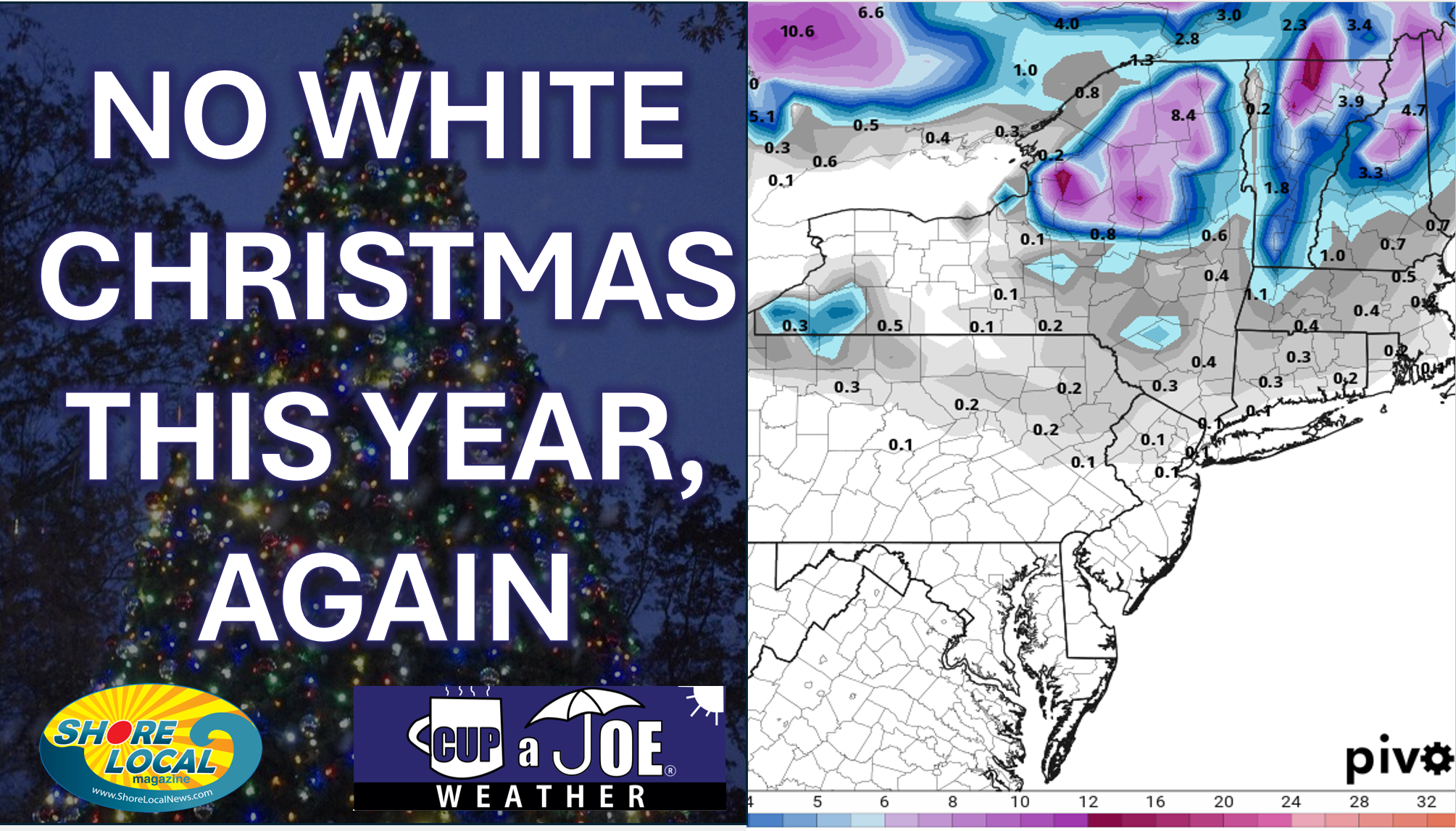
    For the 16th year in a row, no White Christmas forecast at the Jersey Shore

    It’s been one of the coldest starts to December on record at the Jersey Shore. However, a thaw is here, leaving our chances of a white Christmas at near zero.

    This article first appeared in Shore Local News on Dec. 18

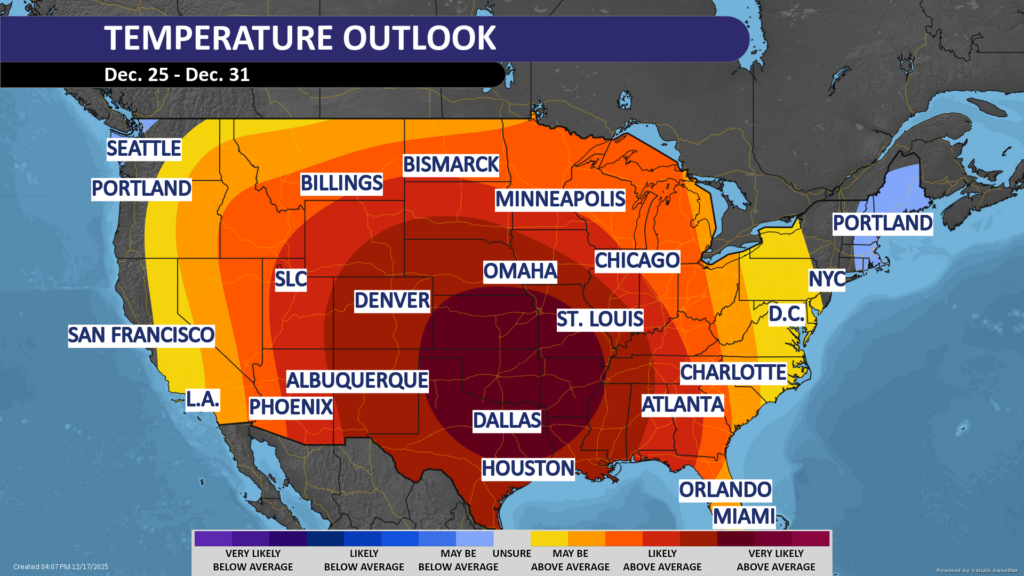
    The Climate Prediction Centerhttps://www.cpc.ncep.noaa.gov/, part of the National Oceanic and Atmospheric Administration (NOAA) is leaning toward above average temperatures for the days around Dec. 25. It’s not just here either. The center is leaning toward most of the Lower 48 being milder than average, with the best chances of warmth in the Deep South and Southern Rocky Mountains.

    Image and forecast is from Dec. 18, 2025

    I know some of us can’t stand the snow, but I believe most of us agree that snow during the holidays is nice to see, for at least a little bit. But our frigid weather came too early.

    At Atlantic City International Airport, the likelihood of an official white Christmas — at least 1 inch of snow on the ground — is 6%. There’s also a 6% chance of any snow at all falling on Christmas.

    Farther south, Lower Township has a 5% chance of a “technical” white Christmas, with the probability of snow falling on Dec. 25 at 3%.

    Up the coast is where the best chance of a Jersey Shore white Christmas can be found. Long Branch has a 15% chance of at least 1 inch of snow on the ground, and a 7% chance that Dec. 25 will have at least some snowfall throughout the holiday.

    Our last official white Christmas at the Jersey Shore was in 2009. Do you remember that one? I was a freshman at Rutgers University then. I still remember waking up at my parents’ house in Central Jersey and seeing how bright Christmas morning was with the sun reflecting off the snow.

    We got darn close last year, though. A cold front brought snow showers on Dec. 24, 2024. However, only a trace, or unmeasurable amount of snow was recorded. Your grass or car may have been dusted with snow, but Christmas Day, it was gone.

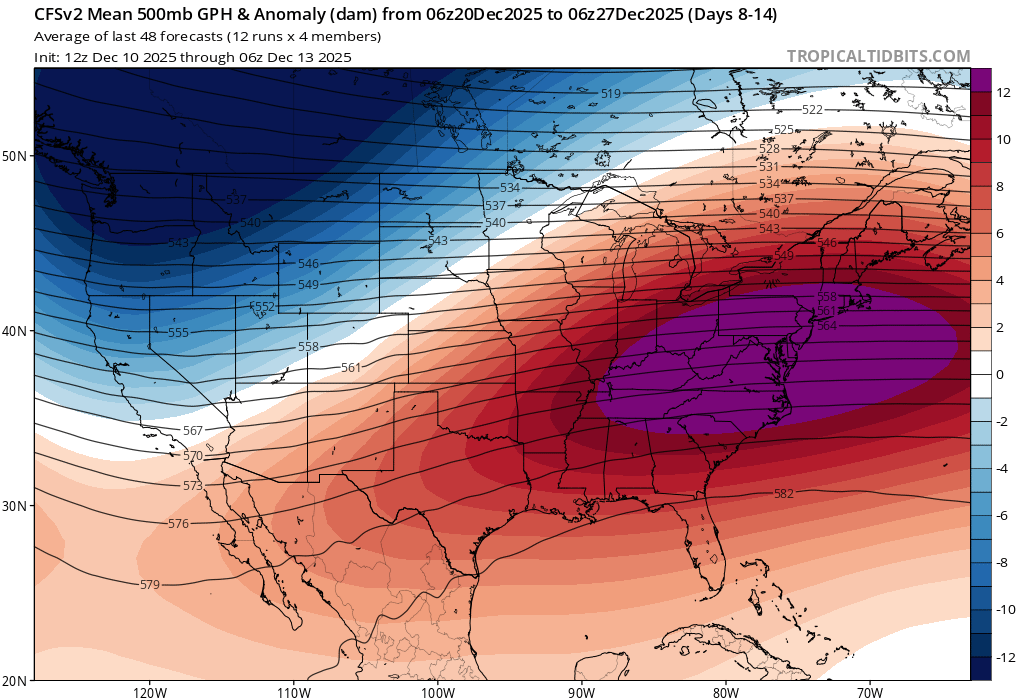
    The big feature in our weather forecast next week will be a thicker-than-usual atmosphere over the Northeast. Called a ridge, this thicker atmosphere can hold more heat in. On the surface, high pressure should more or less hang out near Bermuda. That means a milder wind out of the south most days, including Christmas.

    The forecast for roughly 18,000 feet high above sea level for the week of Christmas. The purple area over New Jersey means the atmosphere, is much thicker than usual for December. That allows for warmer air to potentially move in.

    While winter time Bermuda highs don’t bring hazy, hot and humid weather like they do during the summer, they do keep the Snow Miser out.

    Highs around 50 degrees seem like a good bet to make as I write this 7 day before the holiday. I feel pretty confident that the beaches will be above freezing Christmas morning, too. A little precipitation is possible but this would very much likely be rain, not snow.

    We’ll take it, the New Jersey Department of Environmental Protection has us in a drought warning – but anything that does fall wouldn’t ruin travel plans, though.

    Traveling across the United States next week looks fairly good, too.

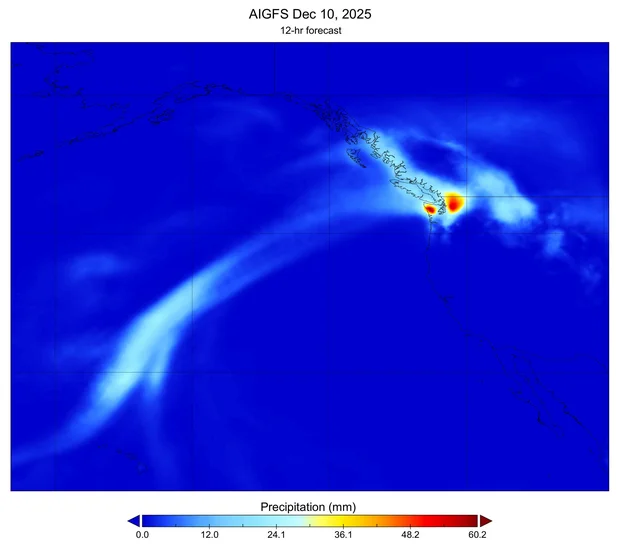
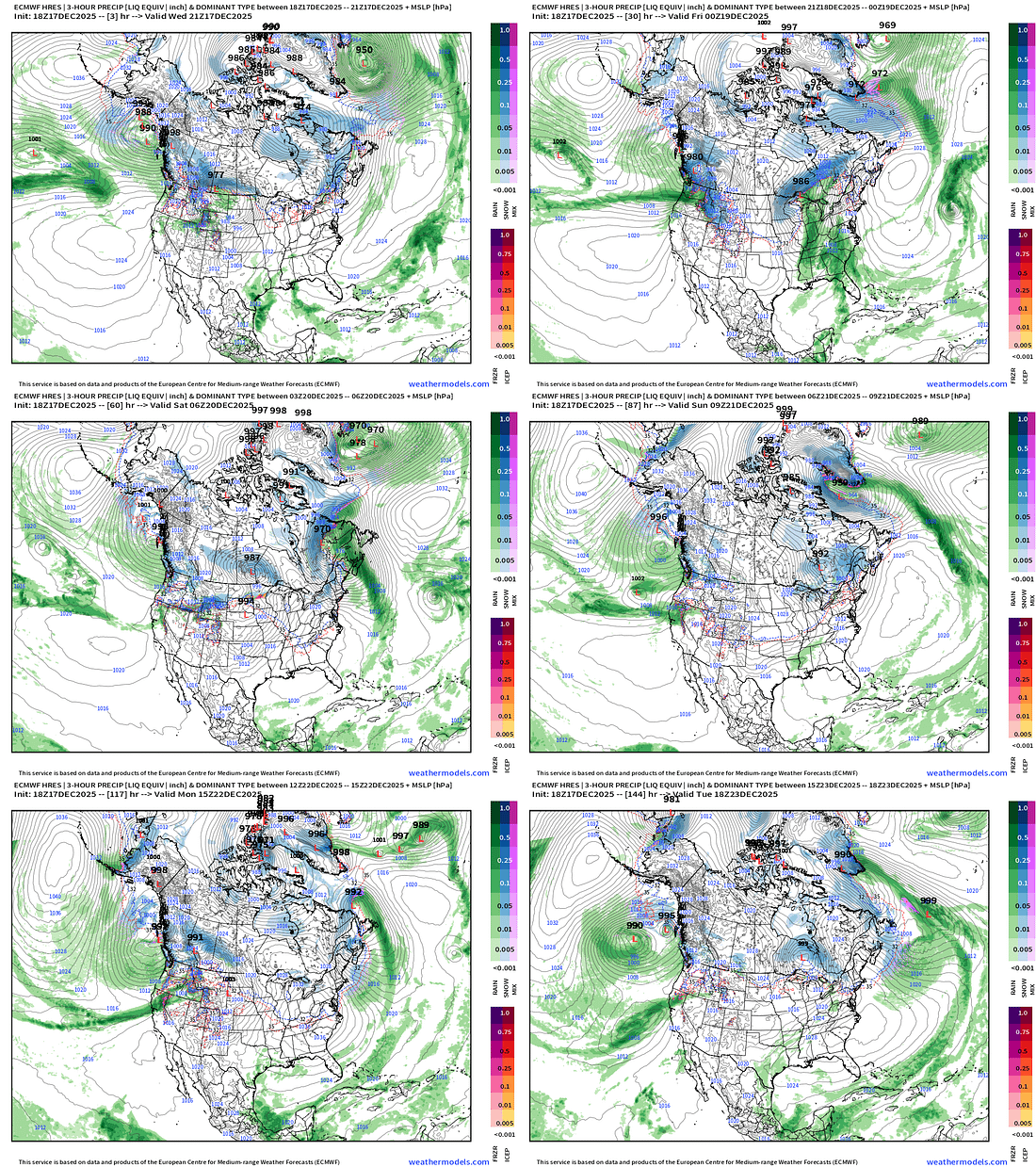
    Then, a round of snow, caused by an atmospheric river slamming into the West Coast, will pass through northern California and the Pacific Northwest Dec. 21-22. It then moves through the most northern tier of states as snow. That means Montana, North Dakota, northern Minnesota, Wisconsin and northern Michigan are the areas that would see snow.

    Forecast precipitation and sea level pressure from Dec. 18 to Dec. 23, 2025. The storm that hits the Pacific Northwest later this weekend will then travel across the northern tier of states next week.

    Those airports can manage this kind of snow, though. If you’re going there next week, that’s awesome. I’d like to check out those areas.

    If you like the thaw, I have good news. The polar vortex should be back at its home at the North Pole through the end of the month, at least. So, a long-lasting cold shot like we just had early in the month, won’t happen again until mid-January at the earliest.

    Joe Martucci, a certified broadcast meteorologist and digital meteorologist, is also the president and director of meteorology for Cup A Joe Weather and Drone. You can connect with him at www.cupajoe.live.

  • NJ is back in a Drought Warning, but it never really left

    NJ is back in a Drought Warning, but it never really left

    On Dec. 5, the New Jersey Department of Environmental Protection (NJDEP) issued a drought warning for the state. It brings back not-so-distant memories of barely flowing streams and record dry weather. However, unlike the previous drought warning, Jersey Shore fares the best in the state this time around.

    A drought warning is not an emergency yet — it’s an early step to manage water supplies when a drought is starting to happen. It comes after a drought watch, but before a full drought emergency. The main goal of a drought warning is to stop things from getting so bad that the state must declare a real water emergency.

    Via the NJDEP

    “All New Jerseyans are requested to follow water conservation practices, and to use water wisely, particularly when using water outdoors,” the NJDEP wrote in their statement.

    To be clear, there are no state mandatory water restrictions in place. That can only be issued if the governor declares a drought emergency. However, like we saw with New Jersey American Water last fall, water companies can issue their own restrictions to users.

    The last drought warning was in effect from November 2024 to June 2025. That came just after the driest autumn on record for New Jersey. Even after June, the NJDEP still had Atlantic and Cape May counties on a drought watch, to increase our awareness of the impact on our water supply.

    In the previous drought warning, the Jersey Shore had the most severely dry conditions. This time though, the coast is making out better than our friends to the west and north.

    The United States Drought Monitor, which is unaffiliated with the NJDEP, issues drought updates every Thursday, using data from the previous Tuesday.

    As of Dec. 4, the most recent update at the time of this writing, Cape May County, from Sea Isle City to Dennis on south, is in the first stage of drought, called “moderate drought.” The rest of the Jersey Shore is completely drought-free, though. Data shows that 55% of New Jersey is in drought, though.

    Most of that is on the Delaware Bayshore and then roughly the New Jersey Turnpike northwest. About 10% of the state is in the second level of drought, known as severe drought. That’s mainly in Sussex, Salem and Cumberland counties.

    The drought monitor looks mainly at the precipitation, soil, rivers and plants. Meanwhile, the NJDEP focuses on reservoirs and drinking water. Both are useful tools, though we in New Jersey will act based on the NJDEP, not the drought monitor.

    Either way, both agree that the Jersey Shore is least impacted by drought.

    The simplest answer to our improved circumstances here is the rain. The Jersey Shore climate region, generally east of the Garden State Parkway, had the most among the Office of the New Jersey State Climatologist’s three state climate regions since drought ended in June until October.

    Coast – 18.21 inches

    South – 16.71 inches

    North – 16.22 inches

    Then came November. It was drier than average. Cape May and Atlantic counties picked up between 1 to 2.25 inches of precipitation. The average for November is 3.37 inches at Atlantic City International Airport, and 3.44 inches at Sen. Frank S. Farley Marina in Atlantic City, according to the National Oceanic and Atmospheric Administration. So, it was dry.

    It was even drier than average in the north. November in Boonton (Morris County) and Belvidere (Warren County) were among the driest 20% on record.

    At the same time, the shore continues to pick up the most from whatever rainmakers we get. On Dec. 2, over an inch fell in Egg Harbor Township, Cape May Court House and Atlantic City. Much of Northwest New Jersey had less than a half inch.

    However, we need to look at more than just what’s happened recently to get a picture of our drought situation. Drought usually is long term, occurring over multiple years. We’re probably in the middle of one. We’ll improve at times, but the ground in New Jersey is dry and has been dry for at least a year. A wetter month here and there is good. A months-long, sustained period of ample rain and snow is needed to buck this trend, though.

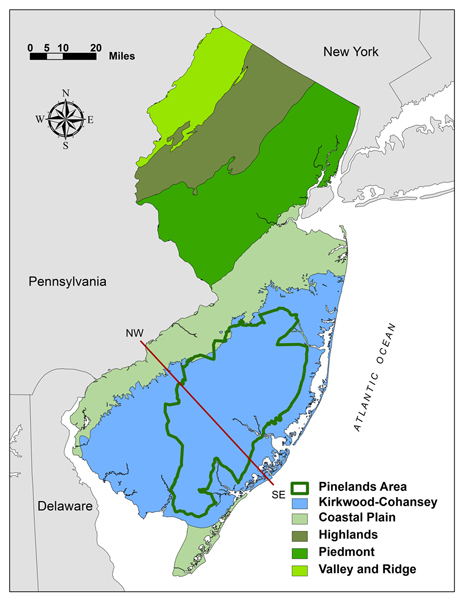
    Groundwater levels and stream flows over the past 90 days are “extremely dry” in the Coastal South region, according to the NJDEP’s Dec. 7 update. That’s roughly Toms River to Seaside Heights on south. It’s been this way for multiple weeks. We rely on groundwater from the Kirkwood-Cohansey aquifer for our freshwater needs.

    The location of the Kirkwood-Cohansey aquafer in blue, within New Jersey (via the state of New Jersey)

    There was improvement during the summer, but we haven’t been “near or above normal” in at least a year.

    Like last year, having a drought during the cool season is better than having one during the warm season. Sprinklers are turned off, pools and water parks are closed and water usage is just less. Moreover, the sun is weak and doesn’t evaporate as much water as in the summer.

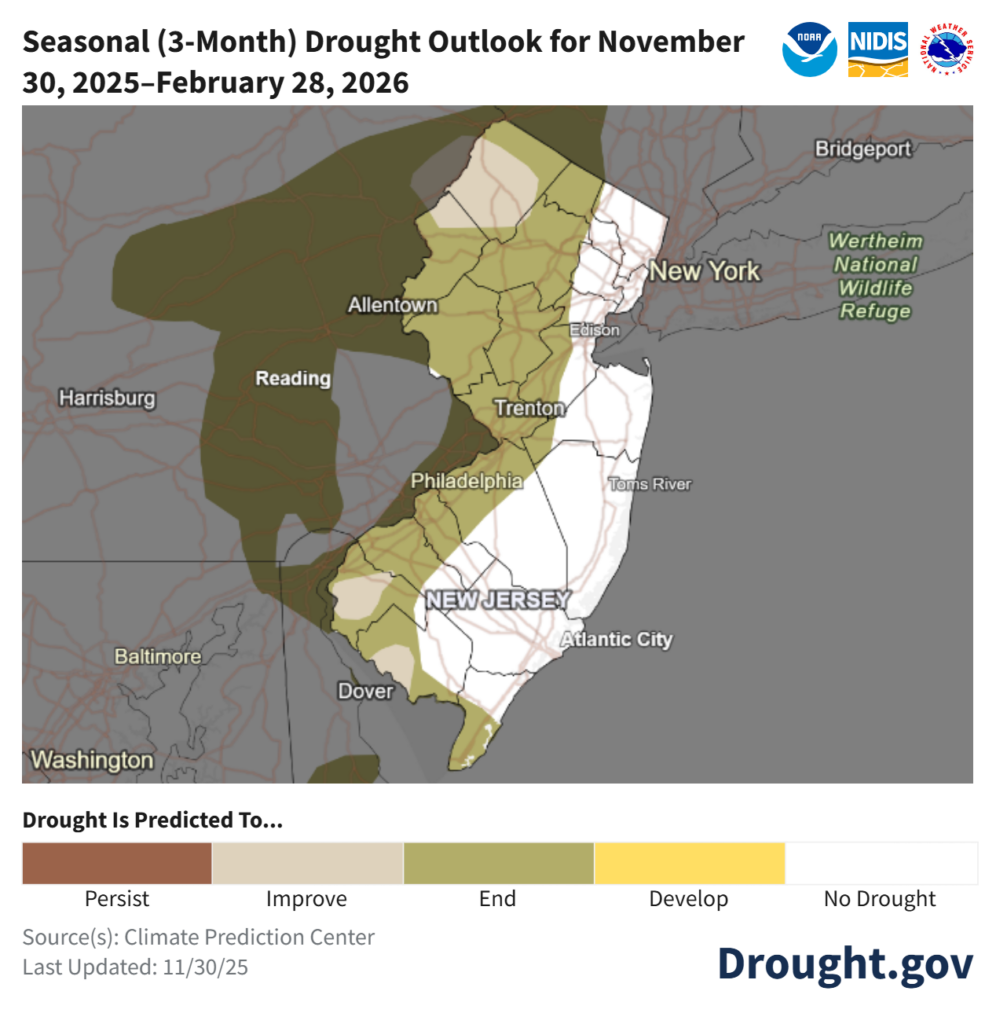
    So, does that give us enough runway to pull out of this drought? NOAA believes so. For the areas the US Drought Monitor has in a drought now, an improvement is expected over the winter according to their Nov. 30 update. For December, there is a lean toward a wetter (perhaps whiter) than average month.

    For now, reduce water usage where you can. It’s not as big of a problem as last winter. This will be monitored closely.

    Joe Martucci, a Certified Broadcast Meteorologist and Digital Meteorologist, is the President and Director of Meteorology for Cup A Joe Weather and Drone. You can connect with him at cupajoe.sparkable.opalstacked.com/.

  • With polar vortex unlocked, NJ likely gets a frigid start to winter

    With polar vortex unlocked, NJ likely gets a frigid start to winter


    Stream the Jersey Shore Live Weather Channel for free!
    The polar vortex has been poked and distributed in the stratosphere. Now it’s a waiting game as rounds of Arctic air run through New Jersey, reload and sweep through the Northeast again for much of December.

    As of Nov. 30, the time of this writing, it was unknown whether the Sudden Stratospheric Warming (SSW) occurred near the North Pole. If the stratospheric polar vortex were disturbed so much that its westerly winds reversed course, causing the SSW, and it happened in November, it would be the earliest in the satellite era (1968).

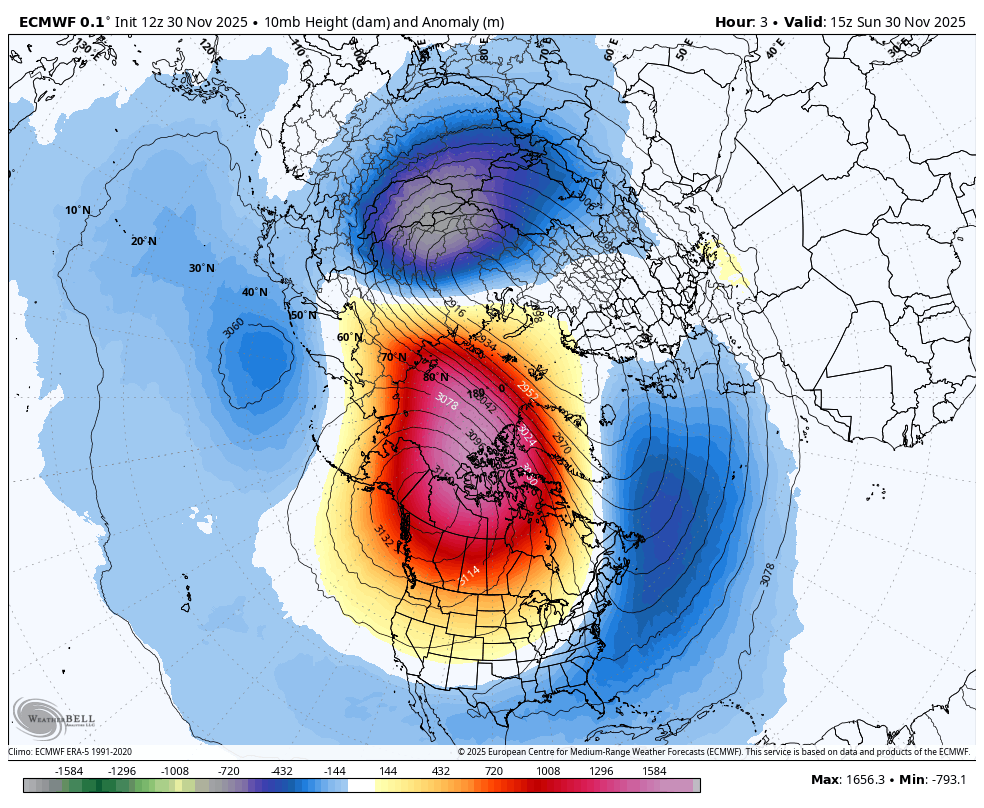
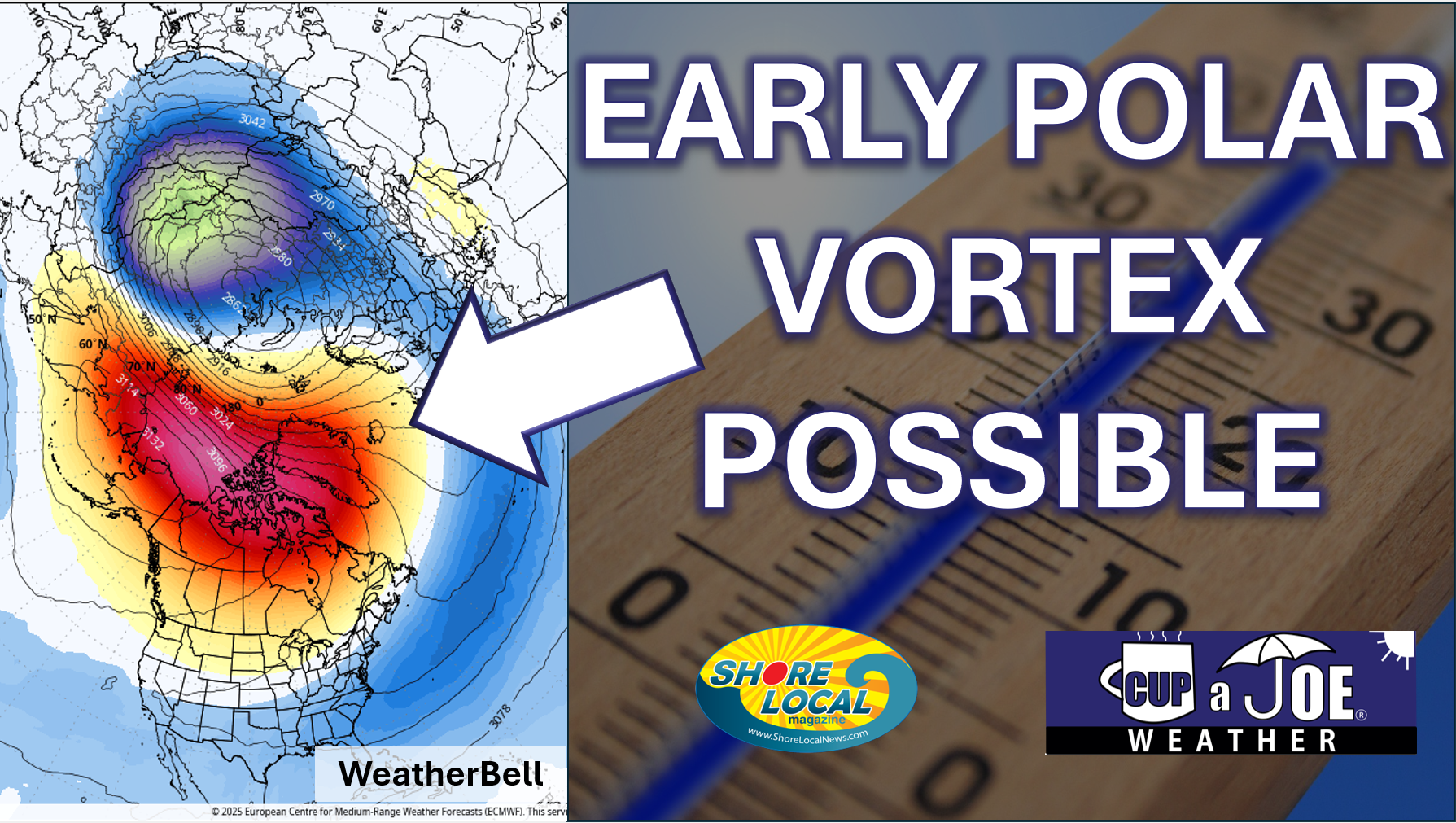
    Either way, though, the polar vortex’s spinning top at the North Pole was disrupted. Much warmer-than-usual air filled into the Arctic about 100,000 feet high. The stratospheric polar vortex stretched south into North America. Specifically, it moved into Western Canada and Alaska.

    The height above sea level where you reach 10 millibars of pressure (lines) with its departure from average in blue, yellow or red for Nov. 30. Notice the red area in Western Canada and Alaska. That’s where the center of the polar vortex was (via WeatherBell).

    The extremely cold air in the stratospheric vortex almost never mixes directly down to the surface. Instead, the SSW changes the large-scale circulation, which then allows pre-existing surface-level Arctic air (from northern Canada, Siberia, etc.) to plunge southward in the troposphere.

    As of Nov. 30, that Arctic air had surged south from the North Pole to Hudson Bay and Quebec, Canada, according to Ryan Maue, a meteorologist and climate scientist at WeatherTrader.

    The jet stream, the river of air about 30,000 feet high, which separates polar and tropical air masses, then becomes wavy, moving south to north, to south again. The jet stream is in the troposphere.

    That clash of warm and cold air from the jet stream also causes cold-core storms, like a nor’easter to form at the surface. For now, though, let’s focus on the cold.

    When will cold air outbreaks occur at the Jersey Shore?

    There are three times for colder-than-average temperatures:

    1. A continuation of the current cold through Dec. 6

    2. Dec. 8-10

    3. Dec. 14-18

    These aren’t long stretches of cold, however, it will be 10 or more degrees below average for many of those days. That translates to high temperatures in the upper 30s to low 40s. For low temperatures, this means lows on either side of 20 degrees inland. Meanwhile, the shore would see lows of 25 to 30 degrees.

    Remember that our coldest day of the year, on average, occurs in the second half of January. So, while they don’t sound extremely bitter for late January standards, this is not what it should feel like in early December.

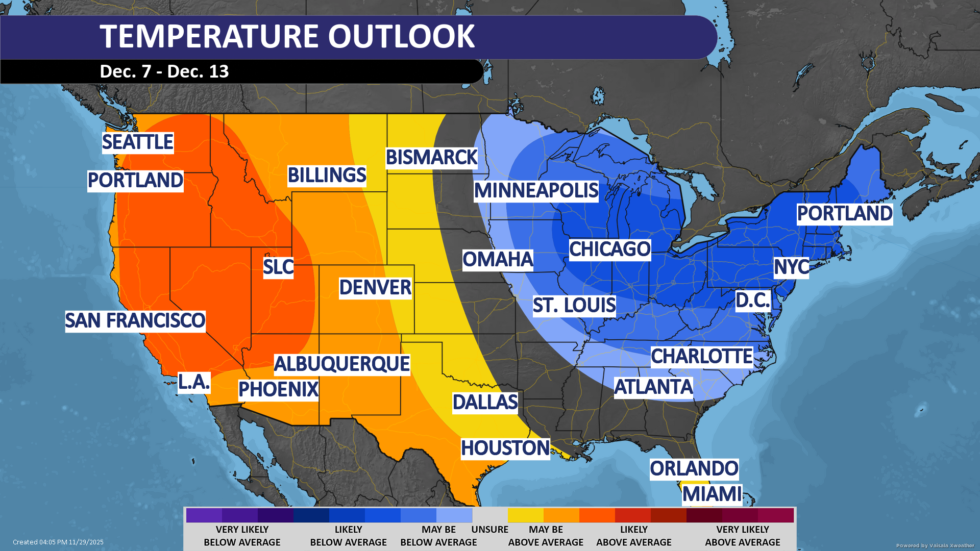
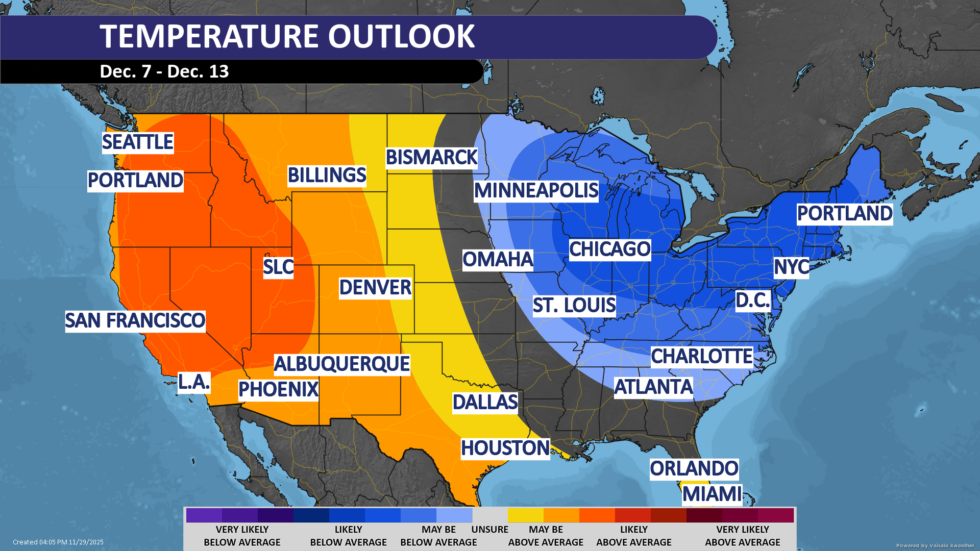
    The National Oceanic and Atmospheric Administration (NOAA), forecasts Dec. 7-13 to be below average for the Northeast and Great Lakes states. However, NOAA has the most confidence on below-average temperatures for every county in New Jersey except for Cape May County – a sign that the Cape May Bubble is still strong year-round.

    All kidding aside, it will be a chilly start to climatological winter, which runs from Dec. 1 to Feb. 28, the coldest three months of the year, on average.

    Forecasting what days snow will fall at the Jersey Shore more than five days out is nearly impossible. I won’t do that. However, there are two forces at play. How much snow we see, or don’t see in December will prove which force was stronger.

    A colder-than-average December is simply better for snow than a warmer-than-average December. It gives you more opportunity for snow. It’s that simple.

    On the other hand, a pattern appeared in November. When it’s dry, it’s colder than average. When there is precipitation, it’s at or warmer than average. That cold and dry, or mild and wet pattern drives snow lovers crazy. It’s a function of the storm track being at or west of New Jersey. That brings more southerly, warmer winds around counterclockwise-spinning storms.

    At the Sen. Frank S. Farley State Marina in Atlantic City, 10 days also had precipitation in November. Eight of them were above average or within a degree of average, according to NOAA. Ten days of precipitation also happened at Atlantic City International Airport; six of them were above average or within a degree of average.

    To see how the polar vortex could interact for yourself, go to a weather forecast model website like WeatherBell (subscription needed) and look at the 2PVU (potential vorticity units) forecast, which looks at the boundary between the troposphere and the stratosphere.

    Where you see the blues and purples indicates the outline of the polar vortex boundary. In a strong polar vortex, it is compact, circular and centered near the Arctic. If it’s not, like the first half of December, that means the polar vortex has weakened, which eventually allows frigid air at the ground to spill places south.

    Joe Martucci, a Certified Broadcast Meteorologist and Digital Meteorologist, is the President and Director of Meteorology for Cup A Joe Weather and Drone. You can connect with him at cupajoe.sparkable.opalstacked.com/.

  • Record setting phenomenon threatens cold, polar vortex in NJ this December

    Record setting phenomenon threatens cold, polar vortex in NJ this December

    Blasts of frigid for December air may be NJ’s reality this December thanks to an unusual chain of events bringing the polar vortex.

    Meteorologists like me are keeping a close eye on the sky above the North Pole. We’re watching for something called a sudden stratospheric warming (SSW). If an SSW happens, it’s like poking a big, spinning cold-air circulation called the polar vortex.

    When you poke it, the vortex can wobble and send frigid air south. That cold air could slide all the way down to New Jersey in the middle of December. If it does, we would get temperatures that are way colder than normal.

    “If a full SSW is achieved in November, as predicted by the ECMWF (European Centre for Medium-Range Weather Forecasts), that would be the first time in the satellite era (post 1979),” said MIT climatologist Judah Cohen in his blog Nov. 18. (Dr. Cohen was also our guest on Tidal Flooding Talk on Nov. 25)

    If this occurs, that means December will be more like “Decembrrr,” with it “beginning to look a lot like Christmas,” as the Perry Como song goes.

    What is sudden stratospheric warming?

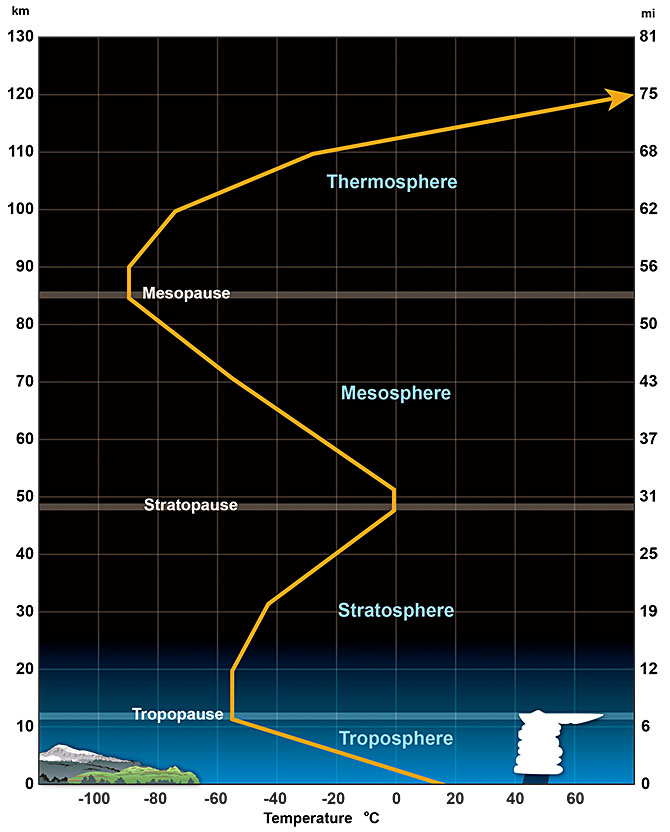
    Sudden stratospheric warming is a process in which the temperature of the stratosphere, the second lowest layer of Earth’s atmosphere, warms quickly. Typically, this is about 30 to 50 degrees within a week.

    The layers of the atmosphere on Earth (Via NOAA)

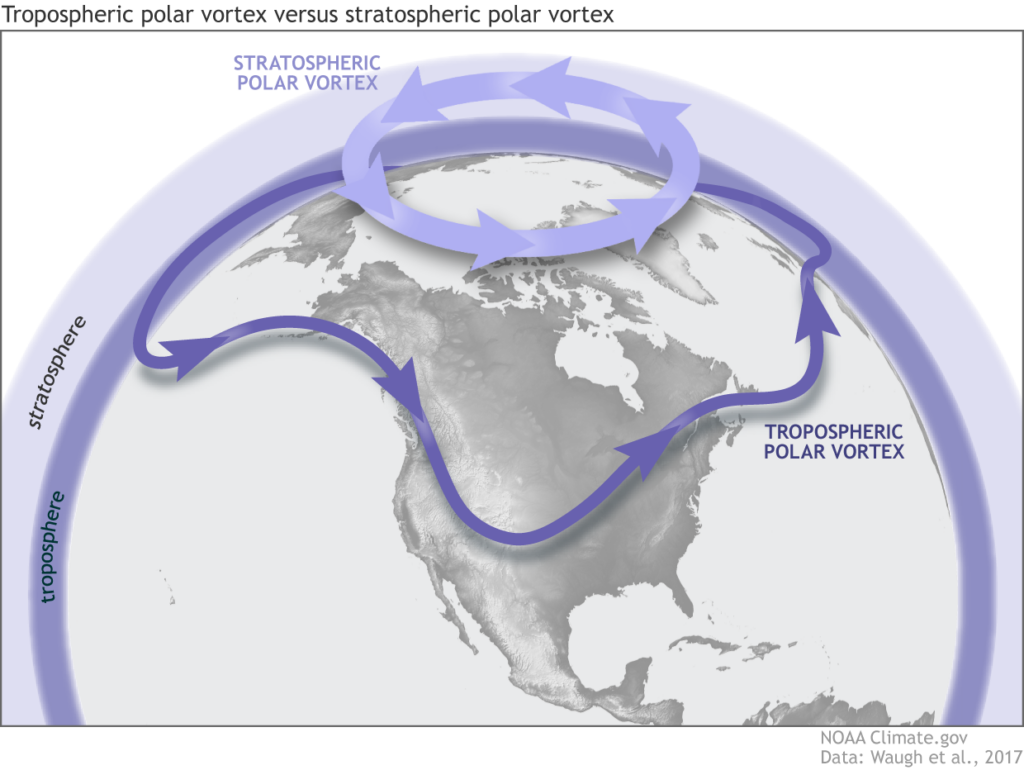
    When this occurs, the polar vortex — the spinning area of very cold, westerly winds in the stratosphere that typically sits over the North Pole — is disrupted. When that happens, it can do one of the following:

    1. Split into two or more pieces, pushing south from the North Pole.
    2. Winds weaken dramatically or even reverse and come out of the east.
    3. Stretch itself farther south.
    When you hear that the polar vortex is disrupted, that means the stratospheric polar vortex. The stratospheric polar vortex likes to spin counterclockwise at the North Pole in the Northern Hemisphere. However, can be disturbed by a SSW event (Via NOAA).

    Note that SSWs can only occur during roughly October to April, when the polar vortex is strong. Outside of this time, the polar vortex is weak and essentially hibernates for the warm season.

    What does polar vortex disruption mean?

    When the polar vortex is disrupted — in this case by sudden stratospheric warming — the stratospheric vortex can shift over parts of the Northern Hemisphere, usually between 40 and 65 degrees north latitude. The Jersey Shore sits between 38.9 and 40.5 degrees north latitude.

    The extremely cold air in the stratospheric vortex almost never mixes directly down to the surface. Instead, the SSW changes the large-scale circulation, which then allows pre-existing surface-level Arctic air (from northern Canada, Siberia, etc.) to plunge southward in the troposphere.

    The jet stream – the river of air about 30,000 feet high which separates polar and tropical air masses – becomes wavy, moving south to north to south again. The jet stream is in the troposphere.

    That clash of warm and cold air from the jet stream also causes cold-core storms, like a nor’easter, to form at the surface. Put that on the East Coast and position the cold air from the jet stream exactly right, and New Jersey has a snowstorm.

    However, not all polar vortex disruptions impact New Jersey, or even the East Coast. The frigid cold can spill into the Great Plains, like it did in February 2021 when much of Texas was without power. It can go to Europe, or Asia, too.

    How often do sudden stratospheric warming events occur?

    SSWs have about a 50% chance of happening in any given winter. The Washington Post says it happens once every other winter, on average.

    When they do happen, they’re typically in January or February. As MIT’s Cohen said, never in the satellite era has an SSW event happened in November. November SSWs were observed in 1958 and 1968, but in an era before high-tech weather satellites, high-altitude airplane observations and more, this isn’t a reliable claim.

    The most recent SSW event in the Northern Hemisphere was in early March of this year. It quickly brought the end of the polar vortex season. In fact, it was the second earliest SSW to end the cool season since 1958.

    However, it didn’t mean much for New Jersey. March was well above average up and down the state. The polar vortex, and its impacts, went to Europe instead.

    What do early sudden stratospheric warmings mean for N.J.’s winter?

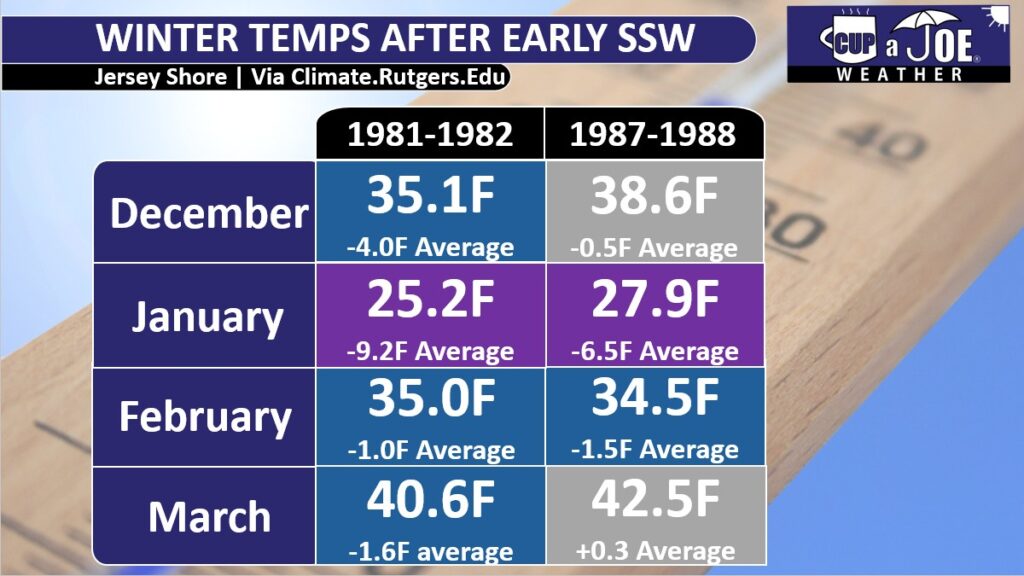
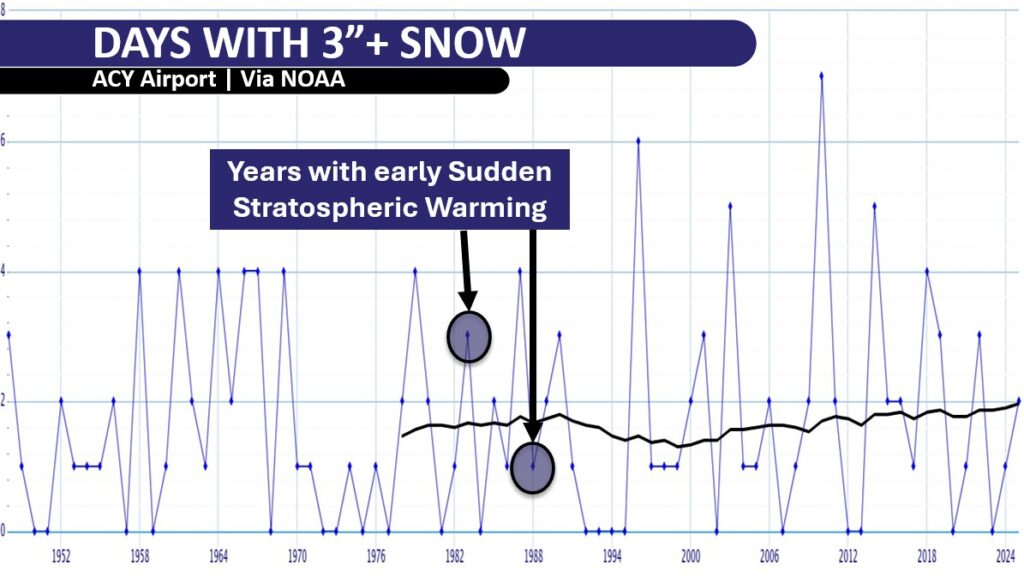
    Two winters had SSWs in early December: 1981-1982, and 1987-1988, according to Cohen.

    Both of those followed the same pattern when it came to temperatures. January was at least 6.5 degrees colder than the current average. January 1982 was the sixth coldest January on record for the Jersey Shore going back to 1895, according to the Office of the New Jersey State Climatologist.

    February was also below average, but less so, between 1 and 2 degrees.

    December and March had differences, too. In 1981-1982, both months were colder than average. December was a whole 4 degrees below average.

    The winter a few years later saw above average temperatures for December and March.

    All that cold doesn’t translate to snow, though. Both the winters of 1981-1982 and 1987-1988 saw two days with more than 3 inches of snow at Atlantic City International Airport, according to the National Oceanic and Atmospheric Administration. That’s about average.

    Other parts of the shore had the same fate. In Lower Township, Cape May County, 3 or more inches of snow occurred on just one day in winter 1981-1982. The 1987-1988 winter had two days.

    Long Branch, Monmouth County, only had data for the winter of 1981-1982. However, even there, 3 or more inches of snow occurred twice, which is below average. Big cold doesn’t always translate to big snow.

    What can we expect this december?

    Like my winter outlook story said, we need to watch for an early start to the cold and perhaps snow in the first few weeks of December. First, we have to wait and see if that sudden stratospheric warming (SSW) happens this week up in the Arctic.

    If it does happen, follow me online for updates. I’ll watch where that super-cold Arctic air will rush down to the ground. We will know by the first few days of December if that cold air is heading for New Jersey or not.

    If it does come to New Jersey, it would mean an extended period, or maybe a few prolonged periods, between Dec. 10 and Dec. 31, when it is much colder than average. We are talking daytime highs only in the 30s. At night along the shore it would drop to the 20s, and inland it would get down to the teens when clear.

    We are still weeks away from the coldest part of winter, so those numbers are pretty cold for December.

    It is still too early to make a clear snow forecast. However, temperatures in the 30s are much better for snow than temperatures in the 50s. So if we get that cold air, I expect at least some snow that sticks to the ground.

    Stay tuned for more updates, and Happy Thanksgiving to you, your friends and your family. Enjoy the free $400 ShopRite turkey.

    Joe Martucci, a Certified Broadcast Meteorologist and Digital Meteorologist, is the President and Director of Meteorology for Cup A Joe Weather and Drone. You can connect with him at cupajoe.sparkable.opalstacked.com/.

  • Historic 1st Snows at Jersey Shore: Facts and Figures

    Historic 1st Snows at Jersey Shore: Facts and Figures

    The first snow of the season at the Jersey Shore is usually something to smile about. It’s light and fun. Maybe just a few flakes in the air or a quick snow shower that melts fast. It makes you think of cozy things: a warm fire, snow on the sand at the beach, or a surprise day off from school or work.

    At two weather stations near the Jersey Shore – Atlantic City International Airport and Lower Township – the first snow average is 1.6 inches deep. That’s not much. Most people think it’s more fun than trouble.

    However, sometimes the first snow is a big surprise.

    Four times at Atlantic City International, and three times in Lower Township, the very first snowy day of the season dropped more than 6 inches. That’s a lot for the first one.

    I love snow any time, but a huge first snow can catch everyone off guard. It’s like playing a big game without warming up, or running a race in brand-new shoes. Nobody is ready yet. Meteorologists might miss a forecasting tidbit. Road crews might not put out enough salt and plows. Drivers forget to go slow and careful like they do later in winter. That makes slippery roads extra dangerous.

    On average the first real snow at the Jersey Shore waits until the second half of December. However, there are a few times in weather history when snow has been noteworthy and early.

    December 5, 2002

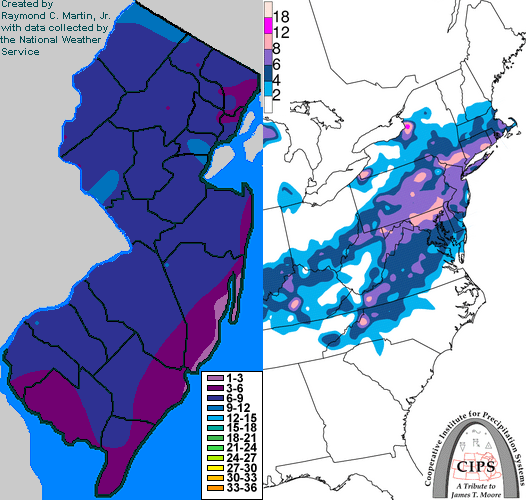
    In 2002 the first snow of the season at the Jersey Shore was a nor’easter that dropped more than 6 inches of snow.

    Every county in New Jersey had snow, according to NOAA. An area of low pressure developed on a frontal boundary along the Gulf Coast states. Eventually, that low pressure moved through the Southeastern United States, went off the North Carolina coast and quickly raced northeast, according to Raymond C. Martin Jr. It was a nor’easter.

    Snowfall totals were sizeable:

    • 7.6 inches in Estell Manor, Atlantic County
    • 7.0 inches in Hammonton, Atlantic County
    • 6.0 inches in Woodbine, Cape May County
    • 5.5 inches in Green Creek, Cape May County
    • 5.0 inches at Atlantic City International Airport

    Perhaps more impressive was that these totals were greater than the snow seen the entire previous winter in much of South Jersey. This was in the middle of a long stretch of colder-than-average temperatures. The snow that fell took six days to fully melt across the area as high temperatures stayed below 35 degrees nearly every day from Dec. 4 to Dec. 10.

    November 30, 1967

    Before 2002, you had to go back 35 years to experience a first winter storm as significant for the Jersey Shore.

    At ACY Airport 7.8 inches of snow fell, the second largest leading snowfall of the season on record (a late start in 2022 was higher). Lower Township experienced 3.0 inches of snow.

    This snow engulfed much of the Mid-Atlantic. A Baltimore Sun headline proclaimed: “Near Record November Snowfall Catches City Without Its Plows.”

    November 6, 1953

    This is one of the largest first snows on record, and one of the earliest, too. Snow spread from western North Carolina to New England.

    This wasn’t a 100% snowstorm; 3.2 inches of snow at ACY Airport mixed with a total of 3.98 inches of precipitation. In essence, about 10% of the precipitation that fell was snow. Still, it counts.

    Places farther south saw less snow mixed in. By the time you went to Lower Township, the storm was all rain. The Cape May Bubble was still alive and well then, too.

    The New York Times wrote that New York’s highways were covered in an icy sheen and many motorists going upstate had to sleep overnight in their cars.

    The storm was tropical at first. It was a tropical depression that moved across Florida. It then transitioned from a warm-core, tropical storm, into a cold-core, nor’easter. Ready for the storm was a huge mass of cold air in the Northeastern United States. That turned what was warm rain into some snow.

    December 8, 1928

    The third biggest first snow of the season in Lower Township’s long stretch of weather records (back to 1897), was a pure snowmaker, even at the immediate coast.

    Lower Township saw 9.6 inches of snow on 0.80 inches of precipitation, according to NOAA. That’s a snow ratio of 12:1, meaning this wasn’t a sloppy, wet mess of snow, either.

    ACY Airport wasn’t around yet. However, Atlantic City kept snow records then and they were blanketed in 3.9 inches of snow. High temperatures stayed in the 30s for the next two days after that, keeping the snow on the ground, too.

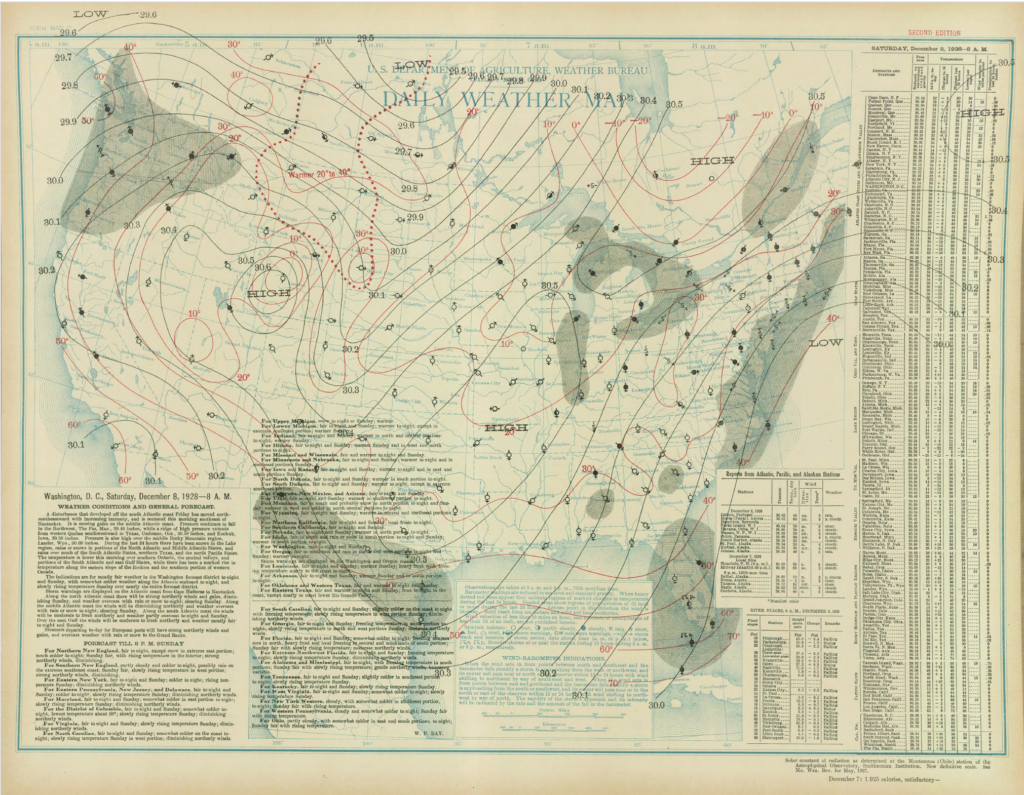
    Archive weather maps from NOAA show that this was a coastal storm. Low pressure the morning of Dec. 8 was roughly 40 degrees north latitude, and 75 degrees west longitude. Today, that’s known as the “benchmark,” or the position coastal storms should cross to bring at least some snow to the coast. Winds were from the north or northeast at the Jersey Shore, pumping in the icy air.

    The surface weather analysis for the Dec. 8, 1928 snow. The National Weather Service was a part of the United States Department of Agriculture then.

    Thanksgiving Day, 1912

    Talk about cold turkey. Nov. 28, 1912, brought a statewide blanket of snowfall, delivering a rare “White Thanksgiving.” In fact, it has an argument to claim a spot as the snowiest Thanksgiving on record statewide.

    In Lower Township, 4.5 inches fell. In Atlantic City, Northfield and Tuckerton, 4.0 inches fell.

    Barely an inch of snow fell in Taylor Ham land in the northern part of the state (yes, there’s a Central Jersey).

    I imagine there were a lot of melted (dirt) roads that turned into ice at night. The days following it were well above freezing during the day, dropping a good bit below freezing at night.

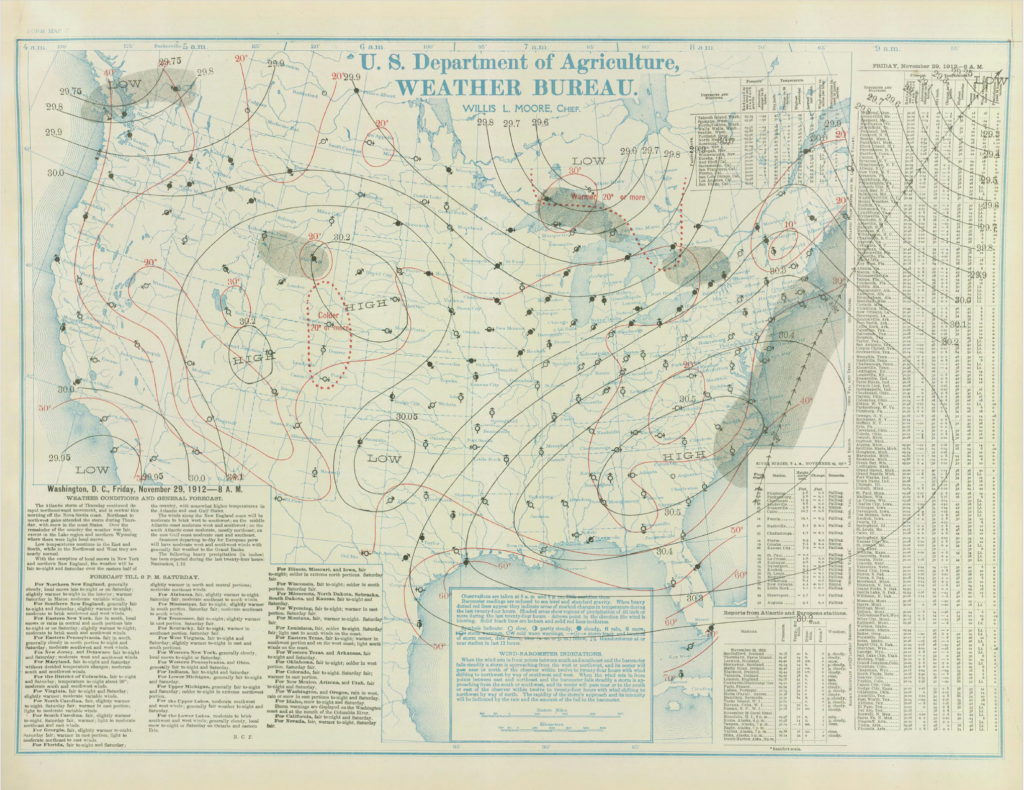
    Like the early 1928 snow, this storm was a coastal storm. Known as a Miller A type storm, it began off the Georgia coast. It quickly moved north-northeast, passing almost right at that 40-degree north latitude, 75 degree west longitude benchmark.

    The surface weather analysis for the Thanksgiving 1912 snow. The National Weather Service was a part of the United States Department of Agriculture then.

    What are your snow thoughts?

    Love it? Hate it? You want one snow and then that’s it? Drop me a note on social media or email.

    Joe Martucci, a certified broadcast meteorologist and digital meteorologist, is also the president and director of meteorology for Cup A Joe Weather and Drone. You can connect with him at cupajoe.sparkable.opalstacked.com/.

  • A wild ride of temperatures: 2025-2026 Jersey Shore Winter Outlook

    A wild ride of temperatures: 2025-2026 Jersey Shore Winter Outlook

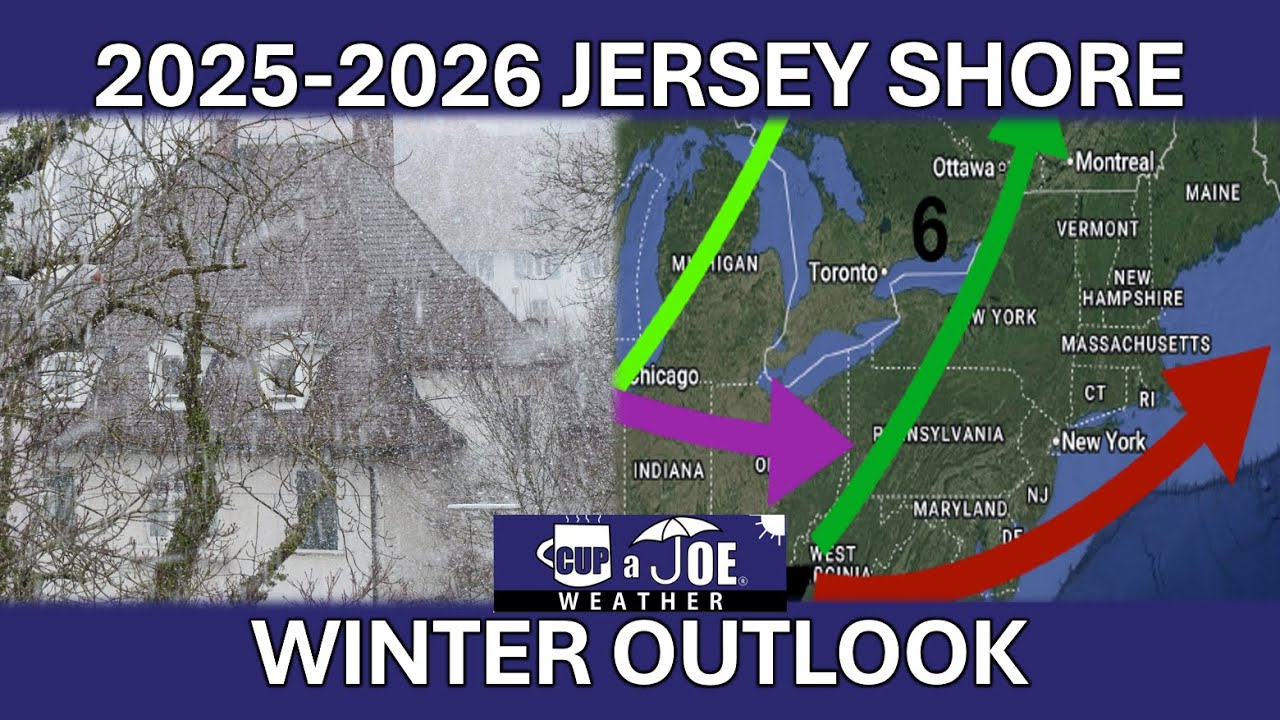
    The 2025-2026 winter outlook has similarities to last winter’s weather. However, there’s enough support in the forecast to give snow lovers hope this season. My Jersey Shore friends, it’s that time of the year again – time for the winter forecast.

    With the sun setting by 5 p.m., holiday decorations for sale at nearly every store and sweatshirt weather during the day, snow season is around the corner.

    Before we get into predictions, here’s a few important notes to remember:

    1. I don’t do my own winter forecasting. It takes a lot of time and research that begins in August and ends around Halloween. This forecast is a mix of some research I’ve done and information from trusted sources like Steve DiMartino of NY NJ PA Weather, a fellow certified digital meteorologist.

    2. Miles make a difference. In one storm, Ocean City could be all rain, while Egg Harbor Township has 3 inches of snow and Asbury Park has a foot. This forecast is for the general shore area, not one particular house.

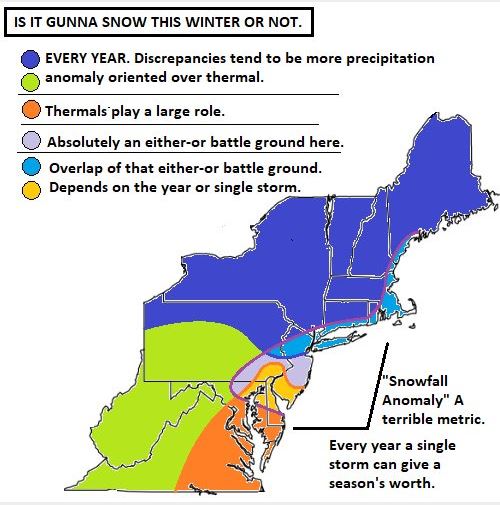
    3. Average snowfall is meaningless at the shore area. Atlantic City International Airport averages 17.3 inches of snow, according to the National Oceanic and Atmospheric Administration. However, since records began in 1944, four winter seasons had less than an inch of snow, and six were buried in more than 40 inches of snow.

    4. The ocean, which keeps our fall warmer than the New Jersey Turnpike corridor during the fall, also keeps us milder during the winter. An onshore wind with a nor’easter will keep the lawns brown, not white. You have to go to northwestern New Jersey, the Poconos and places north to be guaranteed snow.

    Via @CotentWeatherGuy on X.

    Still, the winter forecast is exciting. It’s the most popular outlook of the year and I love talking about it with you.

    How did last year’s winter forecast do?

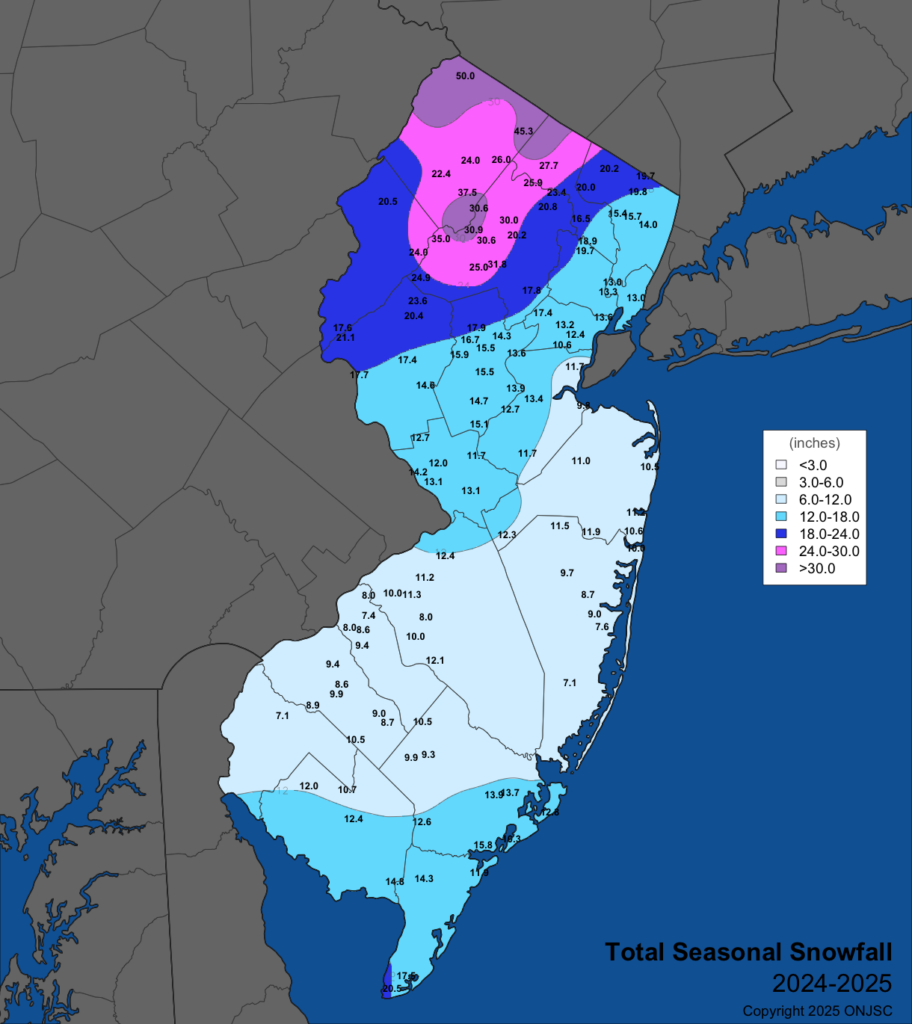
    Lower Township, at the southern end of Cape May County, had the most snow in the entire Jersey Shore area – 20.5 inches fell there. In fact, the only places in the state that were higher were northwest of Interstate 287, in the typically colder northwest New Jersey.

    Otherwise, most of Atlantic, Cumberland and Cape May counties saw between 12 and 18 inches of snow. Farther north, the rest of the shore only had 7 to 12 inches.

    Snowfall totals from the 2024-2025 winter (via The Office of the New Jersey State Climatologist)

    Last year’s forecast column stated: “It’s safe to say that we can expect fewer storms with a possibility of snow.” I gave the shore a 65% chance of snow being 3 inches below the 14.8-inch seasonal snow average at the immediate coast, and the 17.4-inch average for the mainland. Consider it a pretty good forecast.

    The not-so-great forecast was the coastal flooding outlook. I wrote that “near-to-slightly-above-average coastal flooding” was likely. Thank goodness this was wrong. Coastal flooding and beach erosion were nearly nonexistent.

    The column also stated that temperatures would be “warmer than usual overall.” Turns out, our 37.9-degree average from December to March was just above the 30-year climate average of 37.6 at Atlantic City International Airport. At the beaches, the average at Sen. Frank S. Farley State Marina in Atlantic City was 38.9 degrees – below the average of 39.7.

    Quick Jersey Shore winter forecast

    Expect a couple of lighter snow events (less than 4 inches), with a better-than-average chance for bigger storms (4 to 8 inches). However, massive snow of more than a foot is less likely than usual.

    Temperatures should be about average when everything is said and done. However, this should be due to big swings in temperatures averaging out to near average throughout the year. Four days of near-60-degree weather, followed by four days of 30-degree weather, is a strong possibility. Our first sustained cold shot looks to be at some point between Thanksgiving and Christmas.

    Expect more coastal storms than usual. At the risk of sounding wishywashy, some will be mostly rain, and some will be mostly snow.

    Beach erosion and tidal flooding will be more of a quantity than a quality (big issues) thing. However, with the beaches already damaged in spots, it’s a concern.

    Jersey Shore winter forecast in more detail

    The outcomes for this winter will be largely driven by three factors.

    1. Weak La Niña, or colder-than-average water temperatures in the equatorial Pacific Ocean.

    2. Much warmer-than-average water temperatures in the Pacific Ocean, off the United States West Coast.

    3. Less-than-usual Arctic Ocean sea ice in North America.

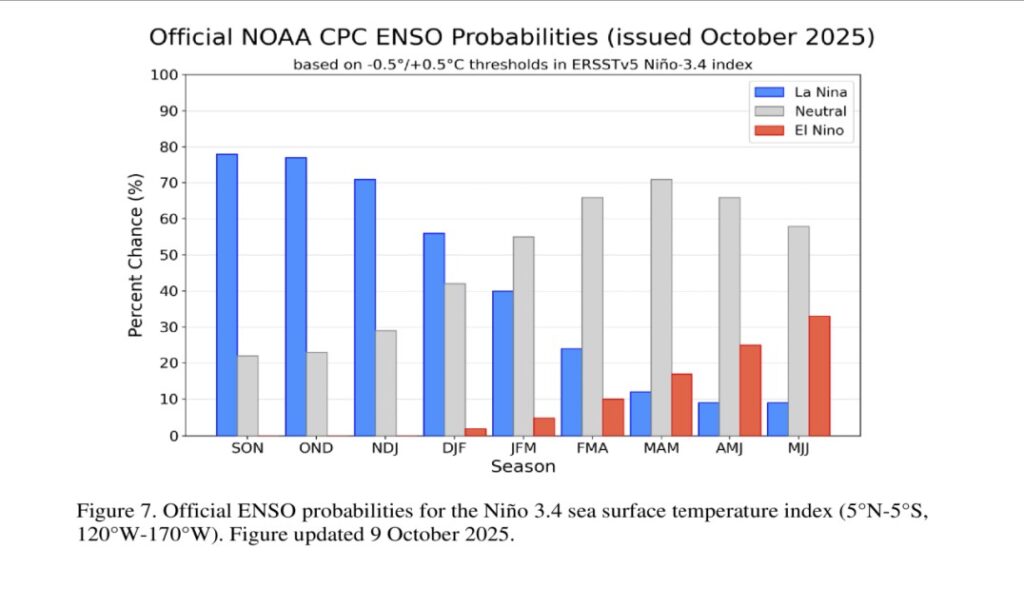
    You can’t start a winter forecast without looking at the state of the El Niño Southern Oscillation. This explains whether water temperatures in the equatorial Pacific Ocean are warmer or colder than average. We’re in La Niña, so it’s cooler than average.

    NOAA expects La Nina to continue through at least January (DJF).

    However, a weak La Niña is only expected to last until February, according to NOAA. We may then go into a neutral state for the rest of the winter. Either way, the point is La Niña favors a slightly cooler and drier winter.

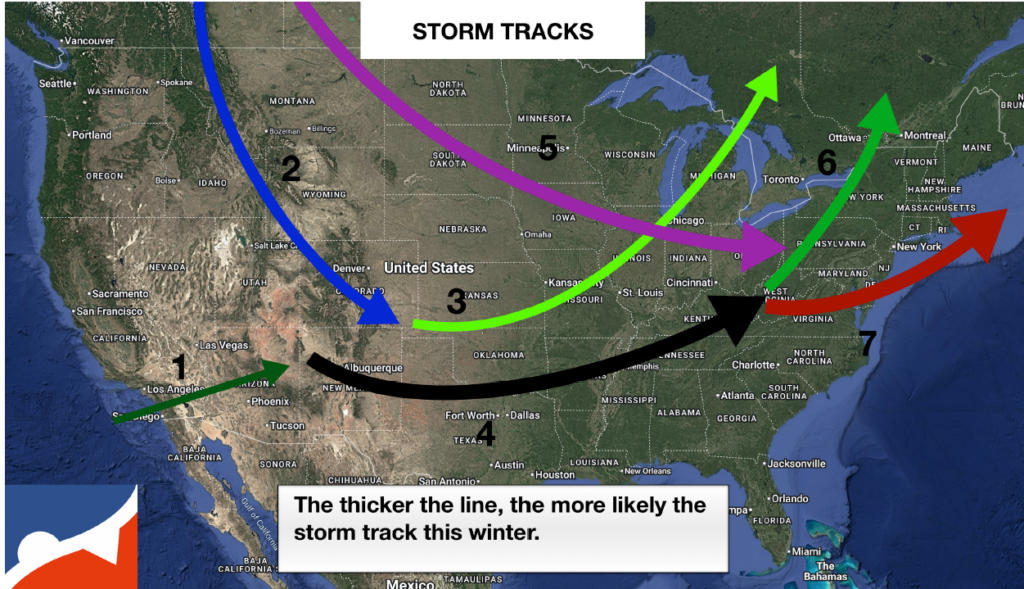
    The next two factors both support stormier-than-usual winter patterns. The relatively warm water off the West Coast supports a storm track right through the Mid-Atlantic. Storms during the winter love a clash of cold and mild, and these line up perfectly for our region to be the battleground.

    Meanwhile, sea ice is well below average on the North American continent. Unless something crazy happens, it will stay this way. That opens the jet stream – the river of air about 30,000 feet high – which is also the storm track, causing it to look like a rollercoaster, snaking south to north over the Eastern United States.

    When the Jersey Shore is on the northern side of the track, storms are mostly snow. When the Jersey Shore is on the southern side of the track, they are mostly rain. Expect to see the classic 55 degrees and rain in Cape May, with 30 degrees and snow in Trenton a few times.

    The seven main storm tracks expected this upcoming winter (via NYNJPAWeather)

    It’s tempting to go above average for snow at the Jersey Shore given all of this, with one or two big snows. However, the coastal storms that do develop off this jet stream will tend to start in Virginia or North Carolina. Even if it is mostly snow for us, they will have a short “runway” as they move northeast to develop heavy precipitation. These are called Miller B storm systems.

    The high number of expected storms increases the likelihood of a few significant snowfalls, ranging from 4 to 8 inches. However, without a storm forming off the coast of Georgia or Florida – known as Miller A storms – it’s unlikely we’ll see major snow accumulations.

    I expect more than the usual number of tidal flooding and beach erosion days. Most of these should be minor to perhaps moderate issues, but with the weakened state of our beaches in some locations, this will bring worse-than-usual impacts. The good news is the New Jersey Department of Environmental Protection believes the sand that was eroded will return by natural processes next spring. It won’t repair the dune cliffs seen along Jersey Shore; it will only fill in the erosion on the more gently sloping sand.

    Being a citizen scientist, for cheap

    The Community Collaborative Rain, Hail and Snow Network (CoCoRaHS) is the nation’s largest group of volunteers in the weather community. Each day, over 200 people in New Jersey and thousands across the United States report on how much precipitation they receive.

    For $50 upfront (to purchase the rain gauge), your observations will be used by many in the weather community. I look at this constantly during storms and would love to see what you have at your home. In fact, New Jersey’s official state record for most yearly precipitation is from a CoCoRaHS gauge.

    We hope to see your reports this winter!

    Joe Martucci, a Certified Broadcast Meteorologist and Digital Meteorologist, is the President and Director of Meteorology for Cup A Joe Weather and Drone. You can connect with him at cupajoe.sparkable.opalstacked.com/.

  • October Nor’easter brought major beach erosion, and NJ’s just getting started

    October Nor’easter brought major beach erosion, and NJ’s just getting started

    The official post-nor’easter report is in and it paints a stark picture of the sandy Jersey Shore, just as nor’easter season is starting.

    The New Jersey Department of Environmental Protection’s (NJDEP) Office of Coastal Engineering released its Initial Coastal Storm Survey and Damage Assessment of the Oct. 12-13 nor’easter last week.

    After major storms, the office conducts beach erosion assessments along the state’s 210-mile coastline. This includes not just the Atlantic Coast, but also the Delaware Bayshore and the Raritan Bayshore, too. The survey paints an unfortunate picture of the South Jersey shore, with another six months of possible coastal storms still to come.

    How much erosion did the Jersey Shore have?

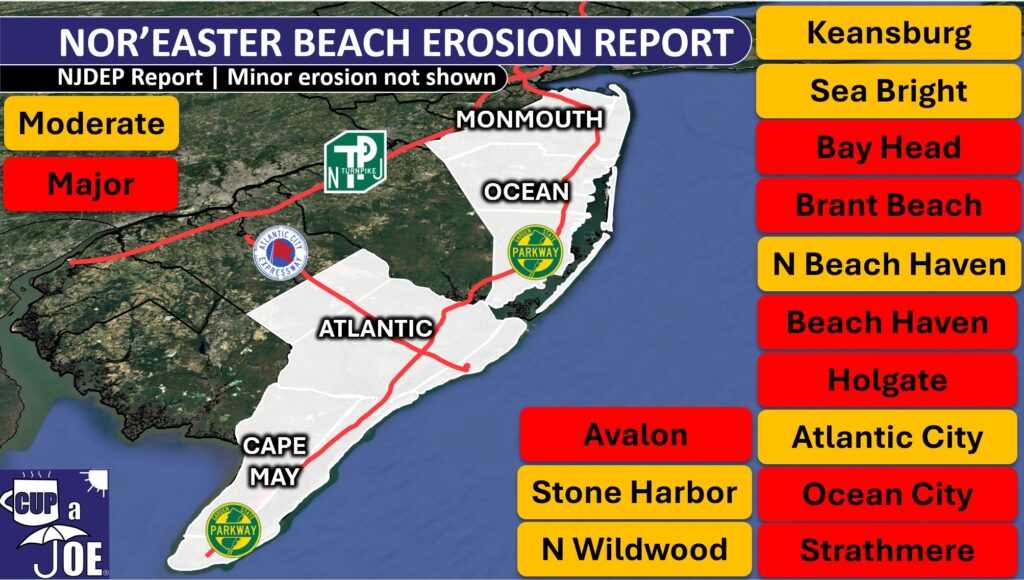
    In the 81 towns that the NJDEP has sent teams out to survey, six had major beach erosion, eight had moderate beach erosion, while 67 towns had minor beach erosion. It could have been worse, that’s for sure. However, the South Jersey Atlantic shore was the hardest hit.

    Ocean City, Strathmere and Avalon all reported major beach erosion. Atlantic City, Stone Harbor and North Wildwood had moderate erosion.

    Note that Brant Beach had moderate erosion, not major. Our error!

    This report is just for the erosion from the Oct. 12-13 storm, and does not consider what happened during Hurricane Erin in August. As it turns out, the nor’easter impacted the beach more than Erin did.

    Note that Brant Beach had moderate, not major erosion. Our error!

    During Erin, no towns experienced major beach erosion, while nine reported moderate erosion. At the same time, Erin produced the highest summertime tidal flooding on record in multiple locations.

    What does major beach erosion look like?

    Strathmere in Upper Township, likely was the hardest-hit location in the state from the nor’easter.

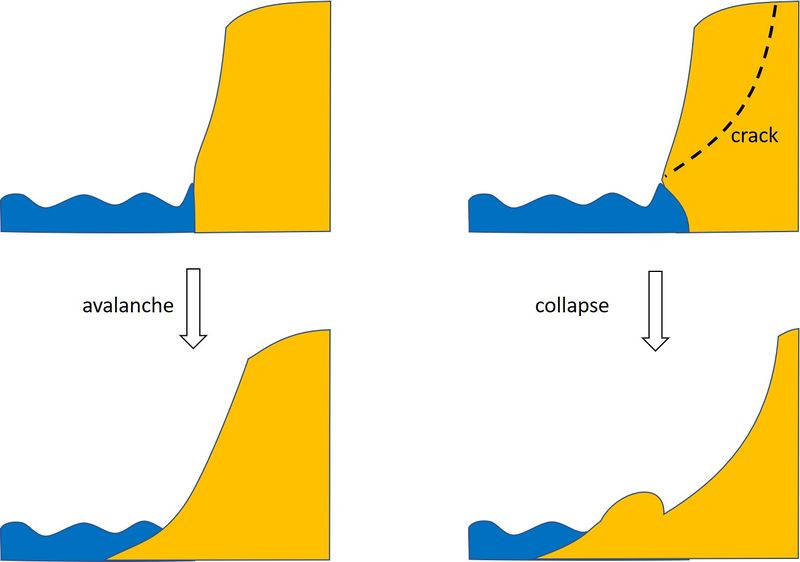
    Dune scarping, or the cliffs of sand created when waves batter the dunes, reach up to 18 feet high, from Seaview Avenue to Sherman Avenue. New cliffs formed on Whale Beach, and the high tide line now reaches the upper beach and dune.

    How sand dunes fail.

    Neighboring Ocean City also endured major beach erosion in parts of town.

    For Ocean City, the NJDEP report describes “moderate sloped erosion throughout the city, with major sloped erosion and vertical dune scarping up to 6 feet in height between First St. to 11th St.”

    Finally, Avalon already had massive cliffs of sand on the north end of town. Now, up to 20-foot cliffs are present between 10th and 15th streets, as well as 17th to 25th streets. Also, the retaining wall, between 11th and 15th streets, is exposed to the open air and ocean.

    Is the beach erosion permanent?

    The NJDEP does not believe so.

    “…much of the material eroded from the ‘dry’ beach area has not been lost, but rather redistributed within the beach profile system, such as creation or enlargement of offshore sand bars. Our expectation is that much of this material will return to the ‘dry’ beach in time following the storm,” states the report from the Oct. 12-13 nor’easter.

    Whether that returns in a few weeks, a few months or more is to be determined, though. Shore Local News has reported that Rep. Jeff Van Drew (R-2nd) is working to establish a trust fund using revenues from offshore energy leases to permanently fund beach replenishment. As of this writing, there is no federal funding for beach replenishment in 2026.

    Beaches are weak going into nor’easter season

    I wrote that after Hurricane Erin, our beaches were in a poor spot when it comes to sand and coastal protection, given the time of year. The October nor’easter only weakened them further.

    Nor’easters typically occur between mid-October and mid-April. So, with five and a half months left to go, there is a high likelihood that another storm, or storms, will chew up the beaches even more. I’ll report on the winter forecast in the first half of November. One thing I’m watching is the track of a coastal storm this week.

    The atmosphere, like human bodies, has muscle memory. In the human body it’s due to the nervous system and practice. In weather, it has to do with physics as well as boundaries between warm and cold air.

    If this week’s storm takes a path similar to the Oct. 12-13 nor’easter, we’ll see more beach erosion. You can also expect more storms to do the same.

    Streaming Weather Channel Almost Ready

    Coming soon is the Jersey Shore’s 24×7 streaming weather channel. All the daily forecast videos, weather updates like this, drone footage, words from our sponsors and more will be on there. You’ll love our feature that allows you to send your best weather photos right to the streaming channel. Find it on my YouTube channel, joemartwx or on www.cupajoe.live.

    Joe Martucci, a Certified Broadcast Meteorologist and Digital Meteorologist, is the President and Director of Meteorology for Cup A Joe Weather and Drone. You can connect with him at cupajoe.sparkable.opalstacked.com/.