SATURDAY’S FORECAST | Happy weekend weather forecast! The growing season threatens to end this weekend in more inland places with the cool mornings. The afternoons will feel like quintessential Fall, perfect for the trunk-or-treats in full swing!
I’m still eying a coastal storm next week, too. No hype. Let’s see where we stand.
Follow my work: www.cupajoe.live Jolt your brand, advertise with me: joe@cupajoe.live
FRIDAY’S FORECAST | Sweata weather! Ok, I have a button down shirt on but I’ll break out the sweater this weekend. It’s getting increasingly cool with more frosts around. What *won’t* your generic weather app tell you? The story on next week’s possible coastal storm.
Follow my work: www.cupajoe.live Jolt your brand, advertise with me: joe@cupajoe.live
Occasionally, while I’m doing a public talk, I’ll be asked
“What are your thoughts on climate change, Joe?”
And, usually, I’ll respond with something like
“I’m not here to tell you my thoughts on climate change. Let me tell you what’s going on.”
Climate change is not a religion. You don’t believe in it or not.
There are facts and forecasts. Then, there’s what to think, not think, do or not do about it. That’s where your beliefs come in.
My job is the facts and forecasts.
In a warmer, wetter and more extreme New Jersey climate, that’s what I do here in this video series. Thanks for watching and email joe@cupajoe.live with any questions.
The facts and forecast vs. beliefs on climate change
Climate change isn’t a religion, you don’t believe in it or not.
🌀How climate change does, and does not, impact hurricanes
Tropical cyclones has and will see significant changes from climate change. However, climate change does not have its fingerprints on everywhere associated with hurricanes and tropical storms.
🏜️ Climate Change in New Jersey: Drought
More extreme precipitation in a climate changing worlds means drier dry weather and wetter wet weather. However, how much drought we’ve seen hasn’t changed in New Jersey.
🌧️❄️ Climate change in New Jersey: When it rains, it pours and snow is heavier, too.
Climate change has brought more rain and less snow. However, how it rains and snow also changed, too.
🌡️ Climate Change in New Jersey: Temperatures
Since records in NJ began in 1895, the average temperature rose by 4 degrees. Vineyards can now produce grapes are far north as Interstate-78, where in the 1970s, it was mainly limited to Cape May County. However, heat is the biggest killer in the United States on an annual basis and those numbers only get higher, even with air conditioning.
Climate Change in New Jersey: The complete guide
Follow my work: www.cupajoe.live Jolt your brand, advertise with me: joe@cupajoe.live
I don’t know about you, but the days definitely feel shorter for me. By 6 p.m. it’s getting dark, and it’s pitch black by 7 p.m. Not only that, but my early-morning walks are remarkably close to needing long pants and a sweatshirt. My wife is wearing a winter jacket now.
In other words, it’s getting deeper into fall.
One of the annual staples of autumn is the arrival of the first frosts and freezes. A heavy frost, or a few hours of sub-freezing temperatures, end the growing season for the many farms and gardens that call this area home.
As of Oct. 23, there has been no widespread frost for the coastal counties. Parts of the Pine Barrens in Cape May, Atlantic and Ocean counties saw frost on Oct. 18. But according to the National Weather Service, which issues frost advisories and freeze warnings, the growing season continues.
For most of us, frost is just something cool to look at or photograph for a social media post. However, for farmers and gardeners, this is a concern that marks the end of the growing season.
A freeze is when the air temperature falls to 32 degrees Fahrenheit. However, keep in mind that the air temperature is measured roughly 6 feet above the ground surface. During the night, colder air can be found lower to the ground where fruits, vegetables and flowers grow. It could be 33 or 34 degrees on the sensor, while a ground freeze is still occurring.
A hard freeze is another term you will hear.
“A freeze in which seasonal vegetation is destroyed, the ground surface is frozen solid underfoot and heavy ice is formed on small water surfaces such as puddles and water containers,” is what the Glossary of Meteorology says.
A hard freeze is the one that farmers and gardeners are leary of. Generally, a temperature at or below 28 degrees is hard freeze territory.
Freezes do not have to have frost. Frost needs a light wind and cloudless sky to occur. Sub-freezing temperatures, as we know, can occur with clouds and strong, biting winds during the winter.
Average first frost and freeze dates
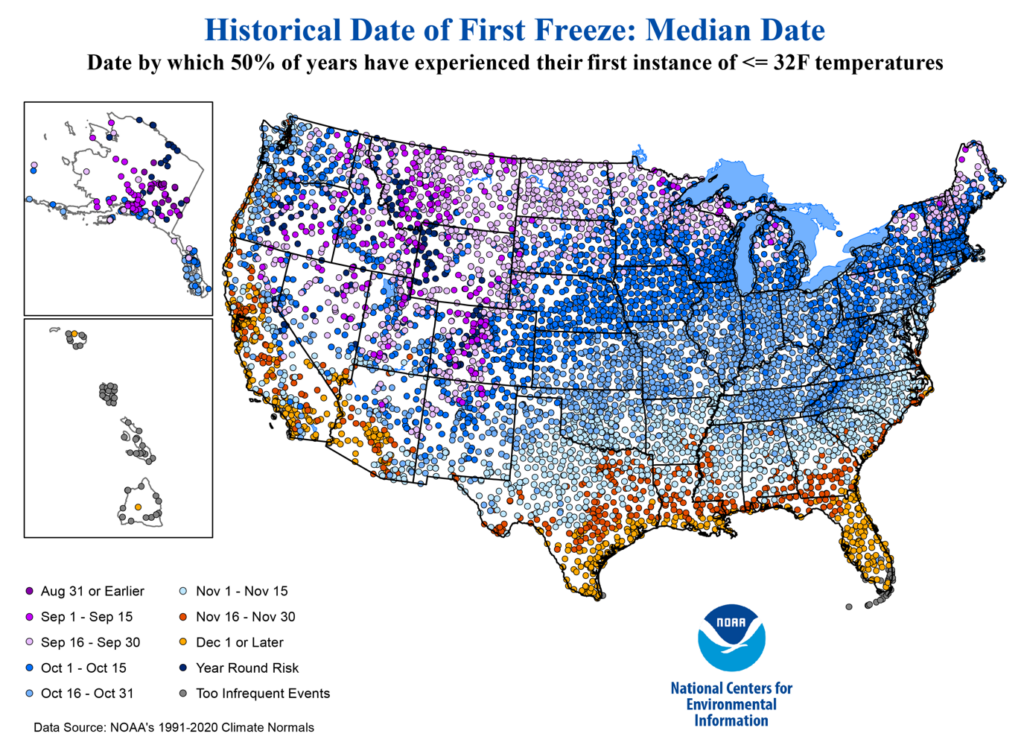
On average, the Pinelands, and the more populated inland spots experience frost sooner than the beach towns do.
For Pinelands communities such as Estell Manor, the median first frost is mid-October. The typical first freeze is Oct. 18 with a hard freeze date of Oct. 30.
For the inland parts of the Jersey Shore counties, away from the Pinelands, the average first frost is around Oct. 20. The average first freeze is Oct. 19-22 with the first hard freeze of Nov. 2-5.
For the beaches, the average first frost is Nov. 1-10. The average first freeze is Nov. 24, with a hard freeze date of Dec. 5.
All the data is from the National Oceanic and Atmospheric Administration.
The only places where it’s odd not to have a freeze yet are in the Pinelands. However, it was only two years ago when the first freeze was Nov. 12. In fact, since records began in 1965, a first freeze in November happened eight times.
First frost or freeze of fall 2025
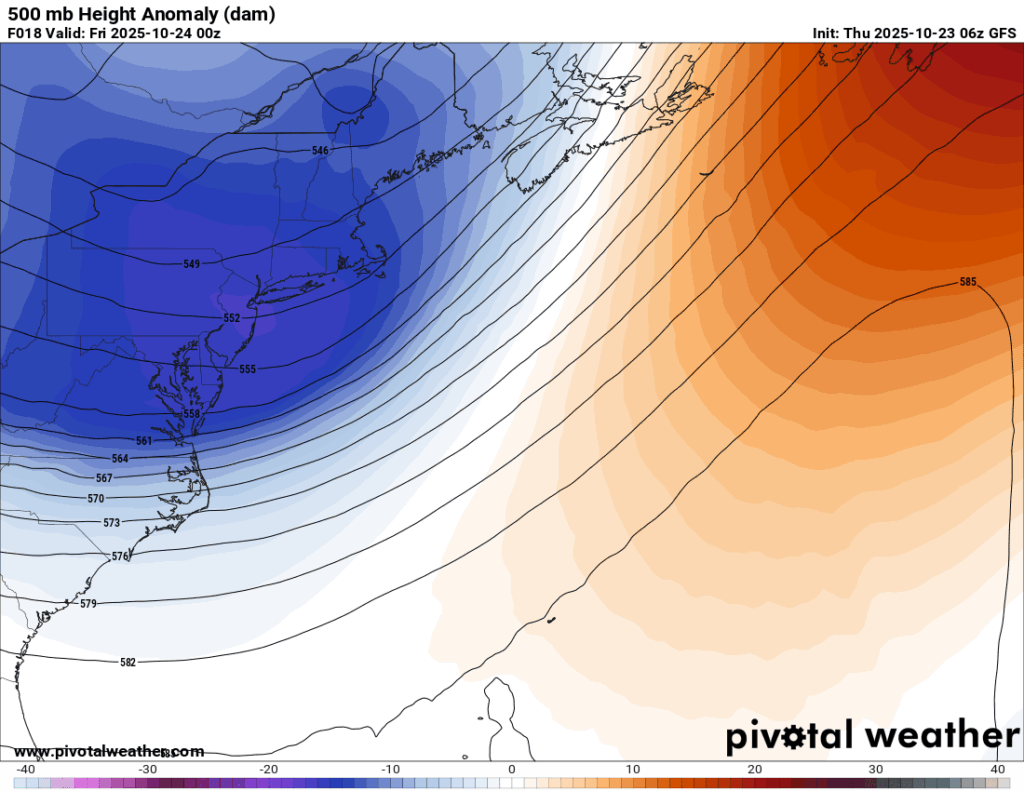
For the Pinelands, the upcoming weekend offers a good chance for the first frost or freeze of the season. A trough of low pressure will swing through, bringing colder air in from aloft. If the sky is clear enough and the winds light, we should have frost, and a freeze is possible.
How high in the atmosphere you must go in order for the air pressure to be 500 millibars. Units are in decameters (tens of meters). The lower the number, the coder the atmosphere is. Blues and purples indicate a thinner than usual atmosphere. Data via the Global Forecast System (American) model.
However, I believe places like Cape May Court House and Longport will remain frost-free and freeze-free after this.
So, what’s next? The first five days of November look to have a good surge of cool air moving in. By that point, average inland low temperatures will be 36-40 degrees; that’s a bit cooler than average and puts us into frost or freeze territory.
Assuming the inland areas have a frost or freeze by Nov. 5, that leaves just the beaches. That’s too far out from now to make an educated forecast. However, you can follow me online for more on that.
Climate change’s role
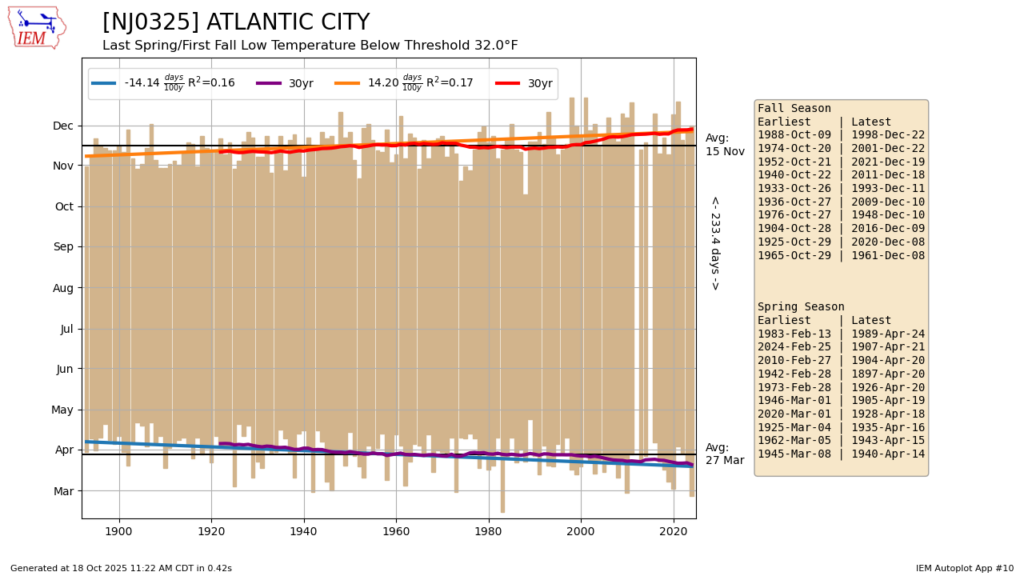
At the Sen. Frank S. Farley State Marina in Atlantic City, the 30-year average date of the first freeze of the year has shifted later, according to NOAA.
1881 to 1910: Nov. 6
1951 to 1980: Nov. 11
1991 to 2020: Nov. 24
That’s an 18-day shift.
Data via the Iowa Environmental Mesonet
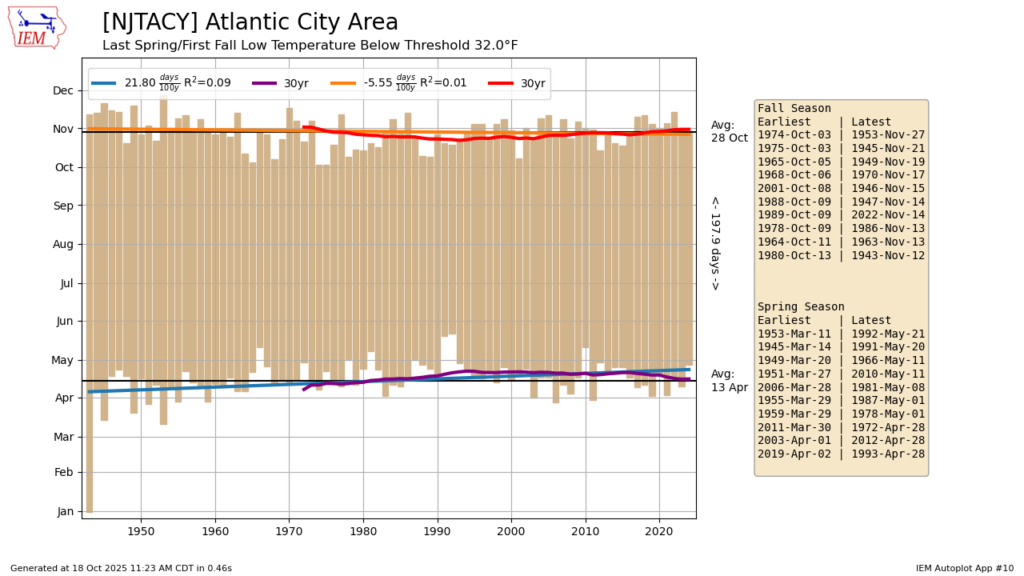
Atlantic City International Airport has seen no major shift over time. Both periods were Oct. 23.
Data via the Iowa Environmental Mesonet
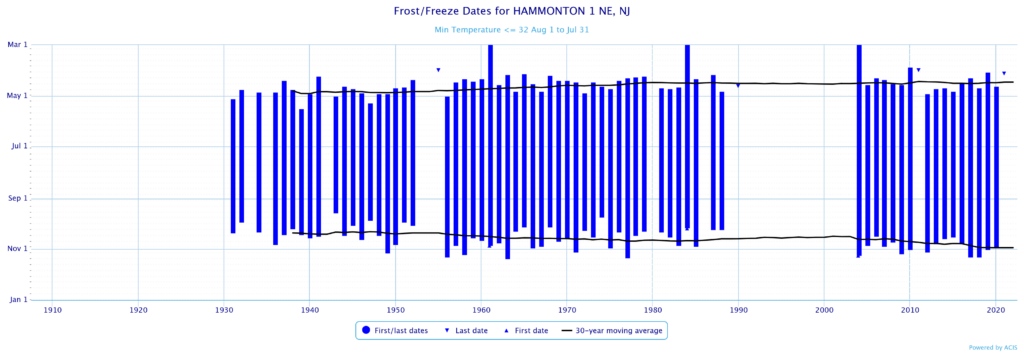
However, Hammonton did see a shift later:
1951 to 1980: Oct. 21 1991 to 2020: Oct. 30
Insert Hammonton First/Last Freeze date over time
Data via the National Oceanic and Atmospheric Administration
Another inland area, Freehold, Monmouth County, had a similar trend.
1951 to 1980: Oct. 17 1991 to 2020: Oct. 24
Today’s climate change is like a steady, fast climb up a warm hill—quicker than Earth’s usual slow ups and downs over thousands of years, but not as sudden and shocking as a giant volcano or asteroid that would slam the planet with instant cold before heating it up.
Joe Martucci, a Certified Broadcast Meteorologist and Digital Meteorologist, is the President and Director of Meteorology for Cup A Joe Weather and Drone. You can connect with him at cupajoe.sparkable.opalstacked.com/.
THURSDAY’S FORECAST | In another sign of Fall, I have our first inland frosts of the season in the forecast! What won’t your app tell you? The context behind a possible coastal storm for Halloween.
Follow my work: www.cupajoe.live Jolt your brand, advertise with me: joe@cupajoe.live
WEDNESDAY’S FORECAST: Last night brought a thunderstorm and light rain to the Jersey Shore. Peace out to that. Dry air, and a long stretch of it are on the way! One thing you’re app won’t tell you? A potential Halloween(ish) nor’easter.
Follow my work: www.cupajoe.live Jolt your brand, advertise with me: joe@cupajoe.live
TUESDAY’S FORECAST | Did ya see the Orionid Meteor Shower last night?! I shared one viewer’s sparkling view of the night sky. That clear sky turns into cloudy, rainy skies Tuesday night. Then, a long stretch of cool autumn weather ahead.
Dominate your fantasy leagues and bets with weather-driven data. MeteoOdds gives you innovative tools, player/game weather impacts, and detailed forecasts. Join FF+ by using the code WEATHER and get 50% off, for life! Turn forecasts into fantasy wins — only at www.meteoodds.com.
SATURDAY’S FORECAST: Brrr! It’s a cold one this morning. If you’re not ready for this weather yet, just wait a little. I spy a high around 70 degrees by the time the weekend is done. A few rounds of rain, one with strong winds, comes next week. Follow my work: www.cupajoe.live Jolt your brand, advertise with me: joe@cupajoe.live
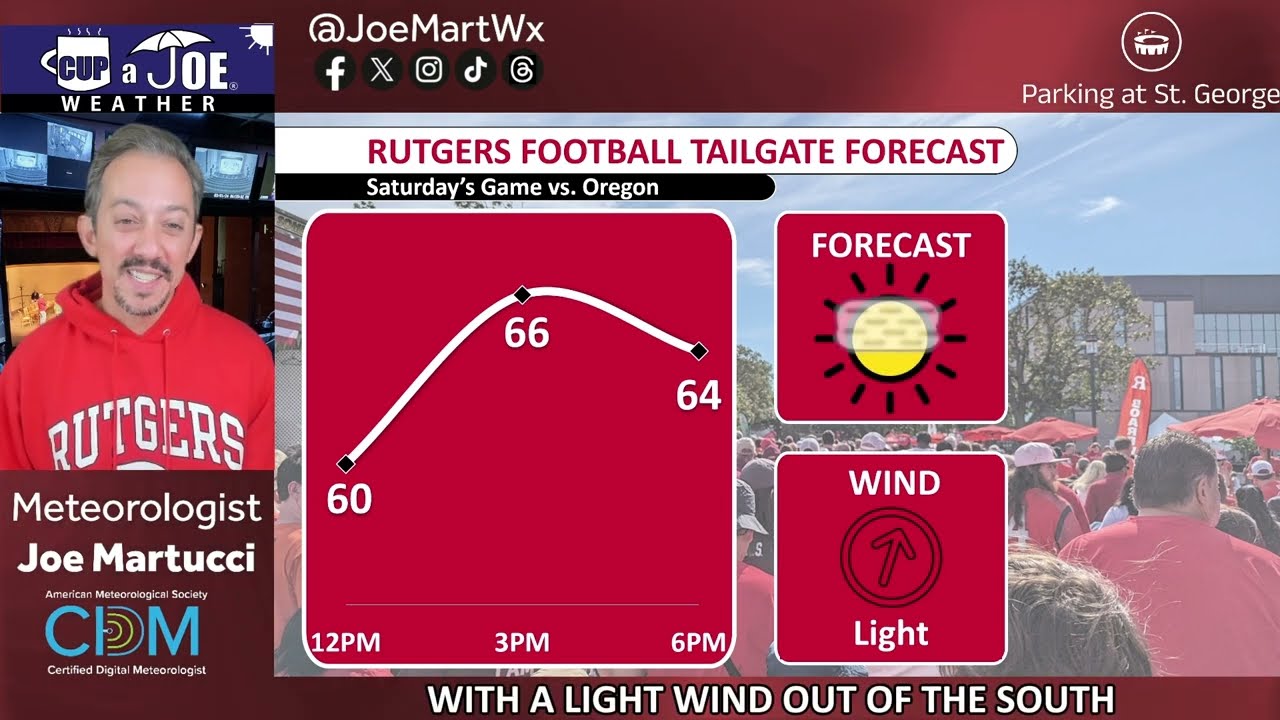
Rutgers football is BACK at home under the light on Saturday night in Piscataway. If you’re tailgating, going to the Rutgers Boardwalk or just the game itself, the weather will be fine. However, it may actually be winning weather, too. Here’s why. RRRRRRRR
Located just 1/3rd of a mile from SHI Stadium, the St. George Greek Orthodox Church is THE place to park and tailgate for Rutgers football games! Lots of space, clean bathroom and excellent service. Reserve your space at www.rutgersparking.com.
FRIDAY’S FORECAST | Fall, fall, fall! It feels just like it today. Highs reach the 60s. Our first frost of the season threatens to end the growing season Saturday morning. I’ll show ya where and then a nice look at our 7-day forecast.
Follow my work: www.cupajoe.live Jolt your brand, advertise with me: joe@cupajoe.live