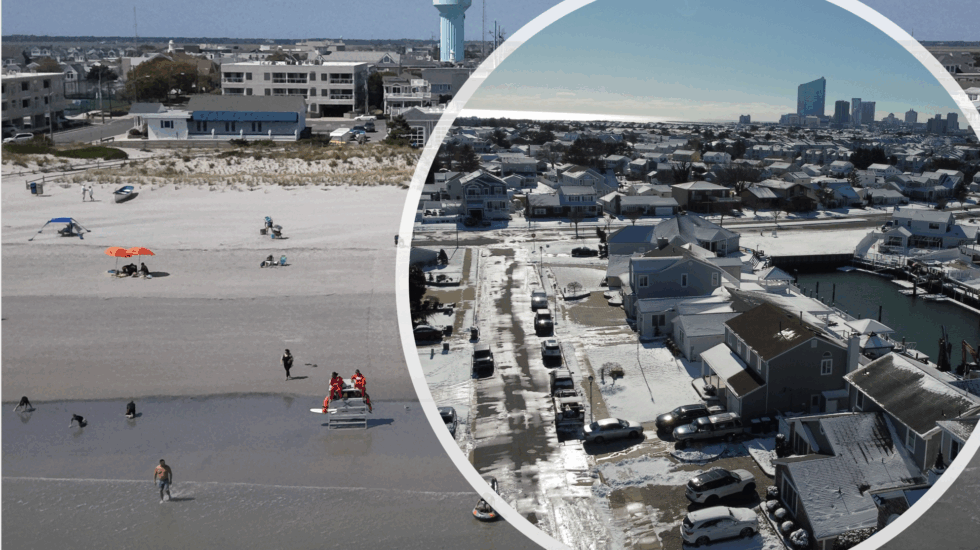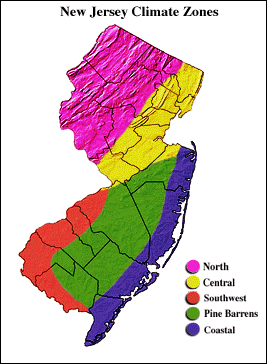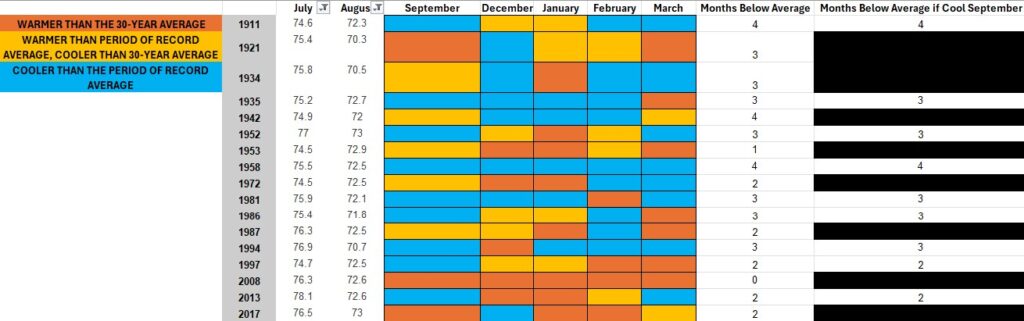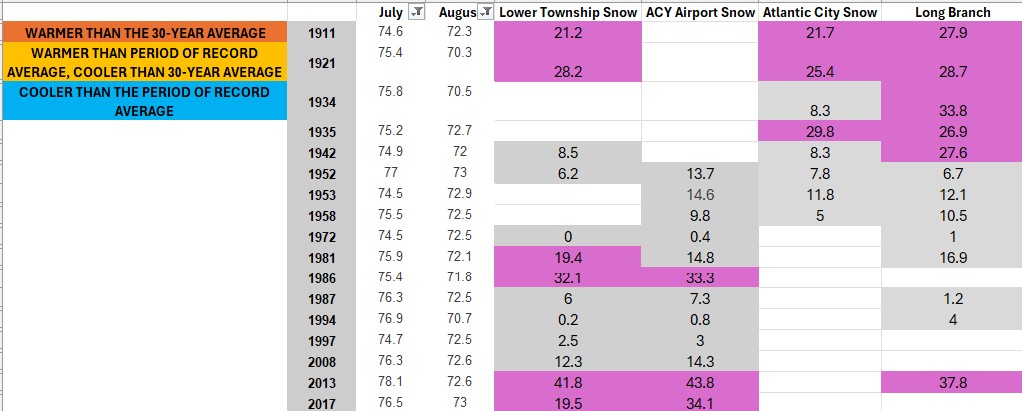
Today is the first of three bad days for the beaches. A tropical storm warning is in effect for the waters. Meanwhile, on land, we have a variety of surf and coastal flooding alerts out to keep us prepared. Let’s talk about what’s ahead, and the weekend.
Never worry about missing severe weather warnings again. Get a recorded call from me when your location is impacted. WeatherCall ensures you stay informed for just $15 a year. Sign up: https://ngorder.wxriskalerts.com/db_app2.php?station=cajx
I was on the phone with a Beach Patrol Captain Monday morning, talking about what Hurricane Erin would mean for the coastline.
His answer: We get these kinds of storms during the winter, but no one is in the water to experience the fury of the ocean.
Let me get this off the top. Swimming or boating in the ocean will be downright dangerous through Saturday and possibly into Sunday. Two people died in the surf the week of Aug. 11, one in Seaside Heights and one in Belmar. The waves weren’t even that rough. Using a personal watercraft (Jet Ski or Wave Runner) in the inlets will be dangerous, too.
Of less danger but still important, you’ll need to set up your beach chairs and towels closer to the dunes than usual. It’s possible salt water even reaches the dunes at high tides. Coastal flooding will be around each evening through Saturday.
This week’s indirect blow from Hurricane Erin is a good reminder of what the Jersey Shore experiences when the joy of summer here fades away, when the days turn gray and storm season eats at the sand. If you’re not a full-time resident in a beach town, this is what we experience in December or February, when the crowds are thin.
Hurricane Erin became a major hurricane, a category three, four or five hurricane, on Saturday, Aug. 16 with the 5 a.m. National Hurricane Center update.
The Saturday, Aug. 16 5 a.m. update from the National Hurricane Center on Hurricane Erin, the first time she became a major hurricane (via the National Hurricane Center).
Erin was the first Cabo Verde hurricane of the year. Cabo Verde storms are the long track cyclones that originate off the West Coast of Africa, near the Cabo Verde Island. They then move west along the trade winds for days. From there, it either goes into the Caribbean Sea or Gulf. Alternatively, they curl northwest, north than northeast, parallel to the East Coast of the United States (major exception: Superstorm Sandy in 2012).
The Cabo Verde islands are outlined in red on the bottom right of the map. It’s located off the west coast of Africa (via Google Maps)
Erin’s will pass between Bermuda and North Carolina on Thursday, forecast by the National Hurricane Center to remain a major hurricane. It then only slowly weakens as it moves northeast, moving faster when it does so.
By the time it reaches the latitude of the Jersey Shore (roughly 39 to 40 degrees north latitude), it’ll be between 500 and 700 miles to our east. However, the storm will be stronger than usual for our latitude.
There are four reasons why Hurricane Erin will bring the most hazardous waters to New Jersey in years.
1) We won’t see rain. You can’t see the storm.
2) It’ll be breezy through Friday, and windy Thursday. However, it won’t cause wind damage or power outages. If you’re not looking at the ocean, it doesn’t look dangerous out.
3) This week is busier than usual for the coastal communities. Most summer camps are over, and most schools aren’t in session. The Beach Patrol Captain I spoke with said that.
4) The ocean is warm and enticing to go into. It continues to be one of the warmest, if not warmest on record for the Memorial Day to Labor Day period, according to Meteorologist Jim Eberwine of Absecon (also my weather-dad). Water temperatures have been well into the 70s.
For the boaters
Significant wave height forecast forecast from government run computer forecast models (Via Ventusky).
A small craft advisory is in effect until Friday evening by the National Weather Service. It’s possible it will extend to Saturday.
The bays will be better but since smaller boats are in the bay, it will be hazardous, too. Seas will be three to five feet. For reference, the bay is typically one to two feet. There will be a big chop on the water, particularly late in the week.
For the surfers and swimmers
Hurricane Lee’s impacts on the ocean were seen Thursday in Atlantic City. Drone footage over and near the Atlantic Ocean shows high waves with foamy, white seas. Hurricane Lee will make landfall in either Maine, New Brunswick or Nova Scotia Saturday night, but impacts will be felt at the Jersey Shore until early next week. (Via Joe Martucci)
Surf heights will be at or over 5 feet until Saturday. Typically, the surf heights are less than three feet.
Not only will the waves be big, but they’ll have power to them. The wave period, which is the time it takes for two waves to pass one point, will be over 10 seconds through Saturday. It’ll peak for over 15 seconds on Thursday. The longer the wave period, the more ability it has to carry more water, making it more powerful. This also brings a very high risk for rip currents.
For reference, there will usually be a high risk of rip currents at nine seconds and a moderate risk after seven.
Surfers love these big waves. However, with winds in nearly the same direction as the southeast swell through Friday morning, these won’t give the clean waves surfers craving. Again, it’s dangerous and I don’t recommend anyone going in the water.
Your beach may show a red flag for an oceanic “high hazard”. It may also show a double red flag. That means the water is closed for public use.
You can expect to see many red or “red over red” (double red) flags on the beach this week due to Hurricane Erin (via United States Lifeguard Association)
“It’s going to look like a washer machine out there,” Eric Hoeflich, of the National Weather Service in Mount Holly, which covers the Jersey Shore, texted me. That’s true. Hurricane Lee in 2023 did have a white, sudsy look to the waves.
Again, the bay beaches will be the better place to get your sea water fix in.
For all people in a town that borders a bay
Coastal flooding will continue to extend until Saturday. This will mainly be during the evening high tides (find your flood forecast here). For two to three hours, expect up to six inches of salt water on low-lying bayside roads. This is the typical, or nuisance flooding, we see several dozen times a year. However, this is mainly from October to April, when some of you may be away from the Jersey Shore.
The blue areas indicate where you can see salt water at least covering the ground during minor flood stage in Ocean City (via ClimateCentral).
Be aware of Thursday evening’s high tide. Expect four to six hours of flooding here. Furthermore, prepare for moderate flood stage. This is when unraised buildings and homes begin to take on water. Up to ten inches of salt water are on low-lying roads and even roads that don’t typically flood do. In short, moving around the bayside towns is challenging for a stretch.
The blue areas indicate where you can see salt water at least covering the ground during moderate flood stage in Ocean City (via ClimateCentral).
Still, Enjoy the Jersey Shore
The Ventnor City Beach Concert at Ski Beach. The concerts, which take place on Wednesday evenings until the end of August, are a great way to spend time at the shore while the waves churn from Hurricane Erin.
The boardwalks will still be good. Ride the rides, eat the saltwater taffy, have a hurricane at the bar.
Daytime temperatures will be in the low to mid-70s. So, it’ll still be comfortable for a cookout, basketball or long runs.
In short, as long as you stay out of the water, there will be plenty of ways to enjoy this summer week.
It’s a story that is told often in Cape May County.
You’re out by the water and you see storm clouds to the west. Your weather app on your phone flashes in bright oranges and reds, showing the heavy rain. It’s moving toward Ocean City, or Reeds Beach or Cape May Point.
But as the minutes go by the storm never comes. The radar turns light green, or maybe blank as the rain disappears.
That’s the Cape May Bubble at work, and there’s hard, scientific evidence that it’s a real phenomenon in the area. Compared to the rest of the state, the temperatures, and the number of thunderstorms and snow storms, are simply different here.
Cape May County geography matters
Cape May County is on a peninsula, surrounded by water on all three sides (Delaware Bay to the west, Atlantic Ocean to the south and east). Yes, New Jersey is also technically a peninsula, but the vast bodies of water around our southernmost county drive much of the weather we see.
Water warms and cools more slowly here. For the county, this means that towns stay cooler than most of New Jersey during the spring and summer. The extra water acts like extra air conditioning. Meanwhile, during the fall and winter, the county is milder than the rest of the state. County business leaders know this and over the years built tourism marketing campaigns based on it.
“Fall for the Jersey Cape” is one such slogan used in years past, promoting beach days into October, and plenty of comfortable days to explore the rest of the Jersey Cape. The result helped put Cape May County in second out of New Jersey’s 21 counties for tourism spending from 2021 to 2024, with $8.1 billion spent in 2024, according to the Cape May County Tourism office.
Data via Cape May County Government
Powered By EmbedPress
Between October and March, Cape May’s average temperatures are about 1 degree higher than Atlantic City International Airport in Egg Harbor Township, according to the National Oceanic and Atmospheric Administration. Data shows that Cape May air temperatures stay warmer through May, like the water on the peninsula’s three sides.
By June and July, temperatures in both places level out. In fact, Cape May has cooler high temperatures from around Memorial Day weekend until early August.
Cape May County has fewer thunderstorms
The Cape May Bubble phenomenon I hear about most often is fewer thunderstorms. Turns out, that’s true. Most of New Jersey experiences roughly six hours of heavy rain falling overhead between May and August — peak storm season.
The one exception? The Cape-May-to-Vineland corridor. Only four hours of that type of rain falls here, on average, according to research led by Frédéric Fabry, director of radar observation at McGill University in Canada.
Frequency of radar detecting rain heavy enough to be classified as a thunderstorm during the research period by Fabry et. al. Notice the lower percentages in far southeastern New Jersey than the rest of the state (Via Bulletin of the American Meteorological Society).
If storms pass west to east, as they typically do, the relatively cooler Delaware Bay during these months stabilizes the storms, weakening them to below the thunderstorm threshold used in the Fabry’s study. Not only are there fewer thunderstorms, but they occur later in the day, on average.
Cape May County, along with Atlantic and southern Ocean counties, has a preferred thunderstorm time of 6 to 8 p.m. The rest of the state is between 4 and 6 p.m.
Fabry and his team took all radar scans across the Lower 48 of the United States to detect how many precipitation (A), thunderstorm-heavy rain (B) and hail (C) occurred over any given location. Echoes refer to the intensity of the radar beam that bounces off the precipitation and returns to the radar site. In New Jersey, that is either the radar site at Fort Dix, NJ or Dover Air Force Base, DE. (Image via the Bulletin of the American Meteorological Society)
Thunderstorms can happen any time of the day, but fewer and generally later thunderstorms lead to more time outside. That means a healthier South Jersey Shore economy.
There is no scientifically proven reason for this. However, conversations with Fabry and Dave Robinson, the New Jersey State climatologist, in years past suggest that the near daily seabreeze influences the later timing.
The shape of the coastline runs southwest to northeast from Cape May to Long Beach Island. It’s then positioned south to north from Island Beach State Park to Sandy Hook. Furthermore, Cape May County is just more southeast. Storms begin many times during the day on the east side of the Appalachian Mountains. By the time they get to Sea Isle City, it’s later than the time they got to Philadelphia.
Cape May County has less rain
The southern (or lower) part of Cape May County is also among the driest in the state. Here’s a look at the average annual precipitation for our major weather reporting stations.
Lower Township, Cape May County: 43.84 inches
Atlantic City, Atlantic County: 43.62 inches
Egg Harbor Township, Atlantic County: 45.96 inches
Long Branch, Monmouth County: 52.53 inches
Trenton, Mercer County: 45.63 inches
Newark, Essex County: 46.60 inches
Belvidere, Warren County: 48.21 inches
Average annual precipitation in New Jersey in the year 2000. While the annual precipitation is slightly different in 2025, Cape May County still remains the driest place in the state on any given year (Via Oregon State University).
The reason, in part, for the drier weather is the water being on three sides.
Seabreeze fronts are common here from March to August. Once the seabreeze front passes from the coastline, inland, the air is more stable. That means it’s less likely to rain.
Furthermore, Cape May County is the county farthest removed from the process known as upsloping, which brings rain to the foothills of mountains. In this case, that’s the Appalachian Mountains.
Cape May County has less snow
Cape May County is the state’s flattest and southernmost county. Therefore, having the least amount of snow just comes with the territory. The long-standing Cooperative Observer Station in Lower Township averages 14.8 inches of snow in a year.
From December to March, snow season, the water temperature in Cape May Harbor is between 39 and 45 degrees, according to the National Oceanic and Atmospheric Administration. Nor’easters, and the northeast winds they bring, funnel this above-freezing ocean air into the county. How many times has Trenton or Hammonton been covered in 6 inches of snow, while Marmora or Ocean City barely has a flake? The relatively mild water is the reason.
Are there other bubbles in New Jersey?
Given the data, you can make the case that the Cape May Bubble is really an Atlantic City Bubble, a Somers Point Bubble and a Millville Bubble. This far southeastern corner of New Jersey experiences different weather than the rest of the state.
I had the opportunity to meet Fabry at the American Meteorological Society conference in Baltimore in January 2024. He still remembers when we first talked about the phenomenon in 2019. He was kind and laughed when I explained just how much people talk about the bubble down here.
The man who proved the Cape May Bubble is real, Frederic Fabry, along with myself at the 2024 American Meteorological Society Annual Meeting in Baltimore, MD.
Given Quebec’s deep-rooted history with tourism in Cape May County, it might be time we welcome him for a visit. Expect the storms to stay away if he comes.
Joe Martucci, a Certified Broadcast Meteorologist and Digital Meteorologist, is the President and Director of Meteorology for Cup A Joe Weather and Drone. You can connect with him at cupajoe.sparkable.opalstacked.com/.
News 12 did an excellent job covering the dramatic rescue of 10 people as a sailboat sank off of Avalon on July 25. Tom Kronsowski had me on to discuss the water and weather conditions that led to the rescue.
Despite some stormy and cool weekends this summer, there’s one thing we can say about the Jersey Shore right now: “Come on in; the water’s warm!”
The ocean water has been above average for most of the summer so far. According to the National Oceanic and Atmospheric Administration, 75-degree water temperatures were recorded off the Steel Pier in Atlantic City on July 5, 6, 8, 12-17, and 23-28. In other words, over half of the July days, the ocean water temperature was warm. That’s more like South Carolina than South Jersey.
It’s the complete opposite of last summer. June and July had zero days with a water temperature above 75 degrees. In fact, 11 July days were in the very chilly 50s, and 55 degrees was the 8 a.m. water temperature on July 18, 2024. Getting in the ocean was tough.
To explain why summer 2025 has been an absolute warm ocean lover’s delight, I’ll use another mantra: “Life’s at ease with an ocean breeze.”
Wind direction determines ocean water temperature
Ranking behind the strength of the warming sun and the currents, the direction of the wind plays the biggest role in water temperatures in New Jersey. In fact, it’s the main player for the day-to-day, or hour-to-hour variations.
Cooler ocean waters are caused by upwelling. Upwelling describes what happens when the typically warmer sea surface water moves away from the coast and out to sea. Colder water from the sea floor then rises to the top along the shoreline.
This is a critical part of our marine ecosystem. That cold water is nutrient-rich and keeps our living ocean alive.
Upwelling is caused by Ekman Spiraling, according to the American Meteorological Society’s glossary.
A look at how Ekman spiral works. Notice the lower image. The water will move to the right of the direction of the wind. In New Jersey, that means a south wind will push the warmer, near surface ocean water away.
I’ll save the meteorology for you, but for the Jersey Shore, and the Northern Hemisphere, upwelling occurs any time the coastline is to the left of the direction of the wind. In our case it means a wind from the southwest or south. The Jersey Shore is to the left of the air current. That causes Ekman Spiraling, which pushes that warm water away.
On the other hand, warmer water gets pushed onshore with onshore winds. A wind from the southeast, east or even northeast will blow warmer-than-usual water in from the Gulf Stream our way.
From the time climatological summer began on June 1, to July 28, winds were out of the favorable southeast, east and northeast direction 30% of the time at Atlantic City International Airport in Egg Harbor Township, according to the Iowa Environmental Mesonet. Yes, the airport is inland, but the large-scale wind measurement known as synoptic wind direction, is usually the same between the airport and the coast itself.
During summer of 2024, winds blew from the southeast, east to northeast just 12% of the time. During the summer of 2025, it has been above the long-term average of roughly 20%.
Go up the coast and you have had the same results only more often. Readings at Monmouth County Executive Airport in Wall show wind direction out of the southeast, east or northeast a whopping 55% of the time through July 28, according to the Mesonet. Last summer it was about 30%.
Eighty-degree ocean water is possible come August
Offshore winds should continue to be a focal point of the August forecast, and with the climatological peak of our ocean waters coming at the end of the month, a few 80-degree ocean water temperatures are very possible.
While I’m not as keen on it as I was in our Halfway Through Summer Outlook column a few weeks ago, there is still a better-than-50% chance that the wind direction comes from the southeast, east or northeast more than average during August.
August 2025 computer model sea level pressure forecast. Northeast winds are expected more than usual in August, bringing in relatively cooler air (via www.tropicaltidbits.com)
We average at least one day with a water temperature at or above 80 degrees at the Atlantic City station in August. So, hitting 80 is not unusual. However, given the constant 70s we’ve had up and down the coast so far, more onshore winds would likely give us at least a few days in the tropical 80s.
Shore summer weekend weather report card update
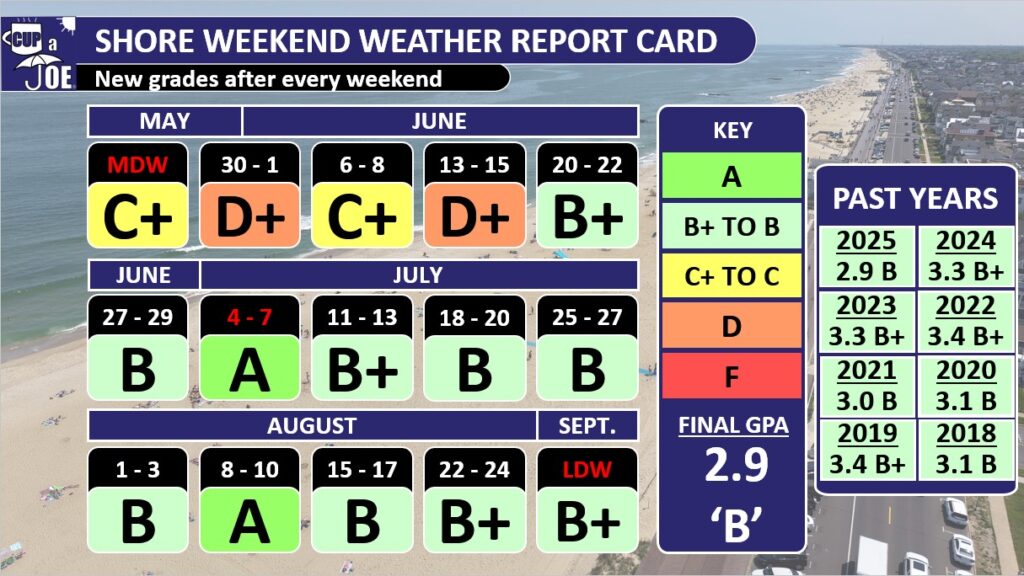
The report card’s been holding its own over the month of July. However, summer 2025 will need to study hard, put in the work and give us beautiful, dry weekends for August in order to keep this summer out of last place.
I graded the July 25-27 weekend a ‘B.’ That brings the grade point average since Memorial Day Weekend to a 2.7 – right around a B-minus.
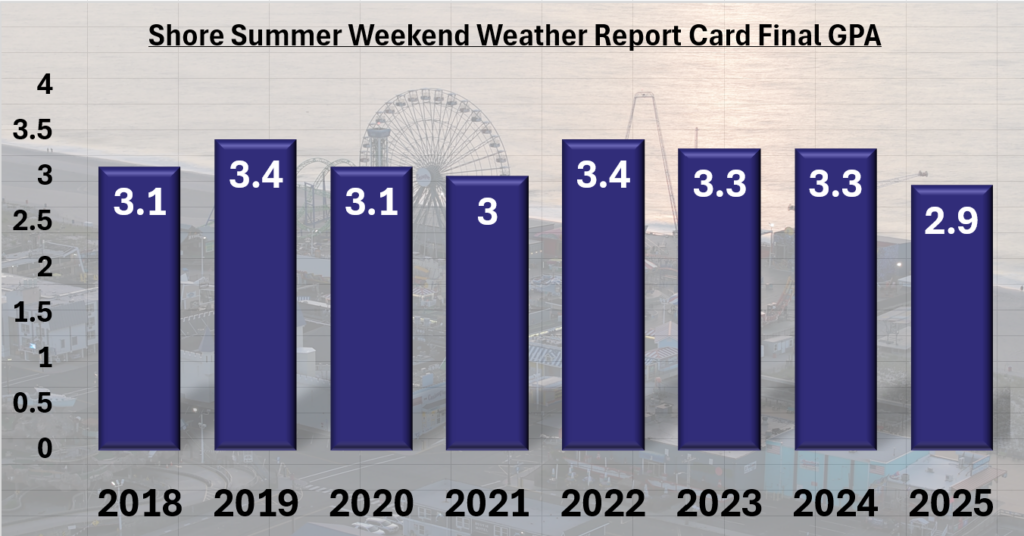
In the eight summers that I’ve graded the weekend weather, the lowest final grade point average was a 3.0 back in 2021.
Climatologically, our weather becomes less rainy in mid-August. So, there’s still time to earn a few ‘A’ grades and dig out of last place.
Joe Martucci, a Certified Broadcast Meteorologist and Digital Meteorologist, is the President and Director of Meteorology for Cup A Joe Weather and Drone. You can connect with him at cupajoe.sparkable.opalstacked.com/.
Climatological summer, which runs June through August, is a little more than half over and the data shows that the weather has had us all sweating more than usual at the Jersey Shore.
The dew point, which measures how much water vapor is in the air in degrees, was much higher than usual at Atlantic City International Airport in Egg Harbor Township, and other places along the Jersey Shore, in June and July. In fact, the readings have been some of the highest on record.
Here’s how to think about the dew point in terms of how it feels during the summer.
40s = Dry 50s = Refreshing 60+ = A bit humid 65+ = Noticeable 70+ = Sticky 75+ = Oppressive
At ACY Airport, June had the seventh highest dew point on record going back to 1947, according to the Iowa Environmental Mesonet. The month averaged a dew point of 63.9 degrees – three degrees above the average. Through July 18, that spiked to 70.2 degrees month-to-date. It’s the second highest on record and 4 degrees above average. Only 1994 was higher.
Dew points during the months of June (left) and July (right) for Atlantic City International Airport, Atlantic County. Note the increase in dew points over the decades (via the Iowa Environmental Mesonet).
It’s even more extreme farther north on the Jersey Shore. Monmouth County Executive Airport in Wall had the highest June dew point on record at 64.6 degrees. From July 1 to 18, the 72.1-degree dew point came in as the third highest on record for the period. Monmouth records go back to 1955, but weren’t consistently reported until 1992.
It’s even more incredible that the dew point is this high considering that the first half of June was cooler than average and the dew point can never fall below the air temperature.
Dew points during the months of June (left) and July (right) for Monmouth Executive Airport in Wall, Monmouth County. Note the increase in dew points over the decades (via the Iowa Environmental Mesonet).
You can thank our changing climate and local weather conditions for the sweaty feeling in the air.
Why so humid? The weather side
In New Jersey, any wind from the southwest, south, southeast or east is going to bring more humidity than usual. The winds from the southwest and south pump in that juicy air from the Gulf of Mexico (Gulf of America). Meanwhile, winds from the southeast and east will blow in moister ocean air.
Climatological summer, from June 1 to July 18, had winds blow from these directions roughly 55% of the time at Atlantic City International Airport, the Mesonet reports. The long-term average for the entire climatological summer is 35%. The different lengths of time mean this isn’t a perfect comparison, but it’s valid enough for this purpose.
The average wind direction and speed (left) for Atlantic City International Airport in Egg Harbor Township, Atlantic County, with the observed wind direction and speed for June 1 to July 18, 2025 (via the Iowa Environmental Mesonet)
Along the shore, the wind at Monmouth County Executive Airport came from the more humid directions about 45% of the time this year. Usually, it’s only about 40%. The big difference is that the main wind direction this year was from the east.
At ACY Airport, the wind mostly came from the south. This made the air feel extra moist, with the highest humidity in years.
Humidity is a measurement of how much water is in the air compared to the air’s temperature. At ACY Airport, the humidity hit 71.9% in June – the highest since 2018. In July it reached 76% through July 18, the highest since 2021.
However, summer humidity can be tricky to understand. The percentages in June and July are high, but in winter, humidity can be 90% or more for days. But it doesn’t feel as stickymbecause it depends on the air’s temperature. Warmer air can hold more water so summer feels much more humid, even if the percentage is lower than in winter.
That leads me to the next point about this sweaty, sultry stretch.
Why so humid? The climate change side
As our summers have become hotter in recent decades, the atmosphere’s capacity for holding more moisture in the air has increased, too. That’s meant more days where the dew point can be a sticky 70 degrees or an oppressive 75 degrees.
During July, dew points have increased 3.3 degrees per century at Atlantic City International Airport.
The most recent July with a dew point below the long-term average was 2014, and 2009 before that. In June, it’s a long-term increase of 2.2 degrees per century.
The data proves that it’s been muggier in recent decades. We can also take a look at the heat index, too. The heat index is what the temperature feels like to the human body, according to the American Meteorological Society.
At ACY Airport and Monmouth County Executive Airport, the heat index – this is how hot it feels when you combine temperature and humidity – for June and July 2025 so far ranks between fifth and seventh place compared to past years. Almost all the years that felt hotter than this June and July happened after 2008, except for one June at Monmouth.
However, here’s something interesting: in some places, the air’s humidity has actually gone down over time.
At ACY Airport, humidity drops at a rate of 3.85% per century. In June 2025, the humidity there was only the 46th highest out of 78 years recorded by the Iowa Environmental Mesonet. For July so far, it’s ranked 26th. But at Monmouth County Airport, humidity has gone up instead.
Not only is the air getting warmer because of climate change, mostly caused by people, but the ocean water is getting warmer, too.
When the ocean gets hotter, more water evaporates into the air. This makes the air hold more moisture, which raises the dew point – that’s the temperature when the air gets so full of water it starts to form dew. It also leads to bigger, heavier rainstorms.
The sea surface temperature in the Gulf increased between 1.35 and 2.25 degrees Fahrenheit from 1970 to 2020, according to peer-review research published in the Journal of Climate in August 2022.
The Atlantic Ocean on the United States East Coast increased between 1.8 to 3.6 degrees during the same time period, according to the National Oceanic and Atmospheric Administration.
New Jersey’s more muggy summers will continue
Given the decades-long trends of higher summer heat and higher summer water temperatures, expect more summers like the one we’ve had already in the decades to come. In fact, climate models project a 1.8 to 3.6 increase in dew points come 2050, compared to 2018, according to that year’s National Climate Assessment, which is mandated by Congress.
Whether the increase in dew points due to climate change is a bad thing or good thing is not for me to say. However, expect more sweaty summers like this in decades to come.
After such a poor start to our weekend boat and beach season, it feels like summer is just getting into swing at the Jersey Shore. It might be hard to believe but the July 12-13 weekend marked the halfway point between Memorial Day and Labor Day. With six more weekends left to go until the season closes and “Locals Summer” begins, let’s look at the past and future of our weather for the coast.
Jersey Shore weather so far
Summer weekends in 2025 were a bad apple from the start. The cumulative grade point average through July 12-13 is 2.6. That’s a C-plus. In the eight years I’ve done the report card, it’s the worst start on record, and it’s not particularly close, either.
The jet stream, the river of air between 25,000 to 40,000 feet above sea level that separates two air masses, sat right over the Mid-Atlantic. Kinks in the jet stream, called Rossby Waves, created areas of lower pressure. They take roughly a week to pass around the Earth. For us, they fell on the weekends for that spell. Furthermore, the hot and humid weather we all think of doesn’t usually settle in until mid-June. The combination of all of this led to a summer start of poor weather weekends.
That being said, the ever important dry and warm weather for our shore economy was present during the middle of the week early in the season. That may have drawn more people to the shore than usual on those quiet, early June days.
Once we hit June 20-22, the report card was between a “B” and an “A.” That “A” occurred right over the Fourth of July weekend. I was across the pond in Scotland and Ireland then. However, from what I saw online and heard from people, it was the best Independence Day weather weekend in years. We had plenty of sunshine, dew points in the refreshing 50s and decently dry 60s, plus no rain. It made up for lost time early in the season.
The two big weather stories of the summer so far were the extreme heat June 21-26. Then the severe weather on July 8-9.
Atlantic City International Airport reached 102 degrees for two days on June 24-25, the longest 100-degree or greater streak since 2011. On June 23, it tied a record high of 98 degrees, then set new records with the 102-degree days, smashing old records of 99°F and 96°F.
Sen. Frank S. Farley State Marina in Atlantic City hit 93 degrees on June 23, breaking a 1909 record, and tied a 2002 record of 95 degrees on June 24. Both locations also set record high nighttime temperatures. Despite starting off with cool weekends, this summer has been a sizzler.
Since climatological summer began on June 1, it has been the fifth hottest at Atlantic City Marina (records back to 1874), Atlantic City International Airport (records back to 1958) and Estell Manor (records back to 1964) through July 13. These numbers, courtesy of the Southeast Regional Climate Center, part of the National Oceanic and Atmospheric Administration, are over two degrees above the average.
Most of the heat was driven by the overnight low temperatures, which are the warmest on record for Estell Manor and Atlantic City International Airport.
Two weeks later, multiple nights of severe weather struck.
On July 8, a tornado warning was issued for Burlington, Ocean, and Monmouth counties. Storms caused downed wires in New Egypt (Ocean County) and fallen trees in Lakewood (Ocean County).
Radar from July 8’s line of severe thunderstorms that moved through the state. (Via RadarScope)A culmonmibus thunderstorm clouds casts a eerie, dark shadow over half of McCullough’s Emerald Golf Course on July 8. (Via Mark Melhorn)
On July 9, another storm hit, with a tornado warning for parts of Atlantic and Ocean counties from 10:57 p.m. to 11:30 p.m. Winds hit 58 mph at Cape May-Lewes Ferry and 42 mph in Surf City. A flash flood warning covered the whole coast from Sandy Hook to Cape May, too. Thankfully, no confirmed tornados were seen at the Jersey Shore.
While not right at the shore, there was also a lightning fatality in Jackson Township, Ocean County on July 15. A bolt of lightning struck an archery range, killing one and injuring over a dozen others who were there as part of a Boy Scout event.
The other story since July began is the warm waters. Ocean water temperatures have been in the 70s for most of the month, and in the mid to upper 70s over the July 12-13 weekend. Consider the average water temperature this time of the year is in the upper 60s, and it’s been a treat. It’s also the complete opposite of last summer, where upwelling kept the ocean icy until early August.
What’s the forecast for the rest of summer?
Expect more muggier-than-average conditions for the rest of July. That means dew points in the sticky low 70s or oppressive upper 70s.
In terms of temperatures, I expect more of what we’ve seen this summer for the rest of the month. Temperatures will continue to be above average but driven mainly by the balmy minimum temperatures. Average morning minimum temperatures are in the low 70s in the beach towns and upper 60s inland.
We’ll likely have another inland heat wave (three or more days of 90-degree-or-greater heat) inland this month, perhaps two.
However, that’s typical for us. I don’t see a repeat of the 100s we had in late June.
For August, I’m pleasantly surprised to see particularly good computer model agreement that rainfall stays about average. It’s actually crazy. Models usually differ slightly. However, they are steadfast in dry weather in eastern New England and wet weather in the Appalachian Mountains. Average means eight to nine days of the month with wet weather.
In terms of temperatures, there’s also exceptionally good agreement that the shore counties stay a little bit below the average. Yes, if you’re tired of the summer heat, you should be in for a treat. Don’t expect autumn-like 60s for highs. However, less daytime highs in the 90s sound like a good bet at this time. Later in the month would start to see that hint of crispness in the air.
The rain and temperatures are connected. Assuming the computer models are correct, high pressure would lock in offshore of Maine or Nova Scotia, Canada. Since high pressure spins clockwise, that would mean an onshore wind for much of the month.
That would bring the relatively cooler air from the ocean. At the same time, the ocean waters in the pleasant 70s should continue. East winds shut off the cold upwelling that makes us shiver in the water on the hottest days.
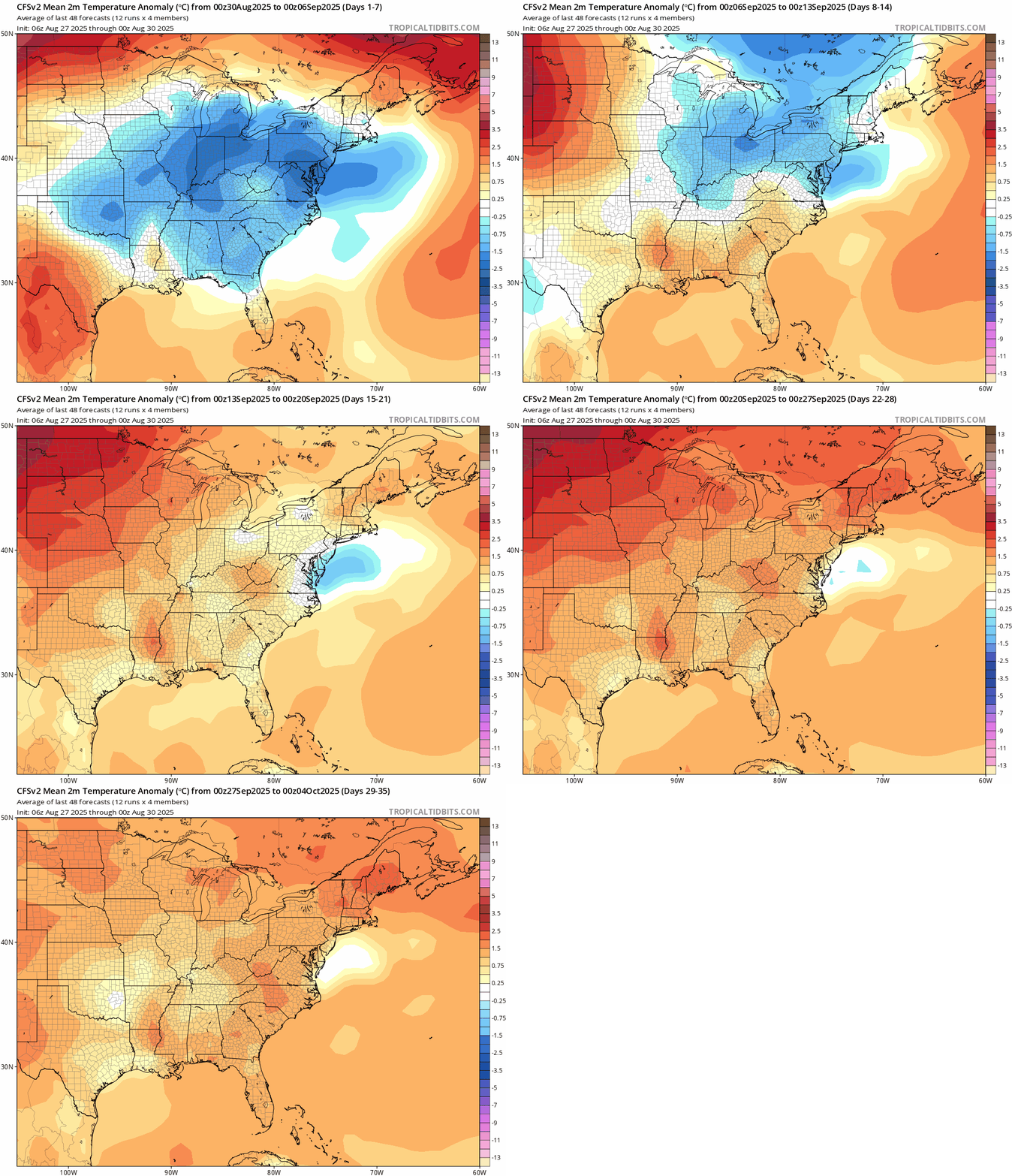
Monthly surface temperature computer model forecast for August, according to the CFS. Most long range forecast models paint a similar picture, with cooler than average air at the Jersey Shore. (Via TropicalTidibts.com)
New Jersey’s hurricane season outlook
So far, the state has been tropical cyclone free. Hopefully, we will keep it that way.
That’s a small drop from the initial outlook in April and near the 1880-2020 average.
Still, it’s always good to be hurricane ready.
Have a NOAA Weather Radio. You can buy one easily online. Make sure your phone can receive weather alerts in an emergency.
As we saw in the Texas floods, getting the alerts from the National Weather Service is a matter of life and death sometimes. Also, have a go bag ready with essentials in case you need to evacuate.
Joe Martucci, a Certified Broadcast Meteorologist and Digital Meteorologist, is the President and Director of Meteorology for Cup A Joe Weather and Drone. You can connect with him at cupajoe.sparkable.opalstacked.com/.
Well, that changed fast. June gloom went to summer sizzle. High temperatures were in the 60s as recently as June 16 inland, and June 17 at the shore. Less than a week later, inland areas sweltered in the heat and humidity. Inland highs were in the 90s, with the sultry weather peaking earlier this week.
In other words, the pattern shift from spring to summer is now done, like we talked about in last week’s column about the cool and wet weekends. While the official temperatures are not in at the time of this writing, it’s likely you have lived through your first heat wave of 2025 inland.
With the heat increasing, both in the short term and the long term, knowledge is key to staying prepared.
What is a heat wave?
A heat wave in New Jersey is defined as three or more days of high temperatures at or above 90 degrees.
Turns out, there is no official definition of a heat wave. The National Oceanic and Atmospheric Administration defines it as “a period of abnormally hot weather generally lasting more than two days.”
The American Meteorological Society says “to be a heat wave, such a period should last at least one day, but…lasts from several days to several weeks.”
The idea of using 90 degrees stems from A.T. Burrows. In 1901, he said a heat wave was when there were three or more days of heat that were above 90 degrees.
While we use that definition in New Jersey now, that doesn’t make sense for the Deep South. Jackson, Miss. has an average high temperature in the 90s from June 11 to Sept. 8. While it’s hot, that’s part of their climate.
Moreover, that doesn’t work in Seattle, where they average 2.5 days in the 90s each year, according to the Iowa Environmental Mesonet.
Heck, it doesn’t even really work in the beach towns here in New Jersey.
The Sen. Frank S. Farley State Marina in Atlantic City averages 4.4 days a year with a temperature of at least 90 degrees. Using the New Jersey heat wave definition, the last one for the city was July 2011.
Heat waves rarely happen at the Jersey Shore beach towns (via the Iowa Environmental Mesonet)
You can figure the same for all of the barrier island beach towns at the Jersey Shore (note that most Monmouth County beaches are not barrier islands and see highs of at least 90 degrees more often, but still not as often as inland towns).
In 2022, I asked those in the local weather news space to comment about what a heat wave is for their viewing area. Central California goes by three days of 100 or more heat. In Amarillo, Texas, it’s three days of 105 heat. In Austin, it’s a week at least in the 100s.
Has New Jersey seen more heat waves over time? To keep it simple, we’ll just use the three days over 90-degree threshold for both the beach towns and inland areas.
Plus, to keep the answer simple, yes there has been an increase in the number of heat waves over time. Here are the number of heat waves, per decade at Atlantic City International Airport per the Iowa Environmental Mesonet.
1940s: 11
1950s: 13
1960s: 17
1970s: 14
1980s: 24
1990s: 22
2000s: 28
2010s: 36
2020-2024: 20 (on pace for 40)
Most of that increase has been during July and August, our two hottest months of the year. Nowadays, you can expect about four heat waves a year.
Heat waves are more frequent inland, at Atlantic City International Airport (via the Iowa Environmental Mesonet)
Go to the coast and there’s also an increasing trend in Atlantic City. However, since there are so few of them, with the last being in 2011, it’s not as strong of an increase as inland areas. Plus, there’s no real change in what month they’re happening more often.
Remember, too, that the threshold is 90 degrees. A week with 90s, except one for one day where it’s 89, would count as two heat waves instead of one. Still, the data shows an overall increase in the number of 90-degree days throughout the region. That’s especially true for the airport, which is always warmer than the coast in the summer.
What’s causing the increase in heat waves?
Number of days at or above 90 degrees at the inland Atlantic City International Airport (left) and Atlantic City (right)
Human influence on Earth is mainly responsible for this increase in two different ways.
First, there’s been an increase in greenhouse gas emissions since the Industrial Revolution in the 1700s. The more carbon dioxide, methane, etc. that is in the atmosphere, the greater the ability for the sun’s heating rays to hit the ground, reflect back into the sky, only to bounce back down again off the emissions.
Secondly, there is an increase in roads, roofs and parking lots. These dark surfaces absorb more heat than the green gas, trees or the white sand. So, when the sun is down at night, that stored-up heat releases itself into the atmosphere, keeping our air warm (weather stations take readings about 6 feet high).
Summer heat safety tips
Staying healthy during heat waves requires some changes in lifestyle. Staying in the air conditioning, if you have it, is your best defense against the scorching heat. During the summer, the state of New Jersey works with towns and counties to open cooling shelters by you.
In Atlantic County, the county libraries in Absecon, Egg Harbor Township, Mays Landing, Pleasantville and Somers Point are open for you. If you’re in Cape May County, the emergency management website provides a list of cooling shelters when needed.
Deciding to go to the beach or pool to cool off is a great idea. However, even going there can be hazardous on the hottest days. The salt water at the beach can dry you out, and you’re still feeling the humidity next to the ocean. Drink plenty of water.
If you’re working outside, you should have 8 ounces (a cup) of cool water every 20 minutes. Take frequent breaks, between 10 a.m. and 4 p.m., when the sun is strongest. If you can do that in the shade, it’s even better.
Finally, know the symptoms of heat exhaustion or heat stroke. Heat exhaustion brings thirstiness, heavy sweating, nausea and weakness.
You can combat this by moving to a cooler area, loosening clothing and sipping water. I had heat exhaustion in Italy in 2019. If you know Europe, you know air conditioning is optional, despite Italy being as hot as it is here. Going into a museum, I got nausea and sweated heavily. We took a car back to our hotel room where we put the air conditioning on as low as possible. I was done for the rest of the day, but much better by nightfall.
Heat stroke, meanwhile, is a medical emergency. Call 9-1-1, get into a cooler spot and get ice on you as soon as you can.
Heat is the biggest killer in the United States, unfortunately. It has been every year since 2016, according to NOAA. However, just a little extra attention to what you are doing outside during heat waves goes a long way.
Joe Martucci, a Certified Broadcast Meteorologist and Digital Meteorologist, is the President and Director of Meteorology for Cup A Joe Weather and Drone. You can connect with him at cupajoe.sparkable.opalstacked.com/.
It’s the annual tradition! Every weekend, from the unlocking of the beaches Memorial Day to the Labor Day that just passed us, we grade the weather at the shore.
The grading is subjective. However, after listening to you, I think it’s fair to say an ‘A’ means the weekend’s weather had:
1) A high temperature between 75 and 85 degrees.
2) No rain.
3) Anything from a partly sunny to sunny sky. We could all use a few clouds to break up the sun.
4) Low humidity.
5) A gentle breeze.
This day in Asbury Park is what a perfect A looks like (via Joe Martucci)
Since this is an average of all the days, a few hours of cloudy sky won’t ruin a perfect ‘A’.
At the same time, this is for the whole shore. A weekend where Brigantine sees pouring rain while Asbury Park is dry won’t mean an ‘F’ either.
Since this is summer, weekends start early. My report card includes Friday, Saturday and Sunday. Memorial Day and Labor Day are also included in those weekends, too. Fourth of July’s weekend is based on what day of the week it occurs.
Sunday or Monday – Counted in with the Friday before the date.
Tuesday or Wednesday – Counted as a standalone date
Thursday, Friday or Saturday – County in with the weekend or Sunday following.
Hurricane season begins on June 1. Really, in New Jersey, we like to say that there’s a 12-month hurricane season. After all, it’s the water, not the wind, that causes the most devastation, and nor’easters bring plenty of water.
This year, there are six. They range from rip currents to wind forecasts, to the change in the size of the forecast cone that you see. Here are the updates below, including how you’ll be able to see them.
Inland watches and warnings on the forecast cone map
The forecast cone is the essential part of understanding what is going on with a tropical system. The cone shows the forecasted path, along with data on location, movement, wind speed as well as watches and warnings.
Before 2024, only the coast was outlined in the applicable watches and warnings (Tropical Storm Watch, Hurricane Warning, etc.) on the map. However, these alerts often went well inland and there was no way to see that on the map.
Current conditions and forecast cone for Hurricane Irene in 2011. New Jersey was 48 hours away from landfall, which came ashore as a weaker. tropical storm. Note that red hurricane warnings only outline the coast (National Hurricane Center).
Last year, the NHC added all areas that were in watches and warnings to the map, whether they were a coastal county or not on an experimental basis. This year, they continue to keep it, but “will now contain the symbology for areas where a hurricane watch and tropical storm warning are simultaneously in effect (diagonal pink and blue lines).
Current conditions and forecast cone for Hurricane Helene in 2024. Note that red hurricane warnings extend inland to Florida and Georgia. also, there is a shaded pink and blue area in the Tampa, west coast, region of Florida (National Hurricane Center).
So, if the Jersey Shore counties were in a hurricane warning, and the inland New Jersey counties were in a tropical storm warning, all of the counties would be colored in on the map. If Atlantic County were in a hurricane watch and tropical storm warning, it would have a diagonal pink and blue line over the county. This came in handy during Hurricane Helene last September. Tropical storm watches were in effect as far inland as western North Carolina.
Before 2024, you would only know that if you lived in those counties, saw a news segment on it, or dug deep into the National Hurricane Center website. However, last year, you could see it right on the map. Of course, Helene brought catastrophic flooding to western North Carolina — $79 billion in damages were estimated to have occurred, according to the National Hurricane Center.
Rip current risks shown
When a tropical storm or hurricane is active in the Atlantic Hurricane Basin, the National Hurricane Center will provide rip current risk information on a national map. This also includes places like Puerto Rico and Guam.
The rip current risks will be provided for the day of and the next day, along with a map showing the highest risk over the next two days. This is really for people who want a more national view of what’s happening.
Our National Weather Service local office has put out rip current and surf information for years. You can also check out my Sea and Sand video forecasts for Jersey Shore specific information. However, this is a great way to see the risks in one place.
The National Hurricane Center’s new Rip Current Risk map interface.
More lead time for undeveloped storms
June, July, October and November can bring tropical storms or even hurricanes that quickly develop and make landfall on the East Coast. Tropical Storm Fay made landfall at the Edwin B. Forsythe National Wildlife Refuge at the far southern end of Long Beach Island at around 4 p.m. on July 10, 2020. It became a tropical storm just 23 hours earlier. However, the hurricane center knew Fay would hit New Jersey as a tropical storm even before it became a tropical system.
This update is for situations like this. The National Hurricane Center can issue tropical cyclone advisory products, like forecast updates, watches and warnings, 72 hours before the storm surge or wind hit land, regardless of the storm’s status at the time. Last year, it was 48 hours. So, this is an extension of it.
Extended wind radius forecast
The category of a tropical system is based upon the maximum sustained wind speed. However, tropical storm force winds (39 mph or greater) or hurricane force winds (74 mph or greater) can extend for long stretches beyond the core of the storm.
You have to dig through the hurricane center’s website for it, but they do forecast the size of tropical cyclone wind fields in each of the storm’s four quadrants: northeast (most destructive part), southeast, southwest and northwest).
In the past, the hurricane wind radius forecasts went out 48 hours. This year, it will go out 72 hours, a testament to the improving accuracy of hurricane forecasting. To find this, search for the “Tropical Cyclone Forecast/Advisory product” when a storm is active. It’s abbreviated as TCM, too.
Forecast track cone will shrink
Most of the above updates are due to the impressive work done by the meteorologists at the National Hurricane Center. Hurricane forecasts have become better with time, allowing more useful information to be given to you, with bigger lead times.
Each year, the hurricane center updates the size of their track forecast error cone. This is based on the accuracy of the storm’s track over the past five years.
This year, the size of the cone for the Atlantic Hurricane Basin will be smaller at seven of the nine forecast periods from 3 to 120 hours out. This includes all periods 24 hours and later. The most significant will be a 6% reduction in size for the 60-hour and 96-hour forecast.
How the size of the forecast cone will change for the Atlantic and Pacific Hurricane Basins in 2025, compared to 2024 (National Hurricane Center).
As an example, a larger cone in 2024 could have Atlantic City on the edge. However, thanks to this improvement, Atlantic City could be out of the cone. That has huge implications for emergency management operations, evacuations and more.
The official track error trend for Atlantic Hurricane Basin storms. Note the decrease in error since 1990 on all time scales.
Major update to Hawaii forecasts
The likelihood of a certain height of storm surge hitting a coastline is now operational in Hawaii. It’ll be initiated by the National Hurricane Center’s Storm Surge Unit and made available within 72 hours of hurricane impacts. Storm surge forecast maps began on the mainland United States in 2016.
Watch our Interview with the National Hurricane Center Director
If you go to my YouTube or Facebook pages (@JoeMartWx), catch a special interview with Michael Brennan, director of the National Hurricane Center. It’s all part of the Tidal Flooding Talk show I co-host with Dan Skeldon (a familiar name to many), and Palma Shiles as part of the New Jersey Coastal Coalition. When you have 30 minutes, give it a watch or listen.